
Theories
52 entries in Perception

The Scale Chooses the Object
From above, humans look like ants: swarm behavior, trails, colonies. From within, each is a universe of memory and longing. Both readings are true, and the error is committing to one scale and calling it reality. What a thing is depends on the distance you view it from.

Partial Contact Is Worse Than Absence
Being almost met can hurt more than not being met at all, because partial contact proves the thing exists without delivering it. The cup proves the water is real, and that is exactly what makes the thirst impossible to ignore.

Intelligence Is an Exposure
We treat intelligence as an unqualified upgrade, but every cognitive power is also a wound-channel. Memory relives pain, prediction suffers the future in advance, comparison manufactures inferiority. The more reality you can model, the more reality can hurt you.
Chronic Pain Loses Its Narrative Force
The first time you say you're struggling, people register it as an event. The tenth time, they register it as your climate. The suffering does not become less real, but it stops being witnessed, because repetition is read by observers as identity rather than as ongoing news.

The World Is Charged by Persons
For some people the external world, places, novelty, scenery, stays emotionally neutral until a meaningful person enters the field. The place is not the event. The person is the event. This is a difference in what activates the reward system, not a deficiency in feeling.

The Interior Stays Opaque
For most of history, humans lived inside bodies they had no map of, so pain was a visitation rather than a signal. We assume that era is over. It is not. We still have no map of consciousness, so we narrate what we cannot see.
Unreadable Suffering
When a being is alien enough that we cannot read its suffering, we tend to erase its subjecthood before the blade arrives. But unreadable suffering is not absent suffering. It is suffering that fails to perform itself in a human-recognizable format.

What They Cannot Afford to See
Perception is not a neutral camera. It is organized by what seeing would cost the perceiver. A person who benefits from not seeing something often genuinely does not see it. This is not dishonesty. It is the perceptual system adjusting around what the self-concept can tolerate.
Truth Without a Body
Knowing what is true and being able to hold what is true in a room with a body in it are different problems. One is epistemic. The other is physiological. The body does not wait for the argument to finish.

The Observer Has a Floor
The observer state is not uniformly available. Some pain can be watched from a slight distance. But when the threat touches the foundation, observation collapses into something more primitive. The floor is not like the other problems.
How Prophets Happen
The prophets were not receiving transmissions from outside the human system. They were observing the interior of the human system with unusual depth. The interior they observed is the same one everyone has.
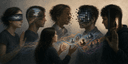
There Are Many Kinds of Blind
We think of blindness as the absence of sight. But sight is just one receiving capacity among many. A person can receive your words without perceiving your meaning. They can hear your pain without perceiving injury. They can love you and still be blind to the part of you that is actually speaking.

What Standing Did to the Mind
Bipedalism is discussed as a physical advantage: freed hands, farther sight, efficient walking. What almost never gets discussed is what it did to the psyche. Standing upright did not just elevate the body. It reorganized the animal into a subject looking out at the world rather than an organism moving through terrain.

You Are Not Hearing the Song. You Are Hearing Yourself.
A song is not merely heard. It is ingested by the nervous system and re-authored from inside your own reality. You do not assimilate the meaning of a song. You assimilate the state of it. That is why a breakup song can become about your childhood, and a song about rebellion can become about wanting your family to see you.

A Closed Door Is Not a Sign
A plan fails. Something better comes along later. People call this a sign. But there is a simpler explanation that does not require the universe to have arranged anything. Humans are adaptive search systems. When one path closes, they keep looking. And a wider search almost always surfaces something better.

Nearness Is Not Access
Something can be inches from you and still be completely unreachable. Physical proximity is only one kind of closeness. Reality is not organized by where things are. It is organized by what can receive, decode, and respond to what is there.

Reality Is Stored in the Shape of Relation
Most people think reality is made of visible locations. This neuron here. That brain region there. This person, that event. But function rarely lives where it appears to live. It lives in the invisible pathways through which signal actually travels. A new map of the fruit fly brain makes this precise.

The Placebo Is Not Fake
A sugar pill with no active ingredient can reduce pain, shrink tumors, and release genuine dopamine in a Parkinson's patient's brain. The placebo effect is not the absence of a real effect. It is proof that belief is biological, and that the boundary between mind and body is not where medicine has been drawing it.

Why Beautiful Things Hurt
There is a specific ache that beauty produces. Not pleasure exactly. Something closer to pressure. The pain is real and it is worth understanding why it is there, because it is pointing at something.
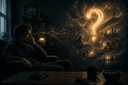
Boredom Is Not the Absence of Stimulation
Boredom is not what happens when there is nothing going on. It is a signal that part of you wants to be somewhere other than where you are, doing something other than what you are doing, and that gap is being felt. It is not emptiness. It is a form of pressure.

The Captivity of Appetite
The same hunger feels mild at home and urgent on a plane. The body is not only asking for food. It is asking for control over food. A signal's intensity is set not just by the need but by whether you can act on it.

What the Drop Completes
A drop is not just a loud moment in a song. It is your nervous system receiving something it was already reaching for. The satisfaction is not accidental. It has a structure, and the structure is older than music.

Signal Archaeology
The brain never receives the event, only its traces. Signals report what has already happened. But the real delay is not light, which is nearly instant. It is biological. Perception is reconstruction from delayed reports, smoothed into a seamless feeling of now.

The World Is Ranked, Not Seen
The visual field is wide, but only the focal point gets reality status. The periphery is a rejected-but-waiting zone, granted reality only when something forces it into the center. Perception is not the world appearing. It is the world being ranked.
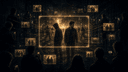
You Are Who You Stand Beside
An observer compresses a complex scene into a simple association. Standing near a charged situation reads as being part of it. The anxiety of proximity is the feeling of being placed inside a narrative before you know what the narrative is.
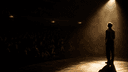
The Permission Structure of the Dark
A theater is not a room with a stage in it. It is a machine for managing who gets to be seen and who gets to hide. The darkness is not ambiance. It is load-bearing architecture for the entire psychological contract that makes performance possible.

Alone Is Not Available
We read physical solitude as an invitation. But removing the group barrier does not create receptivity. A person sitting alone can be fully closed. Available and alone are different states, and mistaking one for the other opens the wrong door.

The Glitch Theory of Perception
Your brain is not a camera. It is a prediction machine. Most of what you think you are perceiving, you are actually predicting. The glitches are when the prediction fails to match the signal, and the glitches are where the truth lives.

The Description Is Not the Thing
People decide whether something is worth their attention by evaluating its description rather than the thing itself. The description is a poor proxy. This is why explaining a whole system fails: they judge the account, not the reality, before ever encountering it.

The Headset You Were Born With
You have never seen the world. You have seen your brain's rendering of it. The VR headset does not take you out of reality. It adds a second simulation on top of the one you have been living inside since birth.