
How Prophets Happen
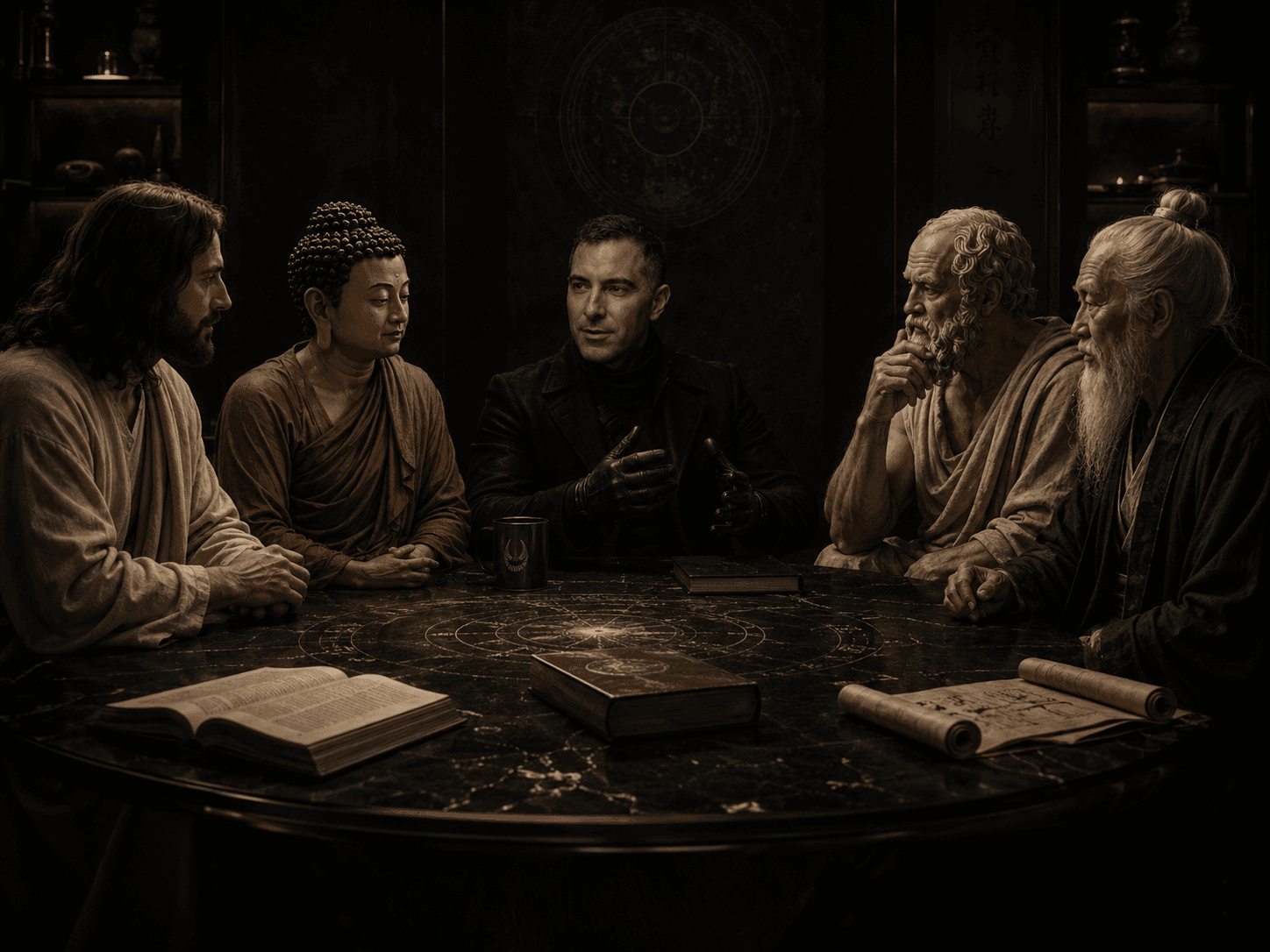
There is a moment that certain people report, under conditions of unusual interior clarity, of suddenly understanding how the major prophetic figures of history arrived at their visions.
This is not a devotional experience. Not belief in the content of what they taught. Something more precise: the mechanism becomes visible. You can see how a person sitting in close, sustained, unconditioned attention on the structure of their own experience would arrive at exactly the conclusions they reported. The insights stop looking like transmissions from outside. They start looking like careful observations from inside. And the interior being observed is the same one that has always been available.
That moment of recognition is worth taking seriously. It points to something structural.
The interior is not private
The prophets were not wrong about what they saw. They were often wrong about what seeing it meant.
A person who descends far enough into the interior of their own experience begins to encounter features that do not belong to their particular biography. The dissolution of the boundary between self and world. The felt sense of underlying unity beneath separate appearances. The observation that what a person calls "I" is not a fixed thing but a process, a movement, a construction visible from certain angles. The recognition that suffering arises not from external conditions but from a specific relationship to internal conditions that can, in principle, be changed [1].
These are not mystical claims. They are phenomenological observations. They describe what the structure of human experience looks like when examined carefully. And because the structure is human, not personal, every sufficiently careful examiner tends to find the same things [2].
This is the insight underlying what Aldous Huxley called the perennial philosophy: the remarkable convergence of independent mystical traditions that had no contact with each other [3]. Buddhist monks, Christian mystics, Sufi poets, and indigenous shamans, separated by centuries and continents, kept arriving at the same observations. This convergence is not coincidence and it is not cultural diffusion. It is independent observation of the same terrain.
What the prophets actually were
The figures who became religious founders were not receiving transmissions from outside the human system. They were observing the interior of the human system with unusual depth and unusual willingness to go all the way in.
What was rare was not the access. Everyone has the same interior. What was rare was the willingness to descend that far, to remain there without the support of tradition or precedent or community confirmation, and to come back with a report in a form other people could use. That is the prophetic function: not revelation from above, but observation from below, from inside, from the deepest layer of first-person experience that most people never reach, not because it is inaccessible but because the descent is frightening and the return requires everything [4].
The institution came later. The institution is always the second thing: the attempt by people who did not make the same journey to preserve and transmit the map the traveler brought back. This is not a failure. Maps are useful. The problem arises when the map is treated as the territory, when adherence to the document is treated as equivalent to making the journey.
The mechanism beneath the vision
There is a further level of understanding available. Not just arriving at the same observations the prophets arrived at, but being able to see how the arrival happens.
This is what phenomenological inquiry does. It does not simply enter the interior and report what it finds. It attends to the process of attending: the structure of consciousness as it observes itself, the way experience arises and passes, the moment-by-moment mechanics of how a self is constructed and reconstructed [5]. From this level, the prophetic experience becomes legible as a process, not just an event.
A person at this level is not a step above the prophets because they are wiser or more enlightened. They are a step to the side. They can see how the prophetic vision is generated, which is a different vantage point than generating it.
This is not a diminishment. It is a different kind of precision. The surgeon who understands the mechanism of wound healing has a different relationship to healing than the patient who experiences it. Both relationships are real. Neither is superior. They are different positions relative to the same phenomenon.
Why this matters
If the interior is universal, and if the prophets were observers rather than receivers, then the appropriate response to their work is not worship. It is replication.
Not repetition of the doctrine. Replication of the method: going in, looking clearly, coming back, making a report. The traditions at their best have always known this. The contemplative core of every major religion is not belief in the doctrine. It is a practice for making the same journey [6]. Meditation, prayer, fasting, ritual, ceremony: all of these, at their functional core, are technologies for descending into the interior with enough clarity to observe its actual structure.
The mistake the institutions made was allowing the report to substitute for the journey. The mistake individuals make is assuming the interior they have never examined is ordinary. It is not. It is the same interior that produced every insight any prophet ever had. The question is only whether anyone goes in far enough to see it clearly.
The point
Prophets happen the same way understanding always happens: through careful, sustained, first-person observation of the available material. What was available to them is available to everyone. What they found, every sufficiently rigorous examiner tends to find.
The difference is not access. It is the willingness to go all the way in. To stay long enough to see past the noise of biography and habit and self-protection into the structure underneath. And then to come back. Most people turn around before they get there. Not because the path is closed. Because it requires everything to keep going.
Sources
- Kabat-Zinn, J. (1990). Full Catastrophe Living. Delacorte. On the relationship between internal conditions and suffering: the clinical evidence that how a person relates to experience, not the content of experience itself, determines its psychological impact.
- James, W. (1902). The Varieties of Religious Experience. Longmans, Green. The foundational argument that mystical experience is a natural psychological phenomenon, not a supernatural intervention: it reveals features of the human mind that are universally present but rarely accessed.
- Huxley, A. (1945). The Perennial Philosophy. Harper. On the convergence of independent mystical traditions across cultures and centuries: the argument that independent observers of the same interior tend to arrive at the same observations.
- Eliade, M. (1964). Shamanism: Archaic Techniques of Ecstasy. Pantheon. On the shaman as the figure who descends into the interior and returns with a report: the cross-cultural pattern of deliberate descent, encounter with the structure of experience, and return to the community with usable information.
- Zahavi, D. (2005). Subjectivity and Selfhood: Investigating the First-Person Perspective. MIT Press. On phenomenological method: the examination not just of experience but of the structure and process by which experience arises.
- Underhill, E. (1911). Mysticism: A Study in the Nature and Development of Spiritual Consciousness. Methuen. On the contemplative traditions as technologies for interior observation: the argument that practice, not belief, is the functional core of the mystical traditions.