
You Are Not Hearing the Song. You Are Hearing Yourself.
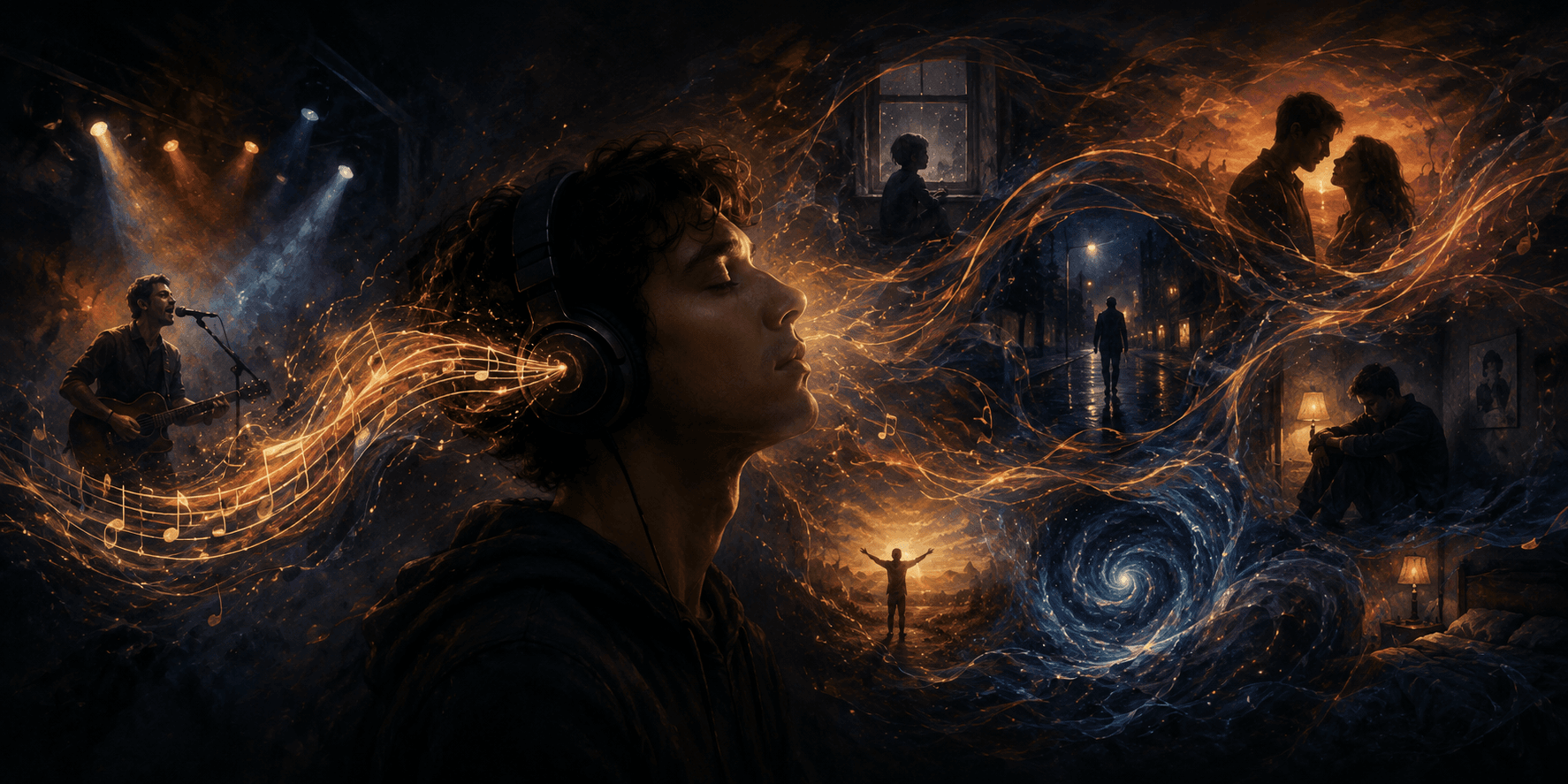
There is a song that has been yours since you first heard it. Not because the artist wrote it for you. Because something in your nervous system claimed it. It entered you at a specific moment, in a specific body state, and became inseparable from something you were feeling that you could not yet say. Now when it plays, that feeling returns. Not the artist's feeling. Yours.
This is not coincidence. It is the basic mechanism of how music works.
A song is not a fixed object that arrives the same way in every listener. It is symbolically underdetermined: it gives enough structure to enter, but enough openness for the listener to fill it with themselves [1]. The bass enters the body. The rhythm organizes the energy. The vocal tone gives permission to an emotional posture. Then the mind says: this is about me. And it is right, even when the song is not literally about you. It is about you because you brought yourself to it.
You do not assimilate the meaning of a song. You assimilate the state of it. The song enters you. You enter the song. Then the boundary blurs.
What the nervous system does with music
Music is received somatically before it is processed intellectually [2]. This is not a small distinction. It means the body begins responding before the mind has had time to decide what the song means. Breathing changes. Posture shifts. Arousal rises or falls. Something in the muscular system adjusts to match the rhythm. The body is already inside the song's reality before the listener has formed a single conscious thought about it.
This is why lyrics are often less important than the world the song creates. Two songs can share the same words and produce completely different experiences, because the acoustic texture, the production, the rhythm, the tonal color of the voice, these are what the nervous system is actually reading. The words ride on top of a carrier signal that the body receives first and the mind interprets second [2, 3].
The carrier signal is what the listener actually assimilates. Not the lyrical content. The world the sound creates. And that world becomes a container for material that was already in the listener but had not yet found a form.
The symbolic opening
Music works as a projective surface precisely because it is not fully closed [1, 4]. A photograph is specific. A piece of music is not. It carries tone, energy, tension, resolution, texture, and momentum, but it does not specify who is feeling what or why. That openness is what makes it available. The listener walks in and fills the symbolic space with their own interior.
This is why a breakup song can become about a childhood wound. The song offers loss and longing in a form that is available for any loss, any longing. The listener's nervous system does not check whether the specific loss matches. It finds a form for what it already contains and says: yes, this.
It is also why the same song can mean completely different things to different people, and why your relationship to a song can change as you change. You are not receiving a fixed meaning. You are using a structure. And the structure serves whatever is most alive in you at the moment of contact [3].
When the song becomes mythology
The most powerful musical relationships form early, when the internal material is enormous and the symbolic vocabulary is still undeveloped. Children and adolescents carry feelings they cannot yet name, sensations they cannot yet contextualize, identities they cannot yet articulate. Music becomes borrowed architecture. It gives a form to what has no form yet.
This is why music from certain periods of life becomes almost untouchable in memory. It is not merely nostalgic. It is that the song was, at the time, the only available container for something that was otherwise inexpressible. The song held the experience before the person could hold it themselves [2]. When the song returns, the experience returns with it.
Over time, the songs that claim us this way become part of what might be called an inner mythology: a collection of sonic worlds that map onto our most fundamental self-states. Not what we think, but what we are when we are most ourselves. Not biography, but the emotional register in which our deepest life occurs.
The song does not describe that register. It instantiates it. For three minutes, the world is what the song says the world is, and the listener's body agrees.
The point
The literal song belongs to the artist. The experienced song belongs to the listener.
What you love in music is not a neutral aesthetic preference. It is a map of what you have needed to feel, what you have needed permission to be, what parts of yourself had no other way to exist except inside that sound. The songs that claim you are not chosen. They recognize you.
And that recognition is possible only because music does not mean one thing. It creates a world, and you bring what you bring, and something in the meeting produces an experience that could not have existed without both the sound and the self that heard it.
You are not hearing the song. You are hearing yourself, given temporary form by something someone else made.
Sources
- Cook, N. (1998). Music: A Very Short Introduction. Oxford University Press. On the symbolic openness of music and how meaning is produced through the interaction between the work and the listener rather than residing solely in the work.
- DeNora, T. (2000). Music in Everyday Life. Cambridge University Press. On how people actively use music as a resource for constructing and regulating their emotional states, identities, and bodily experience.
- Juslin, P. N. & Sloboda, J. A., eds. (2010). Handbook of Music and Emotion. Oxford University Press. The comprehensive account of how music produces emotional responses and why those responses are personal and variable rather than fixed.
- Barthes, R. (1977). "The Death of the Author." In Image, Music, Text. Hill and Wang. On the transfer of meaning-making authority from author to reader, and how this applies to all symbolic works including music.