
Nearness Is Not Access
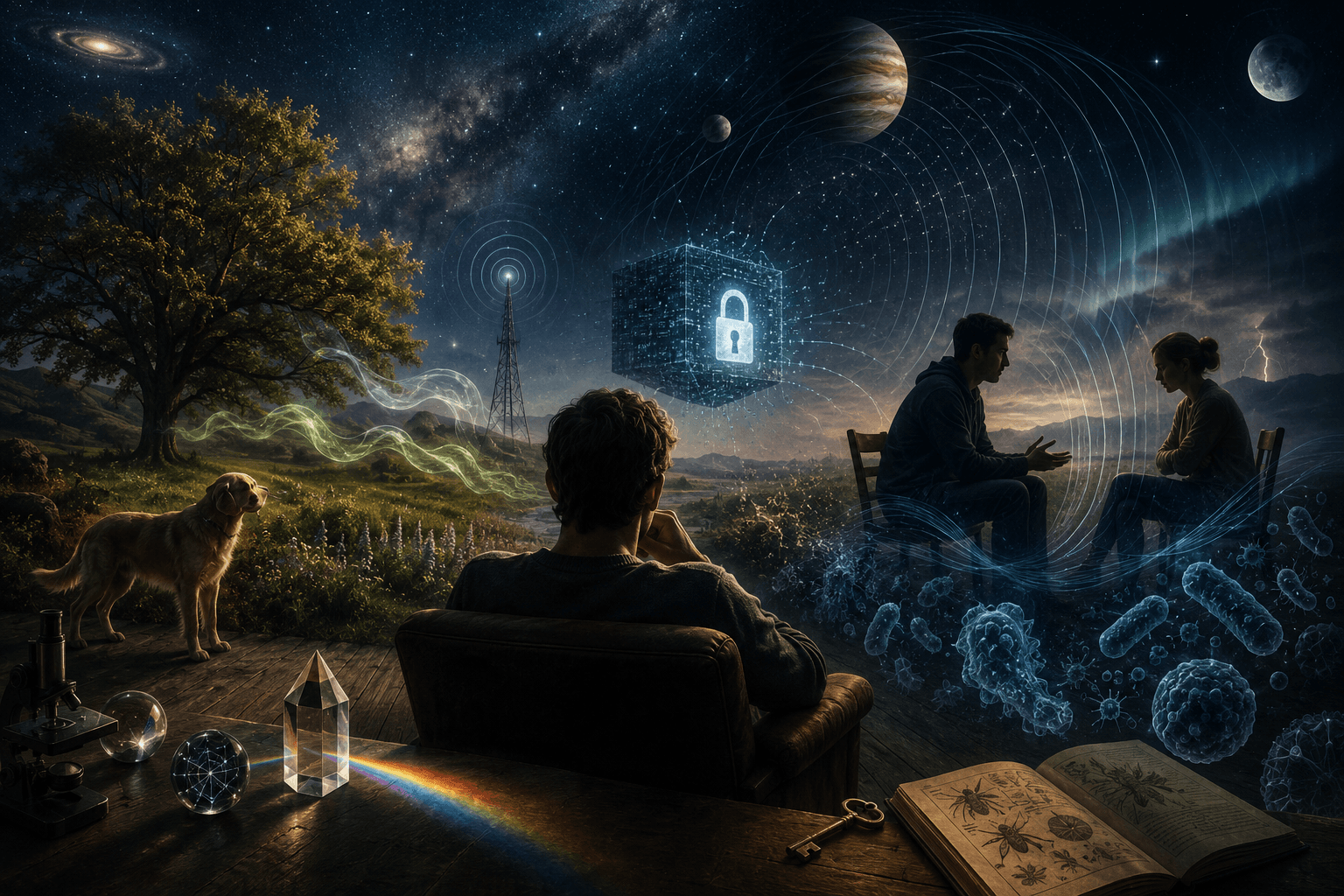
Right now, radio waves are passing through your body. Magnetic fields from the Earth and from every electronic device in the room are moving through you. Bacteria are on your skin and in your gut in numbers that exceed the count of your own cells. Light is arriving at your eyes from sources billions of years old. Infrasound from distant storms is in the air around you. The gravitational fields of Jupiter and the Moon are exerting measurable force on the fluid in your inner ear.
None of this is "far away." All of it is physically present. Almost none of it is part of your experience.
The assumption most people carry, quietly and without examining it, is that being near something means having access to it. That the world you experience is the world that is there. That proximity equals presence. This assumption is wrong in a way that, once you see it, changes how you read almost everything: perception, relationships, communication, and what it means to understand something at all.
Nearness is not access. Distance is not only measured in meters. It is also measured in what your system can receive, decode, and respond to. The world is full of signals that are already here and completely unreachable.
The animal in the room
Jakob von Uexküll introduced the concept of the Umwelt: the perceptual world that an organism actually inhabits, built only from the signals its sensory system can detect and the actions it can perform [1]. A tick lives in a world constituted almost entirely by temperature, butyric acid, and touch. It responds to nothing else. The full complexity of the summer meadow, the sights and sounds and smells that a human standing in the same field would experience, is not present in the tick's world, not because the tick is in a different location, but because the tick does not have the interfaces required to receive those signals.
Every species lives in a different world while occupying the same space. A dog navigating your living room is in a completely different environment than you are, shaped by olfactory information you have no receptor for, registering social information in the smells of the furniture that you could not access if you tried [2]. The dog is near. Its world is not available to you. Your world is not available to it, not in the way you inhabit it.
This is not metaphor. It is the literal structure of how reality becomes available to an organism. Reality does not arrive whole. It arrives only where there is an interface to receive it.
The encrypted file
An encrypted file sitting on a computer next to you contains information. The information exists. It occupies physical space. It is, by any spatial measure, as close to you as anything can be. But without the key, the file is functionally absent. Not distant in location. Distant in access. Presence without availability.
This is the structure that applies everywhere. Something can exist in the same physical space as you and still not be part of your world because your system cannot translate it. The interface is missing. And without an interface, proximity means almost nothing [3].
Shannon's foundational work on information theory makes this precise: information requires both a sender and a receiver [3]. A signal that arrives at a system incapable of decoding it does not become information. It remains noise, or is simply not registered at all. The message is present. The reception does not happen. These are two different things, and confusing them is a source of enormous misunderstanding in nearly every domain.
The psychological version
The same principle operates in every human relationship, and it is where the stakes become personal.
You can be in the same room as someone and be unreachable to them. You can say the true thing clearly, in plain language, and have it arrive nowhere. Not because the words were wrong. Because the receiver does not have the interface required for that particular signal.
A person who was not taught to receive direct expressions of need will not receive yours, even if you are standing in front of them. A person whose emotional architecture treats vulnerability as threat will process your honesty as aggression. A person whose family system ran on silence will experience direct communication as a violation of implicit rules they cannot yet name. In all of these cases, the proximity is real. The contact is not. The distance is not between your bodies. It is between your signal and their receiver [4].
This is why "I told them" is not the same as "they received it." Telling and receiving are two different events, and the first does not guarantee the second. The message leaving you is not the same event as the message arriving in them. What arrives depends on what they can decode, tolerate, and respond to.
It is also why "they were there" is not the same as "they were with me." Physical presence is the easiest form of proximity to achieve. It is also the shallowest.
What interfaces are
An interface is what allows one system to make contact with another. Eyes interface with light. Ears interface with pressure waves in air. Language interfaces with meaning. Mathematics interfaces with physical structure. Trust interfaces with intimacy. Ritual interfaces with collective meaning.
Interfaces are not passive channels. They shape what passes through them. The eye does not deliver raw light to the brain. It already performs massive processing, selection, and transformation before anything reaches consciousness [5]. Language does not deliver raw thought. It shapes what thought can become once it is put into words. Every interface translates and in translating, selects. Some signal passes. Much does not.
This means that adding a new interface genuinely adds a new world. A microscope does not merely magnify what you could already see. It opens a domain of reality that was previously non-existent for you, not absent from the universe but absent from your accessible universe. Before Leeuwenhoek looked through his lens, microbes were not part of human reality, not because they were not there, but because no interface existed [6].
What is currently absent from human reality because we lack the interface is an open question. The honest answer is that we do not know. We know that every species has a different Umwelt. We know that human instruments have already expanded our access to radio waves, X-rays, gravitational waves, and quantum states that our unaugmented biology cannot reach. We do not have a principled argument that those expansions have now reached the edge of what is there.
The point
Your world is not made of everything that is present. It is made of everything your system can receive, decode, and respond to. That is a much smaller set. The rest exists in the same space, subject to the same physical laws, pressing against the boundary of your available interfaces, and not crossing it.
This is ontological humility with teeth. Not a vague acknowledgment that you do not know everything. A specific claim: there is signal in the room that you are standing inside and cannot register. Not because it is absent. Because you do not have the receiver.
The practical implication reaches into everything. In a conversation, the question is not only what was said but what was received, what interface the receiver had available, and what was lost in the translation between those two events. In a relationship, proximity is the beginning of the question, not the answer. In any system you are trying to understand, the signal you cannot currently access is often the one doing the most work.
Distance is not only measured in meters. It is measured in the gap between what is there and what can be received.
Sources
- von Uexküll, J. (1934). "A Stroll Through the Worlds of Animals and Men." In Instinctive Behavior, edited by Claire Schiller, International Universities Press, 1957. The original account of the Umwelt: every organism's perceptual world is constructed only from the signals its sensory and motor systems can engage with.
- Nagel, T. (1974). "What is it like to be a bat?" Philosophical Review 83(4): 435-450. On the inaccessibility of other species' subjective experience and why physical proximity does not produce experiential access.
- Shannon, C. E. & Weaver, W. (1949). The Mathematical Theory of Communication. University of Illinois Press. On information as requiring both sender and receiver, and the conditions under which a signal fails to become information.
- Watzlawick, P., Bavelas, J. B., & Jackson, D. D. (1967). Pragmatics of Human Communication. Norton. On the axioms of communication: you cannot not communicate, but communication requires a receiver capable of decoding the relevant level of the message.
- Merleau-Ponty, M. (1945). Phenomenology of Perception. Translated by Donald Landes, Routledge, 2012. On the body as the primary interface between organism and world, and how perception is already an interpretive act before reaching consciousness.
- Haraway, D. (1988). "Situated Knowledges: The Science Question in Feminism and the Privilege of Partial Perspective." Feminist Studies 14(3): 575-599. On how all knowledge is interface-dependent and how new instruments genuinely open new domains of reality rather than merely revealing what was already visible.