
Reality Is Stored in the Shape of Relation
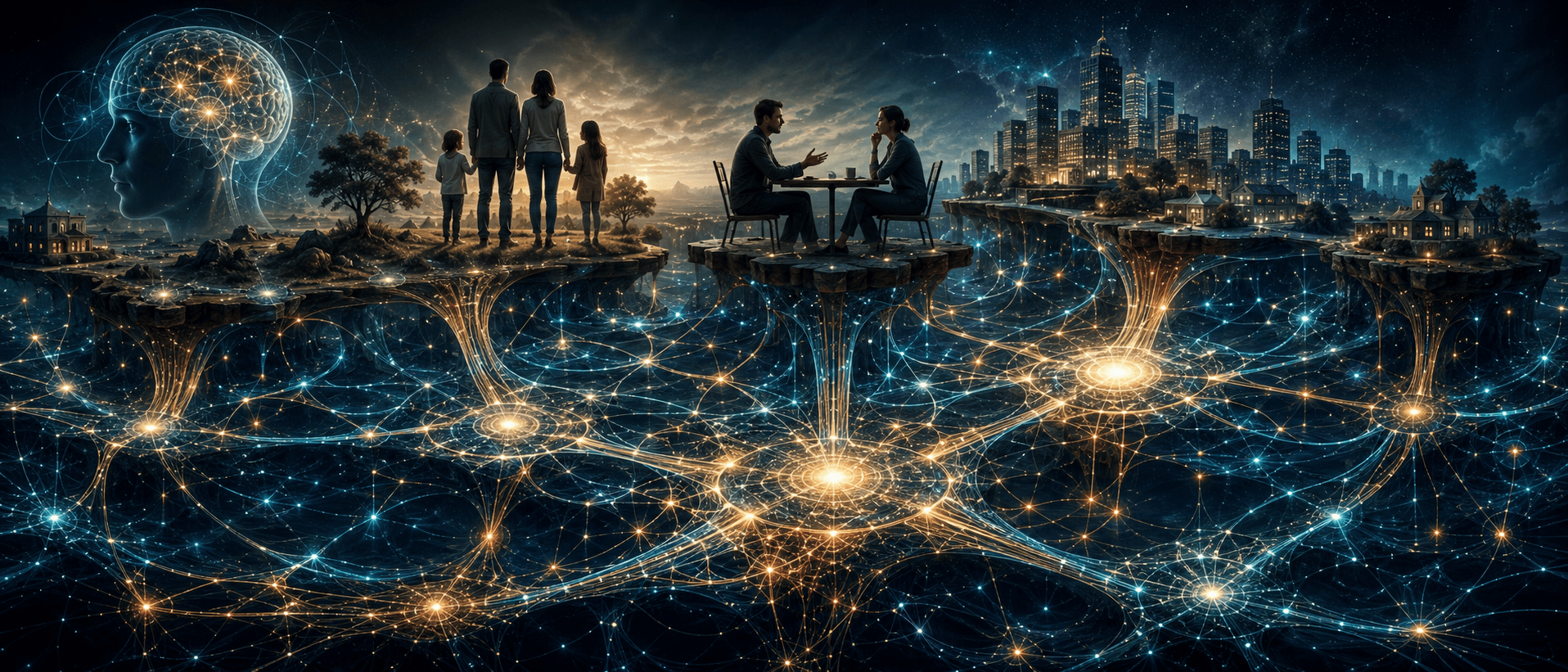
When you want to understand something, the first instinct is to find its parts. A brain: here are the regions. A family: here are the people. A conversation: here are the statements. A business: here are the departments. List the parts, locate them, label them. Now you know what you are looking at.
This is the wrong map. Not wrong in the sense that the parts are imaginary. Wrong in the sense that the parts are not where the action is.
Researchers recently mapped the entire neural network of the fruit fly brain, every neuron and every connection, and then did something unusual [1]. Instead of plotting it in ordinary three-dimensional space according to where neurons physically sit, they embedded the network in hyperbolic space, a geometry where distance grows exponentially rather than linearly. What they found was that the network's structure became more legible. Hub neurons, the ones with the most connections and the most influence over how signals route through the system, moved toward the center. Specialized peripheral neurons moved toward the edge. The hidden organizing logic of the network became visible once you stopped asking where things are and started asking how they connect.
Anatomy tells you where things are. Network geometry tells you how information flows. Those are different questions, and the second one is almost always the more important one.
Function does not live in location. Function lives in the shape of relation. The map most people use is wrong not because it is imprecise but because it is looking at the wrong thing entirely.
What hyperbolic space reveals
Ordinary flat space, the kind you navigate every day, has a specific geometry. Distance between points grows in a predictable linear way. Add a dimension and you add a fixed amount of room.
Hyperbolic space grows differently. It expands exponentially as you move away from any center point, which means it can accommodate far more structure in the same number of dimensions than flat space can [2]. This turns out to be exactly the right geometry for networks where a small number of hubs connect to enormous numbers of nodes, and where those hubs are embedded in rings of progressively more specialized, less connected nodes. The internet has this structure. Social networks have this structure. The brain appears to have this structure.
The fruit fly connectome, when embedded in two-dimensional hyperbolic space, captured the network's organizing logic better than low-dimensional Euclidean maps could [1]. The implication is not merely mathematical. It suggests that the brain's actual architecture, the thing that determines how signals travel and get integrated, is not primarily a story about physical location. It is a story about relational geometry. The real structure is the shape of the connections, not the positions of the parts.
The upgrade to awareness
The earlier post on awareness argued that consciousness requires time: not just a stimulus arriving, but a system that retains enough of the prior state to register that something has changed [3].
This finding adds another layer. Retention is necessary but not sufficient. The signal that enters the system does not simply persist. It travels. It gets routed, compared, weighted, and integrated across a network whose geometry determines what can reach what, what gets amplified and what gets suppressed, what can be unified into experience and what cannot [4].
Awareness may require not only time but structured flow across a hidden network. A stimulus arriving at a receptor is still not experience. It has to enter a system where the geometry allows it to reach the hubs, to be integrated with other signals, to be processed in a way that produces unified experience rather than isolated local activation. Consciousness, on this view, is something like what happens when signal successfully navigates the network's hidden geometry and becomes integrated [5].
This is why destroying specific neurons does not always destroy specific capacities, and why sometimes it does. It depends on whether the destroyed cells were hubs in the network's geometry or peripheral nodes. Location predicts less than you would expect. Connectivity predicts more.
The same principle operating everywhere
The brain is a good place to find this because the neuroscience makes it precise. But the principle is not limited to neuroscience.
Consider a family system. The visible map lists the members, their roles, their stated positions. Dad said this. Mom did not respond. The argument went in this direction. That is the location map: who is where, who said what.
The hidden geometry map asks different questions. Where does the signal go when discomfort enters the system? Who becomes the hub that everything routes through? Which topic sends the whole network into a different configuration? Which person receives information but cannot integrate it? Which pathway, traveled enough times, becomes the default route for conflict? Which node appears peripheral but is actually load-bearing for the whole system's stability?
Those questions reach the actual architecture [6]. The visible layout is not the real layout. The real layout is the shape of how signal travels: where it flows freely, where it gets blocked, where it loops, where it leaks, where it gets integrated and where it gets expelled.
This is also why insight that lands only at the logical level often does not change behavior. The logic arrived at a location. The habit lives in a pathway. Changing behavior requires rerouting, not just reframing. The geometry has to change, not just the label on the node.
The caution
The research finding is real. The headline version, which announced that scientists may have found where consciousness comes from, is not [1]. The study mapped the structural geometry of a neural network. It did not observe awareness directly. One of the researchers was explicit: consciousness lies beyond what the study tested.
The clean version of what was found: a brain's hidden network geometry may reveal organizing structure that ordinary physical maps miss. That is still profound. It does not need to be inflated into a theory of consciousness to matter. The principle it makes precise, that function lives in relation rather than location, is enough.
Over-claiming is its own distortion. The Reality Scientist move is to take what the evidence actually supports and follow it far enough to see what it genuinely implies, without reaching further than the evidence holds.
The point
You are probably looking at visible locations: the words someone said, the position they hold, the event that occurred, the symptom that appeared. These are real. They are also not where the action is.
The action is in the routing. Where does attention go when pressure arrives? What connects to what? What pathway is worn deep enough to activate automatically? What cannot reach what, no matter how clearly it is stated? Which hub is controlling the flow of the whole system without appearing to?
Those are the hyperbolic geometry questions. They apply to your mind, your relationships, your organization, your life patterns, and to any complex system you are trying to understand.
Reality is not stored in the visible parts. It is stored in the shape of relation. The map that finds it is the one that follows the signal, not the one that marks the locations.
Sources
- Timar, G., Kovacs, B., & Krioukov, D. (2025). "Network geometry of the Drosophila brain." arXiv 2602.16417. Hyperbolic embedding of the fruit fly connectome and its advantage over Euclidean maps for capturing network organizing structure.
- Krioukov, D., Papadopoulos, F., Kitsak, M., Vahdat, A., & Boguna, M. (2010). "Hyperbolic geometry of complex networks." Physical Review E 82(3): 036106. The foundational account of hyperbolic geometry as the natural space for scale-free networks and why it outperforms Euclidean embeddings.
- Husserl, E. (1928). On the Phenomenology of the Consciousness of Internal Time. Translated by John Brough, Kluwer, 1991. On retention and the temporal structure required for conscious registration.
- Sporns, O. (2011). Networks of the Brain. MIT Press. On connectome structure, hubs, and the relationship between network architecture and neural function.
- Tononi, G. (2004). "An information integration theory of consciousness." BMC Neuroscience 5(1): 42. On why consciousness correlates with the integration of information across a network, not merely with the activation of local regions.
- Bowen, M. (1978). Family Therapy in Clinical Practice. Jason Aronson. On the family as an emotional system with its own network structure: how anxiety routes through the system, who functions as hubs, and how the geometry of relation determines behavior more than the content of any individual's statements.