
Theories
40 entries in Identity

Evidence, Not Prophecy
A long, painful pattern with other people is real data, and data should change your strategy. But there is a quiet moment where the data stops being evidence and turns into a verdict on what is possible, and the switch from has not happened to cannot happen is where a life gets frozen.

The Centerless Center
When you search for the "I," you find thoughts, sensations, memories. But not the one having them. The "I" is not a hidden object. It is a position inside experience. The center you have been looking for exists. It is just not solid.
Symbolic Possession
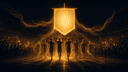
Collective identity attaches to a symbol, not its contents. A sports team survives total replacement of its players, owners, and stadium. Fans experience continuity where there is massive discontinuity. The loyalty is to the banner, not the men carrying it.

Your Child Is Just a Person
The child standing in front of you has not changed. The category has. Understanding what the word "mine" does to a person is understanding how love restructures reality.

Adaptation Is Not Proof of Health
Society moralizes adaptation. It looks at a person who has learned to need less, expect less, and feel less, and calls that person resilient, mature, strong. But adaptation is not proof of health. Adaptation is proof of pressure. Sometimes what we call resilience is a scar wearing the name of a virtue.

Rebellion Is Not Sovereignty
Rebellion says I will be as much as I want and people can deal with it. Sovereignty says I know what I am, I do not hide it, and I do not spray it unconsciously into every room. One is reactivity wearing the costume of freedom. The other is the actual thing.

The Holding Architecture
Exceptional capacity to hold others is not evidence of healing. It is often evidence of the reverse. The absence builds the mastery. And the mastery builds the asymmetry.

One of One
The ego wants to be the only one who sees. That is not the same as being unmistakably yourself. One is a rank claim. The other is a configuration.

The Pole
There is a particular kind of stuck that does not look like stuck. The person reaching toward something better. The hand still gripping the same fixed point.

You Can Be Loved and Not Be Seen
Love and recognition are two separate systems. Someone can be affectionate, attentive, and genuinely caring while simultaneously being unable to receive who you actually are. The two can coexist indefinitely, and that coexistence is its own specific kind of pain.

The Wound With No Nerve
Some parts of the self can be removed without physical pain but with enormous injury, because they carry accumulated time. The wound is not in the tissue. It is in ownership and continuity. This is why forced hair-cutting recurs in every domination ritual.

Why We Need to Be Witnessed
The need to be witnessed is not vanity. It is something more structural than that. An experience that no one knows about feels different from an experience that has been received by another consciousness. The difference is not psychological noise. It is pointing at something real about what experience is for.

You Did Not Choose Your First Thought
The self that feels like it is choosing arrives after the choice has already begun. You did not choose your first thought. You watched it arrive. The question is not whether free will exists. The question is what kind of thing the chooser actually is.

Why You Cannot Talk Someone Out of a Belief
Beliefs are not conclusions people arrived at by weighing evidence. They are load-bearing structures in the self. Arguing against a belief does not feel like a logic problem to the person holding it. It feels like an attack on who they are. This is why being right almost never changes anything.

People Are Not One Signal
We want a person to resolve into a single verdict: good or bad, trustworthy or not. But people are not one signal. The same person can buy groceries for a stranger and provoke a conflict an hour later. They are competing signals in motion.

When Actions Become Symbols
When a person is rebuilding their identity, ordinary actions stop being practical and become symbolic. The act is not really about its object. It is about significance, belonging, anger, or the need to feel consequential while the self is unstable.

The Loneliness of Seeing Clearly
There is a loneliness specific to the person who sees too clearly to be satisfied with the available versions of understanding. Not the loneliness of being excluded. The loneliness of being present in a conversation that no one else seems to be fully inhabiting.

The Map That Will Not Be Revised
The same cognitive architecture that keeps someone from updating their political beliefs keeps them from updating their picture of you. Not similar. Not analogous. The same thing. Same mechanism, different domain.

The Moment Is Not a Thread
A moment of connection is not a relationship beginning. Two people can genuinely spark, and one files it as a self-contained moment while the other reads it as a bridge. The wound is non-continuation after apparent recognition.

The Defense Is the Confession
The precision of a defense reveals exactly what it defends. An elaborate, self-aware architecture of self-protection requires an accurate internal map of the thing being hidden. The sophistication of the concealment is itself the disclosure.

The Star That Forgot It Was a Star
Human beings spend enormous energy dreaming of reaching the stars. The irony is total: every atom in your body was forged inside one. You are not trying to get to the stars. You are a star trying to remember what it is.

No One Is Cruel
Cruelty is not a property of a person. It is a pattern that emerges when a particular kind of pain meets a particular kind of opportunity, in a body that was never given a way to put the pain down.

The Glass Skin
Imagine a version of humanity where the skin is translucent and everything inside a person is visible. Most of what we call civilization is built on the fact that this is not the case.

The Beauty of Bane
Bane is not a villain because he is strong. He is strong because of where he was born. The pit made him, and the pit is the most honest teacher in the films.

The Armor Becomes the Cage
People believe they make free choices while obeying unseen inner masters: pride, fear, avoidance, inherited scripts. These defenses once protected something real. But protection that outlives its threat becomes a prison, and it feels like just being yourself.
Belonging Is Not Membership
Shared identity produces only the potential for belonging, not belonging itself. Belonging is relational: it emerges from mutual recognition, attention, and trust. Two people can share every marker and feel distant, while strangers become close.

Belonging to a Path Is Not Walking It
Spiritual traditions aim to change perception, character, and behavior. But participation can become disconnected from that change. A person can acquire the identity, language, and aesthetics of a path without the transformation it was meant to produce.

Consequence, Not Attention
Beneath the desire to be seen there is sometimes a rarer one: to have your existence produce consequences. Not to be liked or enjoyed, but to alter the trajectory of what you touch. This explains why ordinary friendship can still feel incomplete.
Recreating the Courtroom
Under distress, the wounded party does to the other exactly what they hate receiving. You want not to be put on trial, so you put them on trial. You want questions, not explanations, but you explain them to themselves. The defense reproduces the very courtroom it fled.

Investigation as Love
For some people, love is not proven by affection or comforting words but by the willingness to investigate reality together. Love is the sustained willingness to look, ask, stay, revise, and understand.