
You Are Who You Stand Beside
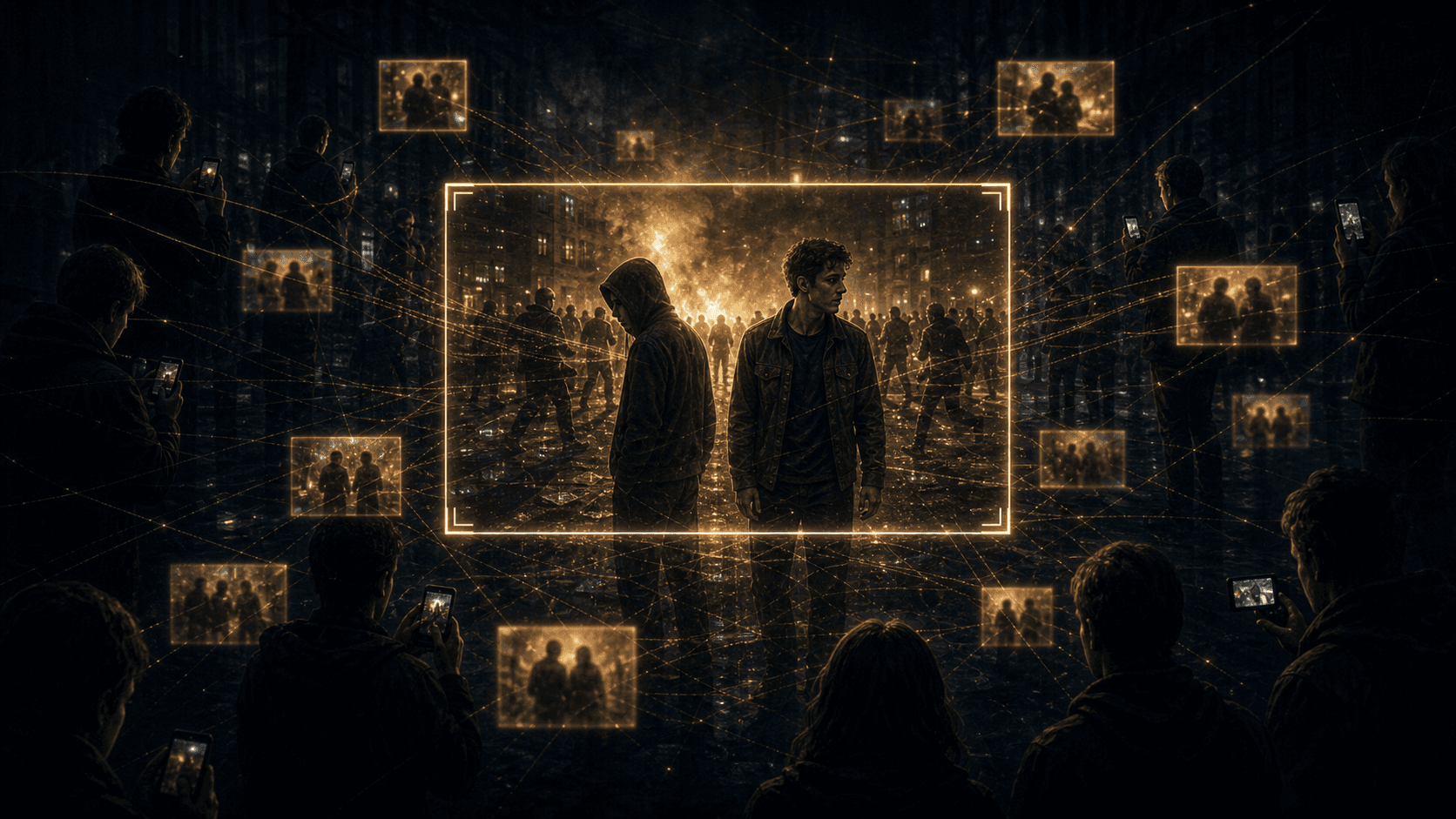
You are standing next to someone when a situation erupts around them. You barely know them. You have no involvement in whatever is happening. And yet you feel a specific dread, a sense that you are being absorbed into something, that to anyone watching you are now part of the scene. You have done nothing, and you can already feel the association forming.
That dread is accurate. It is registering a real feature of how observers process scenes. People do not store complex situations in their full complexity. They compress them into simple associations, and proximity is one of the strongest compression rules. Standing beside something charged reads, to an observer, as being part of it.
An observer compresses a complex scene into a simple association, and proximity is read as involvement. The anxiety you feel standing near a charged situation is the feeling of being placed inside a narrative before you know what the narrative is.
Observers compress
An observer encountering a scene does not record every element and relationship. There is too much, too fast. Instead, the mind compresses the scene into a quick, usable summary, and the summary uses crude rules: who is near whom, what is happening, who appears to belong to what [1].
Proximity is one of the most powerful of these rules. If two people are physically together when something significant happens, the observer's compression tends to bind them: these people are associated, this person is part of this event. The binding is automatic and happens before any information about actual involvement is available. The mind fills in a relationship because the bodies were near, and nearness is the cheapest available cue for connection [1, 2].
This is efficient and usually harmless. But it has a failure mode. The compression cannot distinguish between meaningful association and mere physical coincidence. Standing beside someone by accident produces the same proximity cue as standing beside them by allegiance. The observer's summary reads both the same way: together, therefore connected.
The snapshot, not the film
The deeper issue is that observers capture snapshots, not films. They see a slice of the situation, a single frame, stripped of the history and context that would explain it. And a snapshot of two people near a charged event looks identical whether one of them is central to it or just happened to be standing there [2].
The film would disambiguate. The full sequence would show that this person arrived moments ago, has no role, is as surprised as anyone. But the observer rarely gets the film. They get the frame, and the frame is the basis of the association they form and carry away. The summary built from a single slice becomes the stored fact: that person was there, with them, part of it [2, 3].
This is why being seen beside someone at the wrong moment can attach a connection that no amount of actual non-involvement prevents. The observer is not reasoning about your involvement. They are storing a compressed snapshot in which you appear bound to the scene, and the snapshot does not contain the information that would set you apart from it.
Placed inside a narrative
There is a particular quality to the anxiety this produces, and it is worth naming precisely. It is not only fear of being blamed. It is the discomfort of being placed inside someone else's unresolved story before you know what the story is [3].
When you are suddenly near a charged situation involving a person you barely know, you lack the information to position yourself. You cannot defend them, because you do not know if they should be defended. You cannot condemn them, because you do not know if they should be condemned. You cannot explain the situation, because you do not understand it. You have been inserted into a narrative whose shape is unknown to you, and you are being read as a character in it before you have any idea what kind of story it is [3].
That is the source of the specific dread. It is not guilt and not fear of a known accusation. It is the vertigo of being assigned a role in a story you cannot yet read, by observers who are compressing you into it in real time. You are being characterized before you have the information to know what you are being characterized as [3].
Why it cannot be reasoned away
The frustrating part is that knowing you are innocent does not dissolve the anxiety, because the anxiety is not about your actual involvement. It is about the observer's compression, which operates independently of the truth and which you cannot directly correct [1, 2].
You could be completely uninvolved and the proximity cue still fires in every observer's mind. Your inner certainty of your own non-involvement is invisible to them; all they have is the snapshot. So the gap between what you know and what the scene shows cannot be closed from the inside. The association is being formed in other minds, from a frame you cannot edit, using a rule you cannot override [2].
This is why the situation feels so exposing. The mismatch between your innocence and your appearance is real, and there is no immediate action that resolves it, because the resolution would require giving every observer the film instead of the frame, and the film is exactly what they do not have and will not get.
The point
Observers do not store scenes in full. They compress them into simple associations, and proximity is one of the strongest compression rules: standing beside something charged reads as being part of it. This binding is automatic, fast, and blind to the difference between meaningful association and physical coincidence.
The reason it cannot be corrected is that observers capture snapshots, not films. The single frame of you near a charged event looks the same whether you are central to it or accidentally beside it, and the frame, not the full sequence, becomes the stored fact. You are read into the scene by a cue you cannot edit.
The specific anxiety this produces is the feeling of being placed inside someone else's unresolved story before you know what the story is. Not guilt, not a known accusation, but the vertigo of being assigned a role in a narrative you cannot yet read. And it cannot be reasoned away from the inside, because the association is forming in other minds, from a snapshot you have no way to replace with the truth. Sometimes you are not who you are. You are who you were standing beside.
Sources
- Gilovich, T. (1991). How We Know What Isn't So: The Fallibility of Human Reason in Everyday Life. Free Press. On how people form impressions and associations from incomplete information, compressing complex situations into simple, often misleading, summaries.
- Kahneman, D. (2011). Thinking, Fast and Slow. Farrar, Straus and Giroux. On the mind's tendency to build coherent stories from limited evidence ("what you see is all there is"), drawing strong conclusions from snapshots while ignoring the missing context.
- Gilbert, D. T. & Malone, P. S. (1995). "The correspondence bias." Psychological Bulletin, 117(1): 21-38. On the tendency to attribute to a person traits and involvements that correspond to the observed situation, even when situational factors fully account for their presence.