
The Scale Chooses the Object
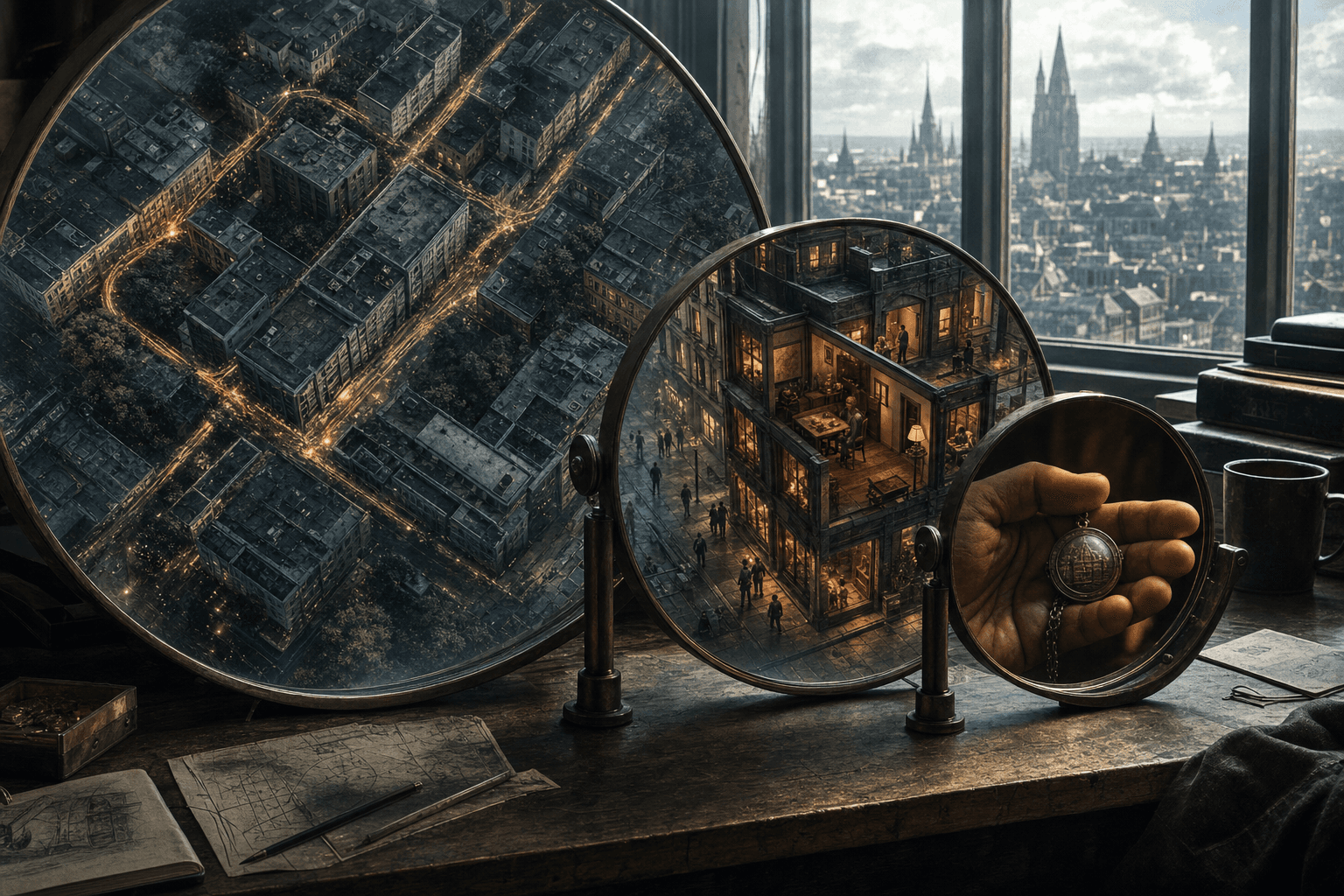
Look at a city from high enough and the people stop being people. They become flows: lines of commuters, streams of traffic, clusters gathering around food and dispersing, bodies moving along invisible trails. From that height humans look a great deal like ants, and they behave a great deal like ants, following paths, defending territory, transporting resources, obeying hierarchy, returning to nests. The individual person, with a whole inner life, simply disappears into the pattern.
Now drop back down to street level. Each of those dots is a universe. The person crossing the road carries childhood, grief, fantasy, unfinished conversations, private fears, a sense of being someone. The swarm resolves back into a million separate interiors, each vast, each singular. And here is the thing that matters: both views are true. The aerial swarm and the interior universe are not competing descriptions where one is right. They are the same reality at two scales, and the scale is what chose which object you saw.
From above, humans are a swarm; from within, each is a universe, and both are true. What a thing is depends on the scale you observe it from, and the error is committing to a single scale and mistaking its object for the whole of reality.
Two true pictures of the same thing
Consider the two pictures side by side. From above: humans as colony organisms, coordinating through signals, following grooves laid by those before them, moving as a metabolism spreading across the planet. From within: humans as conscious individuals, each an interior world of meaning, memory, and desire, irreducibly singular. These are not a true picture and a false one. They are two accurate descriptions of the same beings [1].
They differ because they are taken at different scales, and scale is not a neutral lens that leaves the object unchanged. At the aerial scale, the visible object is the pattern, the swarm behavior, because individuals are too small to resolve and only the collective motion appears. At the interior scale, the visible object is the person, the singular consciousness, because the collective pattern is invisible from inside a single life. The scale determines which object is even available to be seen [1, 2].
So it is not that one scale shows reality and the other shows an illusion. Each scale shows a real object that exists only at that scale. The swarm is real; it is a genuine feature of humans-in-aggregate that does not exist in any single person. The universe of the interior is real; it is a genuine feature of the single person that does not appear in the aggregate. Neither object is more real than the other. They are objects of different sizes, and you need the matching scale to see each [2].
Why patterns are scale-bound
This is a general property of complex systems, not a quirk of looking at people. Patterns exist at particular scales and are invisible at others. A behavior that is obvious in the aggregate, the swarm, the trend, the flow, cannot be seen in a single element, and a property obvious in a single element, its interior, its particularity, cannot be seen in the aggregate. Zoom changes not just the resolution but the kind of thing that appears [2].
The reason is that new properties emerge at new scales, properties that are not present in the parts and not visible from within them. Coordinated colony behavior is a property of many humans interacting; it is not located in any one of them and cannot be found by examining one. Consciousness and singular interiority are properties of the individual; they wash out entirely in the aggregate view. Each scale has its own real objects and its own real laws, and the objects of one scale are genuinely absent from the other [2, 3].
So asking which scale is correct is a confusion. It is like asking whether a forest or a tree is the true object; both are real, at their scales, and the forest has properties no tree has while the tree has properties the forest does not. Humans are the same. At the scale of the crowd they are swarm; at the scale of the person they are universe; and there is no privileged scale from which the real answer is finally read off, because the real answer is different, and equally real, at each [1, 3].
The error of the single scale
The characteristic mistake is to pick one scale, usually because it flatters a conclusion one already wants, and to treat its object as the whole of reality. The reductive move fixes on the aerial scale and declares that humans are merely ants, merely swarm, merely pattern, and that the interior is an illusion. The romantic move fixes on the interior scale and declares that each person is a sovereign universe, denying that they are also, truly, elements of a swarm. Each takes one real object and calls it the only one [1, 3].
Both errors have the same form: mistaking the object of a chosen scale for reality as such. The swarm is real, but a human is not merely a swarm-element, because at another scale they are also a universe. The interior is real, but a human is not merely a sovereign interior, because at another scale they are also swarm. To assert either as the total truth is to forget that it was the scale, not reality, that selected the object, and that a different scale would have selected a different and equally real one [1, 2].
The accurate stance holds the scales together without collapsing them. A human is swarm and universe, aggregate pattern and singular interior, and which one you see is a fact about your distance, not about them. The maturity is to move between scales deliberately, knowing that each reveals real objects the others cannot, and to resist the pull to crown any single scale as the one that shows what things really are. Reality is not at one scale. It is scale-dependent all the way through [2, 3].
The mirror inside the swarm
There is one property humans have that complicates the picture in a productive way: they can see their own swarm. An ant does not appear able to rise above the colony and recognize colony behavior as such. A human can look at the city from above, or in the mind's eye, and say, we are behaving like ants, and this reflective act adds a second layer without erasing the first. Humans are swarm and also swarm-that-can-observe-itself [1, 3].
This does not lift humans out of the swarm. Much of what feels like individual choice is still scale-bound colony behavior: desires transmitted socially, paths followed because others laid them, status read from invisible signals, movement through grooves cut by prior generations. The reflective layer does not cancel the swarm layer; it sits on top of it, able to inspect it, not able to escape it. We are ants with mirrors, following the trails and, occasionally, seeing that we follow them [3].
But that capacity is exactly what makes the multi-scale stance possible, and it is the deepest form of the idea. A being that can occupy more than one scale of its own reality can hold that it is at once swarm and universe, pattern and person, and can decline to reduce itself to either. Civilization may not be the opposite of the anthill; it may be the anthill becoming able to see itself. To be human is to be an element of a pattern that can also, from another scale within the same mind, behold the pattern, and the wisdom is to keep both scales open and call neither one the whole.
The point
Seen from above, humans resolve into swarm: flows, trails, colonies, coordinated motion in which the individual disappears. Seen from within, each is a universe of memory, longing, and singular consciousness in which the swarm is invisible. These are not a true picture and a false one but two accurate descriptions of the same beings at different scales, and scale is not a neutral lens. It determines which object is even available to be seen.
This is a general property of complex systems: patterns exist at particular scales and vanish at others, because new properties emerge at new scales that are not present in the parts or visible from within them. Coordinated colony behavior belongs to humans-in-aggregate and is not located in any one of them; consciousness and interiority belong to the individual and wash out in the aggregate. Asking which scale is correct is like asking whether the forest or the tree is the real object. Both are real, at their scales, with properties the other lacks.
The characteristic error is to fix on one scale and call its object the whole of reality, whether the reductive move that says humans are merely swarm or the romantic move that says each is merely a sovereign universe. Both mistake the object of a chosen scale for reality as such, forgetting that scale, not reality, selected the object. The accurate stance holds the scales together and moves between them deliberately. And the human twist is that we can see our own swarm: ants with mirrors, following the trails and sometimes beholding that we follow them. Reality is not at one scale. It is scale-dependent all the way through.
Sources
- Nagel, T. (1974). "What Is It Like to Be a Bat?" The Philosophical Review, 83(4): 435-450. On the irreducibility of the subjective, interior point of view to any external, objective description, and how a being's inner perspective is a real feature invisible from the outside view.
- Levin, S. A. (1992). "The problem of pattern and scale in ecology." Ecology, 73(6): 1943-1967. On how patterns in complex systems are scale-dependent, so that features visible at one scale of observation are absent at another, and there is no single correct scale for describing a system.
- Anderson, P. W. (1972). "More Is Different." Science, 177(4047): 393-396. On how new properties and laws emerge at higher levels of organization that are not present in or reducible to the properties of the parts, so that each scale of a system has its own real objects.