
The Interior Stays Opaque
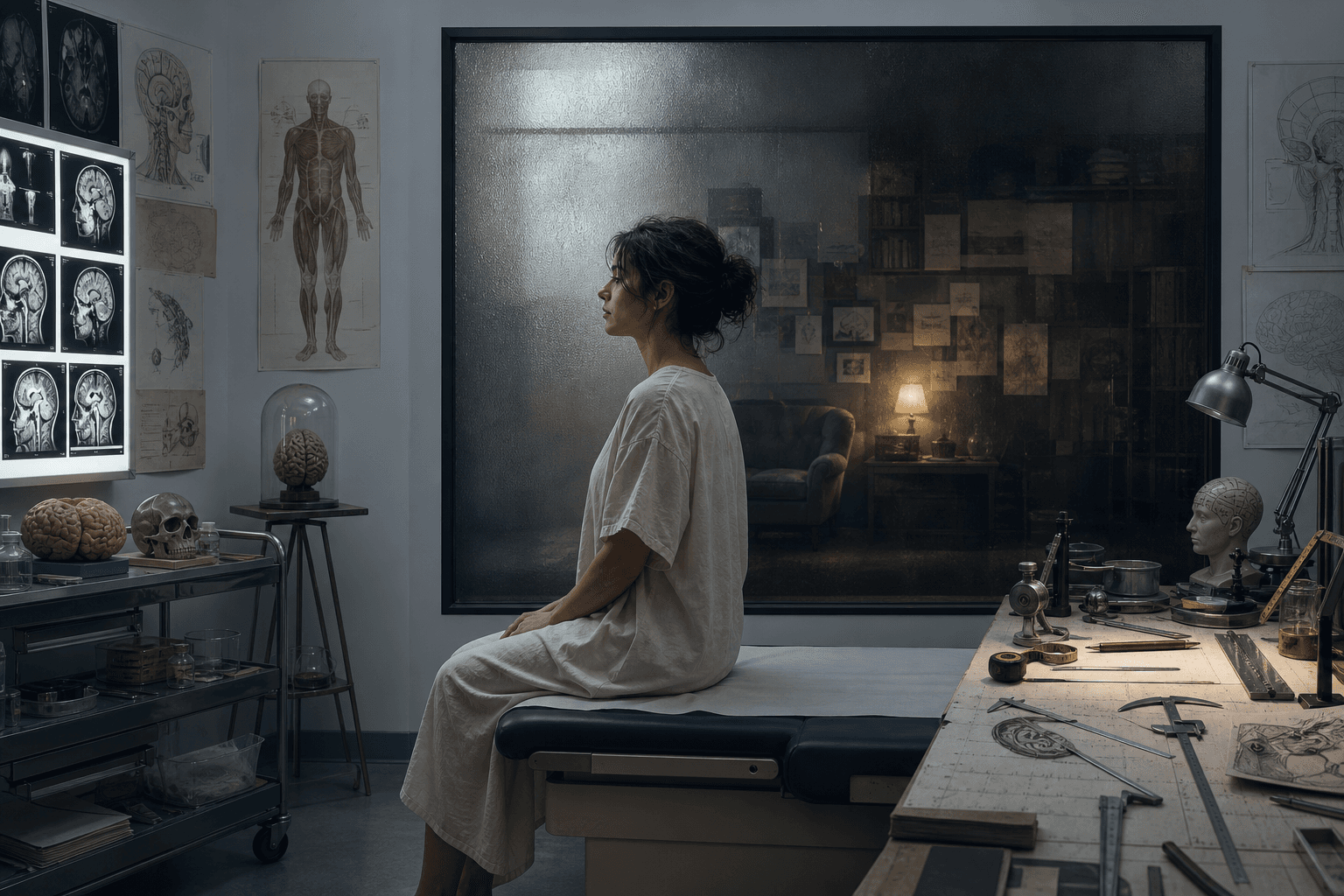
For most of human history, people lived inside their own bodies without knowing what the inside was. They felt fever, pain, the churn of digestion, the failures of organs they could not name, and they had no map of any of it. The interior was a sealed region producing effects with no visible cause. A pain was not a signal from a known structure. It was a visitation: a punishment, an imbalance, a spirit, a curse.
It is comfortable to think that era ended, that we now live with our interiors mapped and understood. But the same condition persists at a different level. We have mapped the organs. We have not mapped experience. And the part of us that produces consciousness remains as opaque to us as the liver was to someone who had never seen one.
Every age believes it has finally reached the inside. Every later age finds it was still in the haunted house. The interior the previous era could not see has been mapped; a deeper interior it could not even ask about remains dark.
Living inside an unmapped system
Imagine inhabiting a body with no anatomical knowledge at all. You feel everything from the inside, vividly: hunger, pain, arousal, exhaustion, the slow approach of death. But you have no picture of what produces any of it. There are no organs in your mental model, no circulation, no nerves, no mechanism. There is only the felt effect and a blank where the cause should be [1].
In that condition, the interior is genuinely haunted. Effects arrive with no visible source. A sharp pain in the chest is not a known structure malfunctioning; it is an event with no anchor, easily read as an attack from outside, a moral consequence, a supernatural visitation. The body is a house you live in while having never seen its architecture, hearing the plumbing and the wiring through the walls without any blueprint of what is behind them [1, 2].
This was the ordinary human condition for almost all of history. Not a rare ignorance but the baseline. People felt their interiors with full intensity and understood them not at all, and so they explained the felt effects with whatever frameworks were available: spirits, humors, divine judgment, imbalance.
We assume the haunting ended
The development of anatomy and physiology gave us the blueprint the earlier condition lacked. We can now name the structures, trace the systems, locate the source of many sensations. Pain became, in this frame, a signal from identifiable tissue rather than a visitation. The interior was opened and mapped, and it became reasonable to feel that the haunting was over [2].
But the haunting only ended for one layer of the interior. The layer that was opened is the physical body: organs, nerves, chemistry, mechanism. There is another interior that the anatomical map does not touch at all: the interior of experience itself. The fact that there is something it is like to be you. The felt quality of the pain, not its nervous pathway. The presence of consciousness, not the brain tissue correlated with it [3].
This interior remains exactly as unmapped as the body was to someone before anatomy. We can correlate experience with neural activity, the way the earlier people could correlate a pain with a location. But the actual production of experience from matter, the why and how of there being any inside at all, is a blank where the mechanism should be. We feel it with full intensity and understand it not at all [3, 4].
The same condition, one level deeper
The structure of our situation is identical to the earlier one, moved down a layer. The pre-anatomical person felt bodily effects and had no map of the body. We feel conscious experience and have no map of consciousness. They explained their unmapped interior with the frameworks of their time. We explain ours with the frameworks of ours [4].
And like them, we narrate what we cannot see. We produce confident accounts of the self, the mind, the will, emotion, identity, in the same way they produced confident accounts of humors and spirits: filling the blank where the mechanism should be with a story that feels explanatory. The stories are more sophisticated and better correlated with observation. But on the central question, the production of experience itself, they are filling a void, not reading a map [3, 4].
This means the sense that we have reached the inside is the same sense the earlier people had within their own frame. They too felt they understood their condition. They had explanations, traditions, confident frameworks. From outside their frame, those explanations look like narration over an unmapped interior. Our explanations of consciousness may look exactly the same from a vantage point we do not yet have.
Why the feeling of arrival is misleading
The recurring pattern is that every age feels it has finally reached the inside, and every later age finds that the earlier one was still in the haunted house, narrating effects it could not actually explain. The feeling of having arrived at understanding is not evidence of having arrived. It is a constant that appears in every era's relationship to its own interior [4].
This does not mean the knowledge gained is fake. Anatomy is real; the body genuinely was mapped. The point is narrower: at any given time, there is a deepest interior that the current frameworks narrate rather than map, and the people of that time cannot easily tell the difference, because narration over a blank feels like explanation from the inside. The map of one layer arrives alongside the continued opacity of a deeper one, and the satisfaction of the first hides the darkness of the second.
The point
For almost all of history, humans lived inside bodies they could not see into, and so their interiors were haunted: effects with no visible cause, explained as visitations. Anatomy mapped that interior and it came to feel that the haunting was over.
But the haunting ended for only one layer. The interior of experience itself, the fact and felt quality of consciousness, remains as unmapped as the body once was. We feel it completely and explain it not at all, and like every era before us, we narrate the blank with the frameworks of our time and mistake the narration for a map.
The feeling that we have reached the inside is the same feeling the pre-anatomical people had within their frame, and it is just as unreliable. There is always a deepest interior that the current age narrates rather than understands. We are still in the haunted house. We have just lit one of its rooms and concluded, as every age does, that we can now see the whole building.
Sources
- Porter, R. (1997). The Greatest Benefit to Mankind: A Medical History of Humanity. HarperCollins. On the long history of living without anatomical knowledge, and how bodily sensations and illnesses were interpreted through frameworks of humors, spirits, and divine agency in the absence of a map of the interior.
- Foucault, M. (1963). The Birth of the Clinic. Presses Universitaires de France. On the emergence of the anatomical gaze and the transformation of the body into a mapped, legible interior, and how this shift restructured the interpretation of symptoms from signs to locatable causes.
- Chalmers, D. J. (1996). The Conscious Mind. Oxford University Press. On the hard problem of consciousness: the unexplained gap between physical mechanism and subjective experience, which remains unmapped even as the neural correlates of experience are increasingly identified.
- Nagel, T. (1974). "What is it like to be a bat?" Philosophical Review, 83(4): 435-450. On the irreducibility of subjective experience to objective description, demonstrating that the interior of consciousness resists the kind of mapping that was applied to the physical body.