
The World Is Ranked, Not Seen
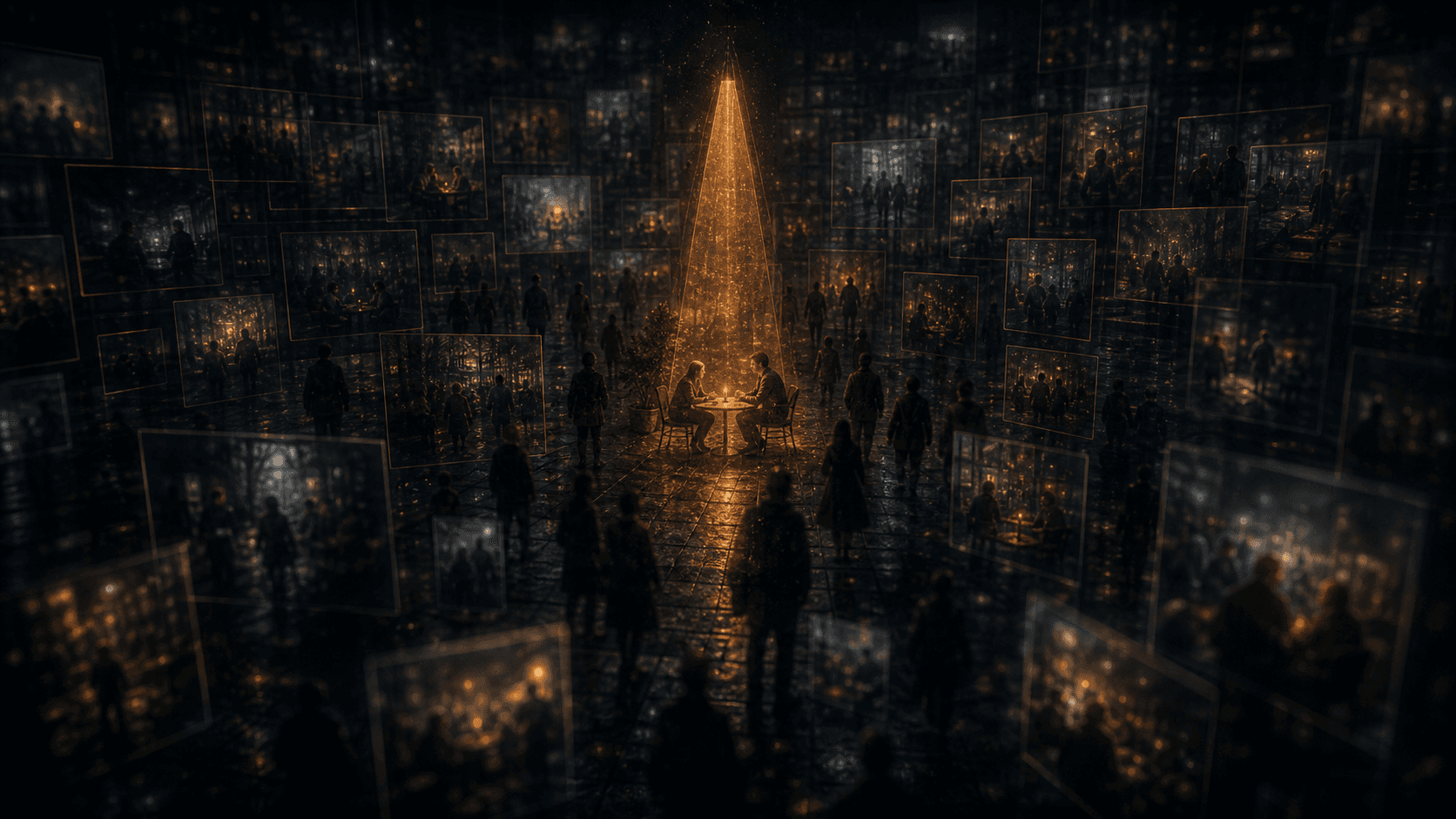
Your field of vision is enormous. At any moment it contains a vast, detailed, continuous scene. And yet you are never experiencing most of it. You are experiencing the one thing you are focused on, and everything else hovers at the edges in a kind of low-resolution standby, present but not quite real, available but not inhabited.
This gap, between what the eyes take in and what the mind treats as real, reveals something about perception. We do not simply see the world. We rank it. Attention grants full reality status to the focal point and leaves the rest in a waiting zone, admitted to reality only when something forces it to the center.
Perception is not the world appearing to you. It is the world being ranked. The focal point is granted full reality; the periphery is a rejected-but-waiting zone, real only when something pushes it into the center.
What enters versus what becomes real
The visual system receives a broad field. But there is a difference between what enters the system and what becomes psychologically real. The eyes deliver the whole scene; the mind grants the feeling of reality almost entirely to the focal point, the thing currently selected by attention. Everything else is there, monitored at low resolution, but not fully present to experience [1].
So vision is not an even, continuous awareness of everything in the field. It is a hierarchy. The focal point is where the mind says: this is the object of reality right now. The periphery is the surrounding possibility-space, relevant only if it changes, threatens, attracts, or interrupts. The scene feels complete and evenly available, but the completeness is a kind of confidence, not an actual moment-to-moment experience of the whole [1, 2].
This is why a small movement at the edge of vision can suddenly become vivid. It was already in the field the whole time. It had simply not been admitted into central reality. Attention works like a gate: many things are present, but only one is fully granted the status of being real right now [2].
Attention as a courtroom
A useful image is a courtroom. Many cases exist, but only one is being heard at a time. The others are on the docket, waiting, real in the sense that they exist, but not currently receiving the full attention of the court. Attention is the same. The focal point is the case being heard. The periphery is the docket: present, pending, not yet granted the floor [2].
This means perception is closer to a ranking operation than a revealing one. The brain is not handing you the world as it is. It is continuously sorting the field into the one thing that gets reality status and the many things that are demoted to the surrounding standby. What we experience as a full, present world is the top of a ranking, with everything below it held in reserve [1, 2].
The ranking is not random. It is driven by relevance: what is useful, what is threatening, what is novel, what matters to current goals. The brain spends its limited capacity on what the ranking deems most important and lets the rest sit in low-resolution waiting. Perception is the output of this prioritizing, not a neutral display of the scene [3].
The same structure beyond vision
This ranking is not only how vision works. It may be how life works. We believe we are aware of our lives, but usually we are aware of the current focal object: a worry, a task, a desire, a person, a pain, a hope. Everything else in the life is in the periphery, present but not central, until something forces it into focus [3].
A relationship can be in the field for years without becoming focal, until it breaks. The body can be in the field without becoming focal, until it hurts. Mortality is always in the field and rarely focal, until someone dies. Money, aging, love, loneliness: all of these are continuously present in the life, but attention decides when each becomes real. Most of a life sits in the periphery at any given moment, waiting [3].
So the structure of vision is the structure of experience generally. There is a narrow focal point that is granted full reality, and a vast surrounding field that is technically present but psychologically dim. What we call being aware of our life is mostly the activity of a focal point moving across a field that is otherwise held in standby [3].
What was always there
The most striking consequence is about change. We tend to think the things that alter a life are new things entering it. But given how perception works, the thing that changes a life is often not new at all. It was already in the field, sitting in the periphery, unranked, for a long time. What changed was not its presence but its rank [2, 3].
The relationship was always strained; the strain finally became focal. The body was always aging; the aging finally became focal. The dissatisfaction was always there; it finally crossed into the center. The periphery is not nothing. It is the rejected-but-waiting world, a silent surround of everything present and unattended. And sometimes the decisive event is not an arrival but a promotion: something that was always there finally being granted reality status [2, 3].
This reframes attention as a quiet kind of fate. What we attend to becomes our reality, and what we leave in the periphery stays dim no matter how present it is, until the ranking shifts. The world does not wait outside us to be encountered. Most of it is already in the field, ranked low, waiting to be seen.
The point
Perception is not the world appearing to you evenly and completely. It is the world being ranked. The eyes take in a wide field, but the mind grants full reality status only to the focal point and leaves everything else in a low-resolution waiting zone, admitted to reality only when it changes, threatens, attracts, or interrupts.
Attention is the gate, or the courtroom: many things are present, but only one is fully heard at a time. So what we experience as a complete present world is the top of a ranking, with the rest held in reserve. And this structure runs through life, not just vision. Most of a life sits in the periphery at any moment, present but dim, until something forces it into focus.
This means the thing that changes a life is often not something new entering it, but something that was always there finally being promoted to the center. The periphery is the rejected-but-waiting world. Perception does not show you reality. It ranks it, and you live at the top of the ranking, mostly unaware of how much is sitting just below, already present, waiting to become real.
Sources
- Mack, A. & Rock, I. (1998). Inattentional Blindness. MIT Press. On how objects clearly within the visual field go entirely unperceived when not attended, demonstrating that entering the visual system and becoming consciously real are distinct.
- Simons, D. J. & Chabris, C. F. (1999). "Gorillas in our midst: Sustained inattentional blindness for dynamic events." Perception, 28(9): 1059-1074. On the dramatic failure to perceive unattended but fully visible events, showing that attention, not mere presence in the field, grants reality status.
- Wu, W. (2014). Attention. Routledge. On attention as a selection mechanism that determines which of the many things available to a subject become the objects of experience and action, structuring conscious life as a prioritized field rather than an even display.