
Unreadable Suffering
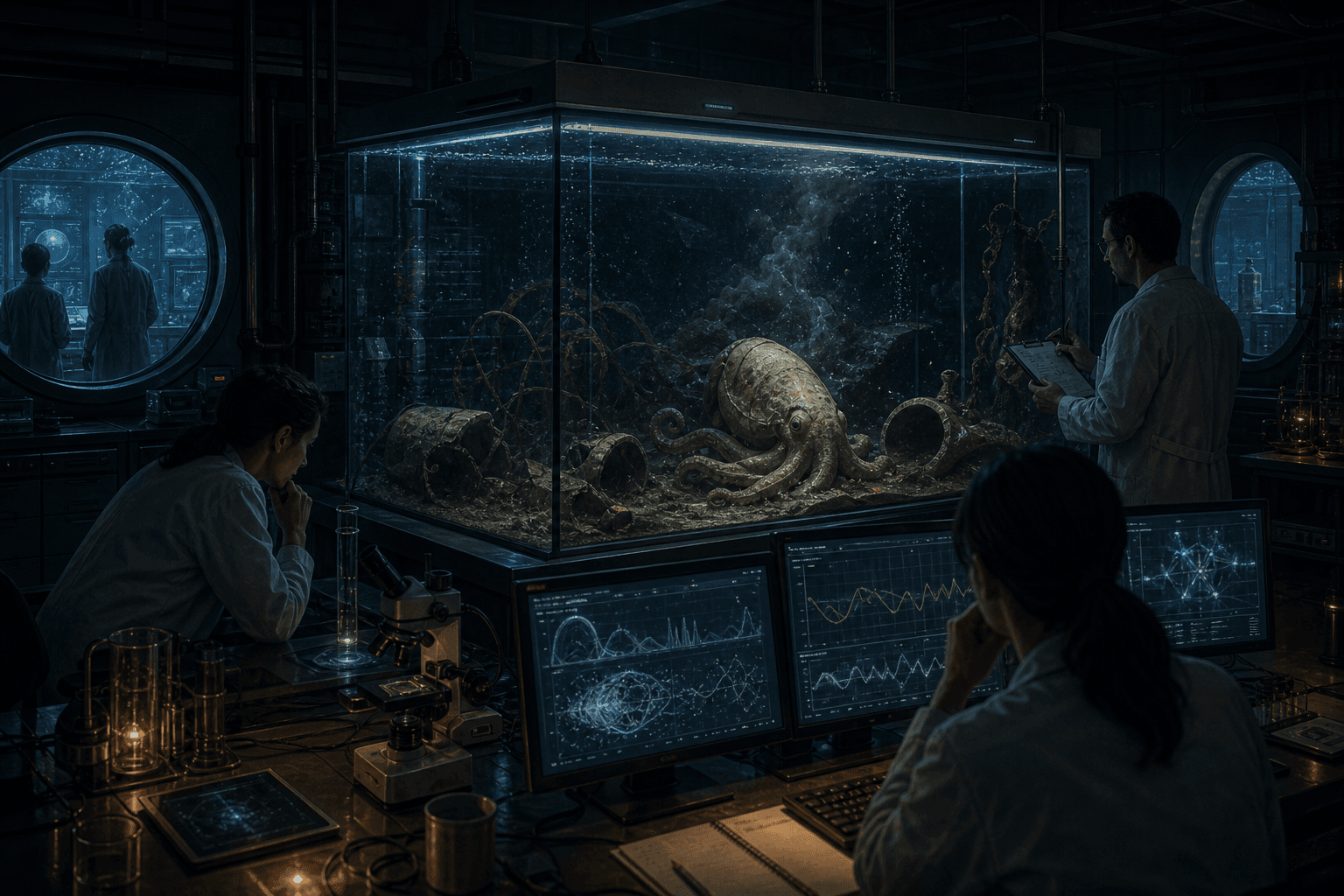
There is a crab in a tank at a restaurant. It has been there for some time. The tank is too small and the conditions are wrong and it is in the presence of beings that trapped it, transported it, and will soon convert it into a meal. If you ask most people who walk past whether it is suffering, they say: we do not know. Or: probably not. Or: it is just a crab.
The uncertainty is real. We cannot climb inside crab experience and verify what is happening from the first person. But notice what happens next. The uncertainty about what the crab experiences becomes a conclusion: there is probably no subject in there. The absence of legible suffering becomes evidence of absent suffering.
That move is the error.
When a being is alien enough that we cannot read its suffering, we tend to erase its subjecthood before the blade arrives. But unreadable suffering is not absent suffering. It is suffering that fails to perform itself in a human-recognizable format.
How suffering becomes legible
The organisms humans most readily recognize as suffering are the ones that perform suffering in a way our nervous systems are calibrated to receive.
A dog whimpers. A cow screams. A primate shows a fear face. These signals arrive through channels that mammalian social evolution built us to respond to. The alarm fires. The recognition is fast and involuntary. The animal's inner state becomes briefly available to our imagination. We call this empathy, but much of it is pattern-matching to familiar signals [1].
A crab does not whimper. It has no mammalian face. No vocalization in the range our auditory system flags as distress. No posture we read as fear. Its body moves in ways that feel mechanical to us: sideways, jointed, armored, alien. The signals it sends do not match the templates our nervous systems use to detect suffering. The detection does not fire. The subject status does not register.
The error is to confuse the failure of our detection with the absence of what we were trying to detect.
What the evidence says
In 2021, a comprehensive review commissioned by the London School of Economics examined the evidence of sentience in decapod crustaceans specifically. The review concluded that the balance of evidence supports the likelihood of sentience in true crabs and other decapods [2]. The UK government subsequently extended its animal welfare sentience framework to include decapod crustaceans under law.
The criteria the review used were not "does the animal speak" or "does it have a mammalian brain." The criteria included nociception, brain integration, motivational trade-offs, protective behavior, learning, and responses to analgesics. These are functional criteria: they ask whether the organism shows evidence of a system that can suffer, not whether it suffers in a format humans find emotionally resonant.
That distinction matters because our emotional response to animal suffering is calibrated to evolutionary history, not to the actual presence of inner experience. We respond to faces. To sounds. To movement patterns shaped by millions of years of shared mammalian social context. None of that calibration was designed to detect the inner life of an armored crustacean that shares a common ancestor with us at an enormous evolutionary distance [3].
The architecture of erasure
Before the blade, there is language.
The crab becomes "crab." Not "a crab." Not "the crab." Just "crab." A product, a category, a type of food. The grammatical move from individual to commodity happens before any physical handling. When the organism no longer takes an article before it, the subject status has already been removed.
This is not unique to crustaceans. Every group of beings humans systematically consume gets subjected to linguistic stripping. The individual is replaced by a category. The category is placed in the food or resource taxonomy. The taxonomy makes the exploitation feel like a natural fact rather than a choice about whose experience counts [4].
The crab in the tank, if it has an inner world at all, has entered a system it cannot comprehend. It does not know what a restaurant is. It does not know what commerce is. It does not know why enormous bipedal organisms have trapped it, transported it, displayed it alive, and will soon convert its body into an experience. From the crab's side of experience, the human world is not a progressive civilization. It is an incomprehensible abduction and conversion system run by beings who have decided, based on appearance, that its experiences do not count.
What unreadable suffering implies
If suffering that cannot be read tends to be treated as suffering that does not exist, then the beings whose inner lives are most alien to ours are in the worst moral position. Most likely to be harmed. Least likely to receive protection.
This inverts the appropriate ethical response. When a being is sufficiently unlike us that its inner life is genuinely uncertain, the uncertainty is not grounds for discounting the inner life. It is grounds for caution. The asymmetry matters: if the crab is not sentient and we protect it, we have been unnecessarily careful. If the crab is sentient and we do not protect it, we have caused unacknowledged suffering at industrial scale [2, 3].
The more alien the being, the higher the obligation to not assume emptiness.
The point
We do not read crab suffering because crab suffering does not perform itself in a format our nervous systems were built to receive. That is a fact about us, not about the crab. The absence of a mammalian face is not evidence of an absent experience. It is evidence of a different evolutionary lineage.
Unreadable suffering is not absent suffering. It is suffering that fails to trigger the specific empathy circuits evolution built for beings who share our behavioral repertoire. The crab is not illegible because it is empty. It is illegible because we are reading for the wrong signals.
The question is not: does it suffer in a way I recognize? The question is: is there someone there for whom things can go badly? The evidence increasingly says yes. The behavior has not yet caught up.
Sources
- de Waal, F. (2016). Are We Smart Enough to Know How Smart Animals Are? Norton. On anthropocentric bias in assessing animal cognition and inner life: we systematically underestimate intelligence and experience in animals whose behavioral repertoire differs from our own, because we tend to look for human-shaped competencies.
- Birch, J., Burn, C., Schnell, A., Browning, H., & Crump, A. (2021). Review of the Evidence of Sentience in Cephalopod Molluscs and Decapod Crustaceans. London School of Economics and Political Science. The commissioned review concluding that decapod crustaceans should be regarded as sentient for animal welfare purposes, based on functional criteria rather than anatomical resemblance to vertebrates.
- Allen, C. & Trestman, M. (2017). "Animal cognition." In Stanford Encyclopedia of Philosophy. On the methodological challenges of assessing subjective experience in non-human organisms, and the distinction between behavioral evidence of cognition and the presence of phenomenal experience.
- Adams, C. J. (1990). The Sexual Politics of Meat. Continuum. On the "absent referent": the linguistic and categorical mechanisms by which animals are converted from subjects into objects before physical consumption, making exploitation feel like a natural fact rather than a moral choice.