
Signal Archaeology
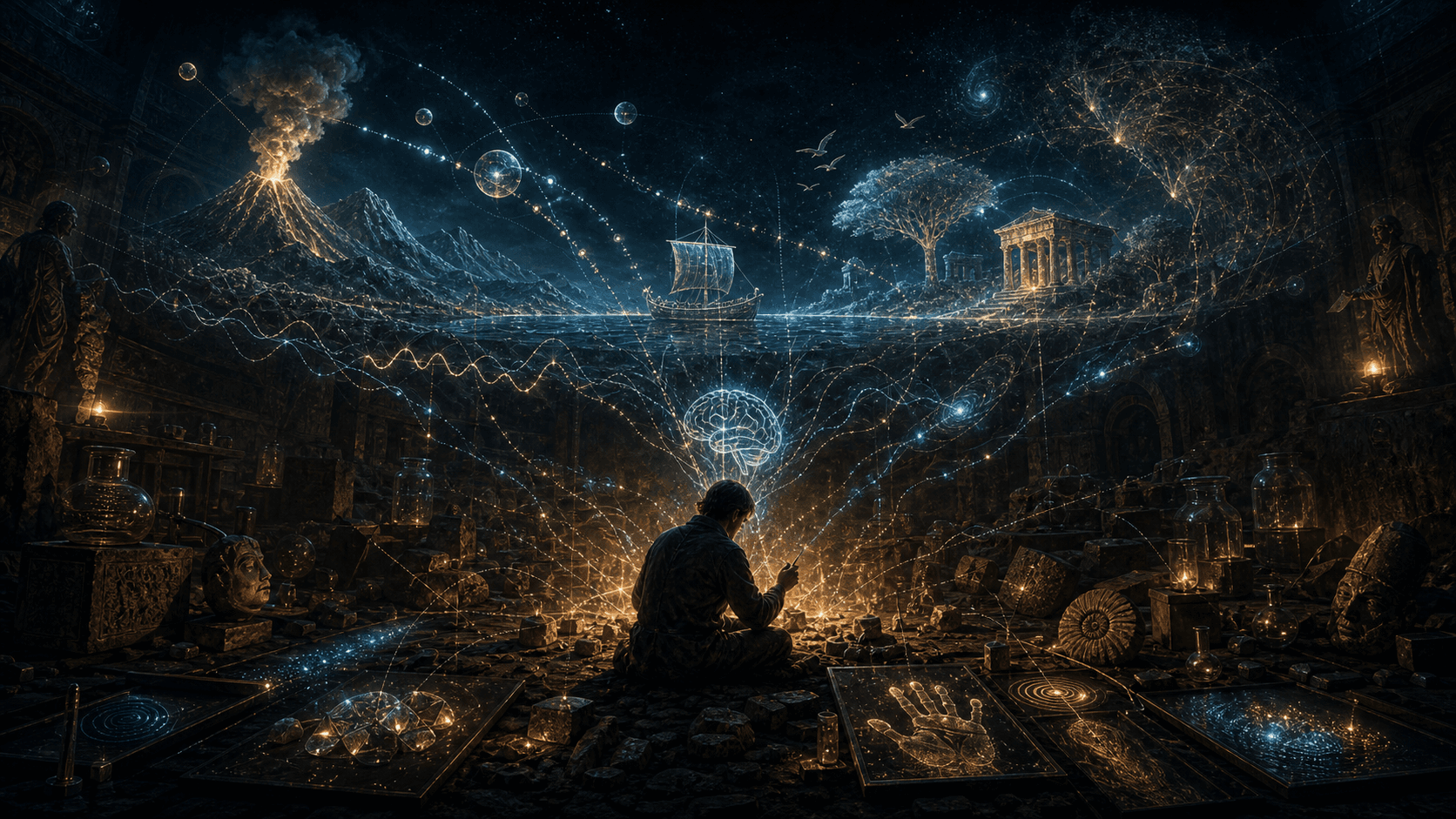
You never touch the world directly. Everything that reaches you arrives as a signal: light reflected off a surface, pressure waves in the air, molecules drifting to the nose, deformation of the skin. The brain does not receive the event itself. It receives evidence of the event, and evidence is always a report about something that has already occurred.
This means perception is a kind of archaeology. The brain is reconstructing reality from delayed traces, assembling a picture of what just happened out of signals that have already left their source. And it does this fast enough that the reconstruction feels like direct, immediate contact with the present.
The brain never receives the event, only its traces, and traces report what has already happened. Perception is reconstruction from delayed signals. The strange part is not the delay. It is that the brain turns delayed reports into a seamless feeling of now.
The world arrives as evidence
Nothing about the external world enters the mind directly. What enters are signals: photons, vibrations, chemicals, mechanical pressure. These are converted by receptors into neural firing, and from that firing the brain builds the experience of a world. At no point does the brain make contact with the thing itself. It makes contact only with the traces the thing sends out [1].
This is true of every sense. Vision is reconstructed from light that has already reflected and traveled. Hearing is reconstructed from pressure waves that have already moved through air. Smell is molecules that have already left their source. In each case, the signal is a report, and a report is always after the fact. By the time the evidence arrives, the event that produced it is already in the past [1, 2].
So perception is never of the present. It is always of the recent past, reconstructed from evidence. The brain is an interpreter of traces, not a window onto the world. What we experience as seeing the world is the brain's reconstruction of what the signals imply.
The delay is biological, not cosmic
The obvious version of this is light delay. We see distant stars as they were long ago, because their light took ages to arrive. It is tempting to think this is the main way we live in the past. But for ordinary life, light delay is negligible. Light from an object a meter away reaches the eye in a few billionths of a second. At human scale, that is effectively instant [2].
The real delay is not in the signal's travel. It is in the brain's processing. After the light arrives, the brain has to convert it, filter it, bind it with other senses, compare it to expectations, and assemble it into a coherent experience. That takes far longer than the light took to arrive: a meaningful fraction of a second, depending on the sense and the task. The pastness of ordinary experience is mostly nervous-system pastness, not light pastness [3].
This matters because it relocates the mystery. We are not meaningfully trapped in the past by the speed of light. We are slightly behind because building an experience takes time. The lag is in the reconstruction, not in the arrival of the evidence. The brain is always working on signals that are already a little stale, not because they traveled far, but because interpreting them takes work [3].
The brain hides the lag by predicting
A brain that simply waited for signals and then slowly assembled them would always be behind, which would be dangerous. So the brain does not merely wait. It predicts. It continuously guesses what the world is doing and what is about to happen, and it uses incoming signals to confirm or correct those guesses rather than to build perception from scratch each time [4].
This is why the experienced present feels seamless and immediate even though it is assembled from delayed reports. The brain stitches together past signal, current body state, and forward prediction into one smooth interface, and it hides the lag so effectively that we never feel ourselves living a fraction of a second behind. The "now" we experience is a controlled construction, synchronized to incoming evidence but leaning forward into what is predicted next [4].
So the experienced present is not the world as it is. It is the brain's best real-time model of what just happened and what is probably happening now, continuously corrected. A dashboard, not the engine. The smoothness of the dashboard is an achievement, not a given: it is the brain compensating for its own delay by predicting past it.
Layers of pastness
Putting this together, ordinary experience contains several layers of pastness stacked on each other. First the event happens. Then the signal travels and arrives, slightly after. Then the brain reconstructs a perception from the signal, taking longer still. Then some residue of that perception is stored as memory. Then the memory is reinterpreted over time [1, 3].
At every layer, we are further from the raw event. Perception is already reconstruction from traces before memory even begins; it is memory-like at the moment it appears, in that it is built from evidence rather than from direct contact. Then ordinary memory adds its own layers of distance and revision on top. Human life is signal archaeology happening fast enough to feel like immediacy, followed by archiving that drifts further from the original with time [1].
None of this makes reality fake. The world is real. But our access to it is always mediated: delayed, translated, compressed, predicted, and stored. We do not live in the raw world. We live in the brain's continuous report about the world, and every report is a report about what has just happened, smoothed into a feeling of what is happening now.
The point
The brain never receives the event, only its traces, and traces always report what has already happened. Perception is therefore reconstruction from delayed evidence, a kind of archaeology conducted fast enough to feel like direct contact. We do not perceive the present. We perceive a reconstruction of the recent past.
The delay is not mainly cosmic. Light is so fast that for ordinary objects its travel time is negligible. The real delay is biological: building an experience out of signals takes processing time, and that is what puts us slightly behind. The brain hides this lag by predicting forward, stitching delayed signal, body state, and anticipation into one seamless interface, so we never feel ourselves living a fraction of a second behind.
The experienced now is not the world itself but the brain's best model of what just happened and what is probably happening next. This does not make reality fake. It means lived reality is always mediated, always a report about the recent past. The mystery is not that we are behind. It is that the brain turns delayed traces into the convincing, seamless feeling of being exactly here, exactly now.
Sources
- Hoffman, D. D. (2019). The Case Against Reality: Why Evolution Hid the Truth from Our Eyes. Norton. On perception as a constructed interface built from sensory evidence rather than direct access to the world, shaped by evolution for usefulness rather than fidelity.
- Eagleman, D. (2011). Incognito: The Secret Lives of the Brain. Pantheon. On the brain's reconstruction of perception from delayed sensory signals, including the way the brain handles the timing differences between senses to produce a unified experience.
- Libet, B. (2004). Mind Time: The Temporal Factor in Consciousness. Harvard University Press. On the measurable delay between sensory stimulation and conscious awareness, establishing that conscious perception lags the event by a significant fraction of a second due to neural processing time.
- Clark, A. (2013). "Whatever next? Predictive brains, situated agents, and the future of cognitive science." Behavioral and Brain Sciences, 36(3): 181-204. On predictive processing: the brain continuously generates predictions and uses sensory signals to correct them, constructing the experienced present as a forward-leaning model rather than a passive readout.