
The Permission Structure of the Dark
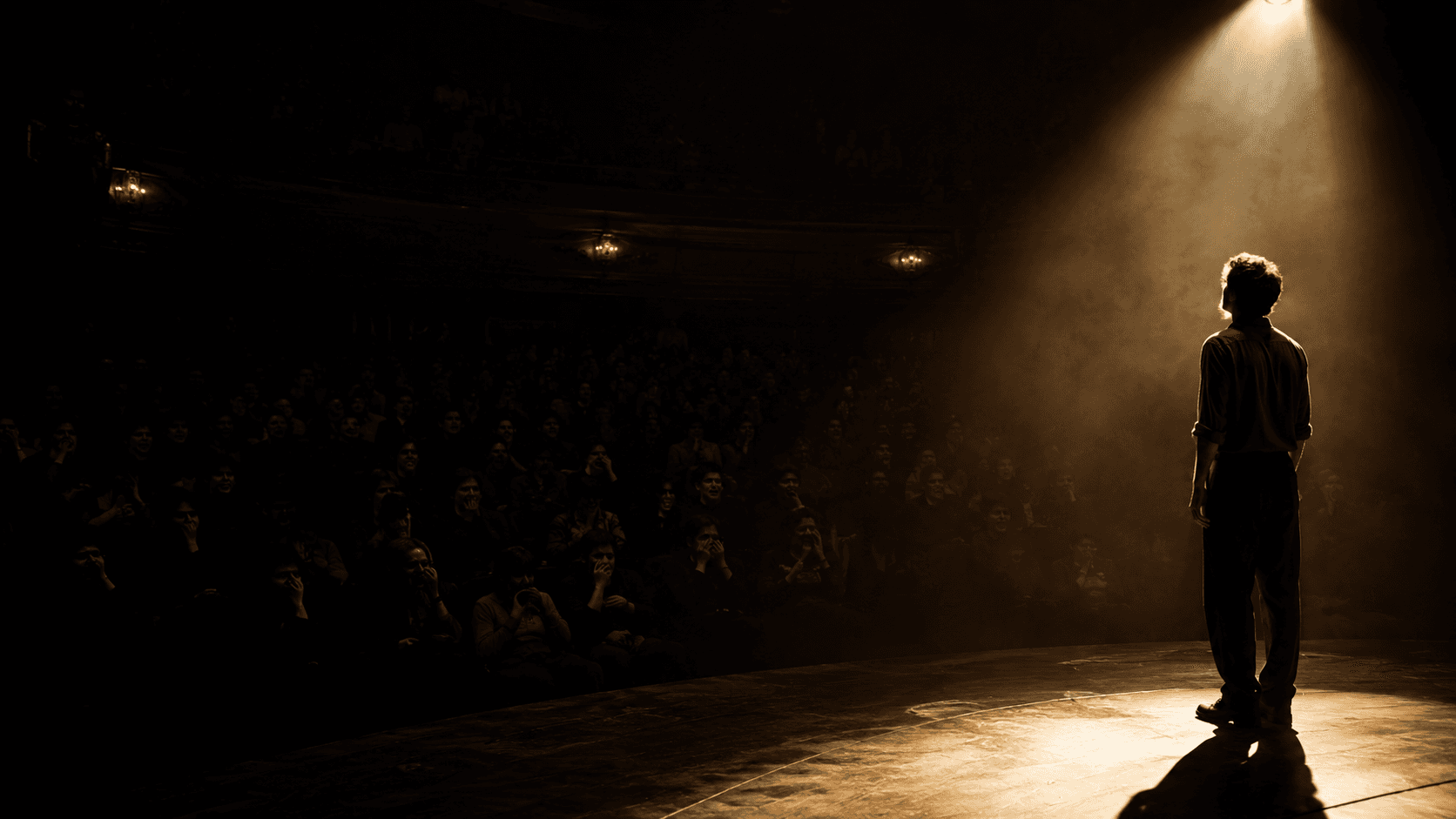
On the asymmetry between the seen and the seeing, and what happens when you remove it
A theater is not a room with a stage in it.
It is a machine for managing who gets to be seen and who gets to hide.
This is the part we almost never examine. We talk about stage fright. We talk about the courage required to stand in the light. But almost nobody looks at what the darkness is doing to the people sitting in it, and how much of what we call "performance" depends on that darkness functioning exactly as designed.
The perceptual contract
When a spotlight falls on a stage, it does not merely illuminate. It issues an instruction: look here. The light designates the focal point. The dark designates everything else, which is to say: the dark designates you.
You are in the darkness by design. Not incidentally. The darkness is not ambiance. It is the load-bearing wall of the entire psychological structure [1].
This contract has two clauses. The first: the performer will be fully seen. The second: the audience will be fully hidden. Both are necessary. Neither works without the other. A theater with the house lights on is not a theater with more light. It is a fundamentally different social situation, one where the contract has been voided and something more anxious and self-conscious has to replace it.
The asymmetry of exposure
Consider what the performer has agreed to. They stand in light specifically designed to eliminate shadow, to reveal expression, to make concealment impossible. Every microreaction is available to hundreds of people simultaneously. The vulnerability is structural, not incidental.
This is part of why live performance feels high-stakes even when nothing real is at risk. The stakes are not external. They are perceptual. To be seen clearly, by a crowd, with nowhere to hide, is one of the oldest human anxieties. The theater does not ask the performer to manage that anxiety. It makes that anxiety the entire point.
Now consider what the audience is not agreeing to.
The person in row G, seat 14, is free in a way that is almost unique in ordinary social life. They can cry without managing the cry. They can laugh at the wrong moment. They can cringe, shift, lean forward, let their face do whatever it is going to do, without anyone tracking it. The dark has granted them something that normal interaction almost never permits: permission to have an unperformed reaction [2].
This is not a small thing. In nearly every other context, responding to something is itself a performance [2]. We modulate our laughter to signal taste. We calibrate our visible emotion to manage how we are perceived. But in the dark, in the crowd, with the attention of the room pulled toward the stage, the self-monitoring apparatus can, for a moment, stand down.
The shame-reduction architecture
There is a specific function the dark performs that almost nobody names: shame reduction at scale [3].
Emotional response in groups is subject to a kind of social auditing. When you laugh out loud, you are briefly exposed. When you cry, you are briefly exposed. When you gasp or groan or cover your eyes, you are briefly exposed. These responses feel safe when you cannot be seen having them. They also feel safe when everyone around you is having them simultaneously. The dark handles both conditions at once. It makes individual exposure impossible and makes collective response feel natural by making everyone equally hidden.
This is why laughing alone at something, even something genuinely funny, never quite replicates the experience of laughing in a room full of people [4]. The shared amusement does amplify amusement, but that is only part of it. Natural laughter is overwhelmingly a social behavior: people are thirty times more likely to laugh in the presence of others than alone [4]. The deeper condition is that unselfconscious response requires the right architecture. You need the crowd, for permission. You need the dark, for cover. And you need the lit focal point, to prevent the crowd from auditing each other [5].
Remove any one of those three elements and the experience degrades in a specific and predictable way.
What happens when comedians break the contract
Comedy is the performance form most dependent on the contract remaining intact [6]. Tragedy can survive a distracted audience. Drama can survive house lights left slightly high. Comedy dies the moment the audience becomes self-conscious.
When the house lights come up, the relationship inverts. The performer is still lit, but now the audience is lit too. The anonymous crowd fractures into a collection of specific, visible, evaluable people. And those people, feeling suddenly seen, revert to performing their reactions rather than simply having them. The laughter doesn't just change register. It changes kind. It becomes a social act instead of a reflex.
Some performers exploit this deliberately. Andy Kaufman understood the asymmetry so well that he used house lights as a weapon, forcing the audience into the exposed position to generate the specific discomfort he was after. But this works only because it violates the contract. The disruption is the point, which proves the contract was the baseline.
The deeper structure
There is something philosophically interesting happening in any theater that the architecture makes easy to miss.
The performer and the audience have, for the duration of the show, agreed to radically different relationships with being seen. The performer has consented to total exposure. The audience has been granted total concealment. And the entire experience, the laughter, the catharsis, the sense of being part of something, depends on that asymmetry holding.
The moment it collapses, both sides lose something essential. The performer loses the protective distance of being observed rather than confronted. The audience loses the freedom of being receivers rather than participants.
What we call "going to the theater" is agreeing to inhabit an asymmetry: one person fully illuminated, a hundred people fully hidden, the whole arrangement held in place by the simple, powerful fact of where the light falls.
The light is doing more work than we give it credit for. It is not just showing us where to look. It is deciding who has to be brave and who gets to be free.
Most of the emotional power of live performance lives in that gap. The performer and the audience are in the same room, but they are not in the same situation at all. One of them is fully seen. One of them is fully hidden. And both of them feel something they could not feel alone.
That asymmetry is the whole thing.
Sources
- Schechner, R. (1988). Environmental Theater. Applause Books. On the spatial politics of performance: how the arrangement of light, shadow, and audience positioning actively constructs the terms of the theatrical event rather than merely framing it.
- Goffman, E. (1959). The Presentation of Self in Everyday Life. Doubleday. The foundational account of frontstage and backstage behavior: the argument that ordinary social life is continuous performance, and that rare "backstage" conditions, where the performance obligation lifts, are structurally distinct from everyday interaction.
- Zimbardo, P. G. (1969). "The human choice: Individuation, reason, and order versus deindividuation, impulse, and chaos." Nebraska Symposium on Motivation 17: 237-307. On deindividuation: the psychological state in which anonymity within a group reduces self-monitoring, social inhibition, and the awareness of individual accountability, allowing responses that the visible individual would suppress.
- Provine, R. R. (2000). Laughter: A Scientific Investigation. Viking. Systematic observational study establishing that laughter is fundamentally social: people laugh approximately thirty times more often in social contexts than alone, and that the function of laughter is primarily relational rather than simply a response to humor.
- Dezecache, G., & Dunbar, R. I. M. (2012). "Sharing the joke: the size of natural laughter groups." Evolution and Human Behavior 33(6): 775-779. On the natural clustering of laughter in groups and the role of co-present others in triggering and sustaining laughter, with implications for the social architecture of comedy performance.
- Martin, R. A. (2007). The Psychology of Humor: An Integrative Approach. Academic Press. Comprehensive review of the social psychology of humor, including the role of shared context, audience awareness, and the fragility of the comedic frame under conditions of heightened self-consciousness.