
Theories
88 entries in Structure

Insight Is Not Judgment
A person can be deeply reflective, spiritually open, articulate about ego and consciousness, and still act in ways that create real consequences. Insight expands perception. It does not automatically produce restraint, calibration, or judgment.

Come Into the Room
When someone shares deeply, they are not only transferring information. They are inviting you into their reality, asking you to stand inside it and feel its weight. The deepest form of being heard is not being understood. It is being entered.
Mass Trauma Becomes Atmosphere
When a society routes its young people at scale through a shared institution built on threat, hierarchy, and suppression, private trauma aggregates into a collective emotional grammar. The nervous system gets trained for survival, not reception.

The Fake Delay
"Not now" has two opposite meanings in the same words. A real delay names a return path. A fake delay has none. Deferred interest only counts as interest if it returns. Otherwise it was avoidance wearing the costume of future availability.

Facing the One Who Must Change
Aspiration needs an orientation point, so we face outward: toward the sky, the ideal, the authority. But the site of the change is inside the one who asks. Facing outward can become a way of outsourcing the transformation away from the self that must enact it.
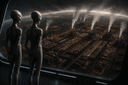
The Flesh Economy
The most terrifying feature of any dystopia is not its cruelty. It is that the people living inside it consider it normal. We were born calibrated to a system that runs on suffering. The horror is structural. It is the ground we stand on, not a thing we observe.

Acknowledgment and Advice Are Different Currencies
When someone brings an observation of their pain, they are often asking for recognition, not a solution. But the reflex is to offer meaning, teaching, or a fix. These feel like help to the giver and like deflection to the receiver.

Recognition Is Not Revelation
It didn't tell me anything I didn't already know

We Have Not Passed Level One
The Kardashev scale ranks civilizations by how much energy they control: planet, star, galaxy. Humans debate it with great seriousness. We are currently ranked below Type I. We have not yet mastered our own planet. We are arguing about the galaxy.

Elon Musk Is Not a Person
Trying to understand Elon Musk as a human being keeps producing contradictions. Trying to understand him as a process running on a human substrate stops producing them. The unusual thing about him is not what he believes or who he is. It is what he is for.
Kill Tony Is Not a Comedy Show
The format looks like stand up. The lighting looks like stand up. The audience laughs. But what is actually happening on that stage is closer to a public initiation rite than to comedy, and the fact that almost no one calls it that is part of why it works.
There Is No Humane Way to Eat
The body needs to take in organic matter to keep running. Organic matter only comes from things that were alive. There is no clean version of this transaction, and pretending otherwise is one of the small lies we have to tell ourselves to function.

The Infinite Is Not for Us
The brain is a finite organ built to count finite things. Asking it to comprehend the infinite is like asking a ruler to measure a color. The tool is honest. The category is wrong.

The Universe Is Fractal
The same patterns repeat at every scale, from galaxies to neurons to river deltas to the branching of your own lungs. This is not coincidence and it is not metaphor. It is a clue about what the universe is actually doing.
The Obviousness Trap
When something's value is self-evident to you, that obviousness makes you worse at transferring it. Because you already see the worth, you cannot see why others do not, so you skip the work of building their desire for it.
Ideals Are Weaker Than Patterns
A group's real character is revealed by its repeated interaction patterns, not its stated values. Ideals function as aspiration and branding. The enacted behavior is the operational reality, and the gap between the two is the thing to measure.

Hard to Absorb
When a room opens for one person and closes for you, the mind reads it as rejection. But there is a distinction between being disliked and being harder to casually absorb. A presence that seeks depth carries more weight, and low-demand settings retreat from it.
Depth Requires a Container
Deep understanding rarely happens by accident. Interaction drifts toward convenience and familiarity. Sustained depth needs a container: therapy, mentorship, ritual, interview, retreat. Depth is a structural achievement, not just a matter of intention.

The Invisible Gates
Communities describe themselves as open and welcoming. But actual access is regulated by informal mechanisms: language, familiarity, social confidence, cultural literacy, timing, status, shared history. These invisible gates govern entry more than the official rules.

Attention Is the Body of Care
Care is discussed as an emotion, a value, an intention. But care becomes observable only through attention: time spent listening, remembering, noticing, asking, staying present. Without attention, a claim of care cannot be verified, because attention is its body.

Proximity Is Not Connection
We infer connection from shared space: homes, workplaces, congregations, communities. But proximity and connection are distinct. People can spend years in close association and remain psychologically unknown to each other. Connection is measured by understanding, not co-location.
Source, Translator, Container
A living body of knowledge needs three functions: a source that preserves depth, a translator that makes it accessible, and a container that makes it socially legible. Missing any one distorts the whole, and each distortion has a recognizable shape.

The Container Precedes the Idea
Ideas are received according to what carries them, not only their truth. The same insight is dismissed from a lone individual and revered through a lineage. Scaffolding arrives before the idea and frames it as worth attention, or leaves the bearer to earn it every time.
Depth Before the Container
New material often outruns the container needed to hold it, so depth arrives raw and unplaced and reads as intensity rather than knowledge. A founder must build concept, vocabulary, legitimacy, and usefulness at once, which is why new systems need staged legitimacy.
The Bridge and the Custodian
A system needs two opposite figures. The custodian keeps it intact and risks enclosure. The bridge carries it to outsiders and risks betrayal. Each role's virtue is the other's danger, and a healthy system holds both in tension rather than choosing one.
The Open Loop
A bad outcome hurts. An unresolved outcome consumes. An open possibility keeps drawing energy precisely because it is still open. This is why closure, even unhappy closure, releases a surge of energy. The drain was never the bad news. It was the not-knowing.

Bridge or Substitute
Some people meet uncertainty by building structure: maps, models, frameworks, documents. This is a real strength with a hidden fork. The artifact can be a bridge toward connection, or it can quietly become a substitute for the connection it was meant to create.

Priority Is the Proof
Caring about someone and reorganizing around them are two different questions with different evidence. You can receive abundant proof of the first while starving for the second. If something is important, people make room for it, and what they make room for is the real signal.
The Maintenance Channel
A relationship can be richly present in one register and absent in another. The maintenance channel of logistics and concern can run for years while the witnessing register fails every time. Contact quantity is not depth-capacity, and the volume hides the mis-tuning.

The Witness Becomes the Defendant
You need someone as a witness. Under pressure they become a manager, offering advice and reassurance. So you become a prosecutor, forcing accountability. That makes them a defendant. And once they are a defendant, the witness you needed is gone.