
There Is No Humane Way to Eat
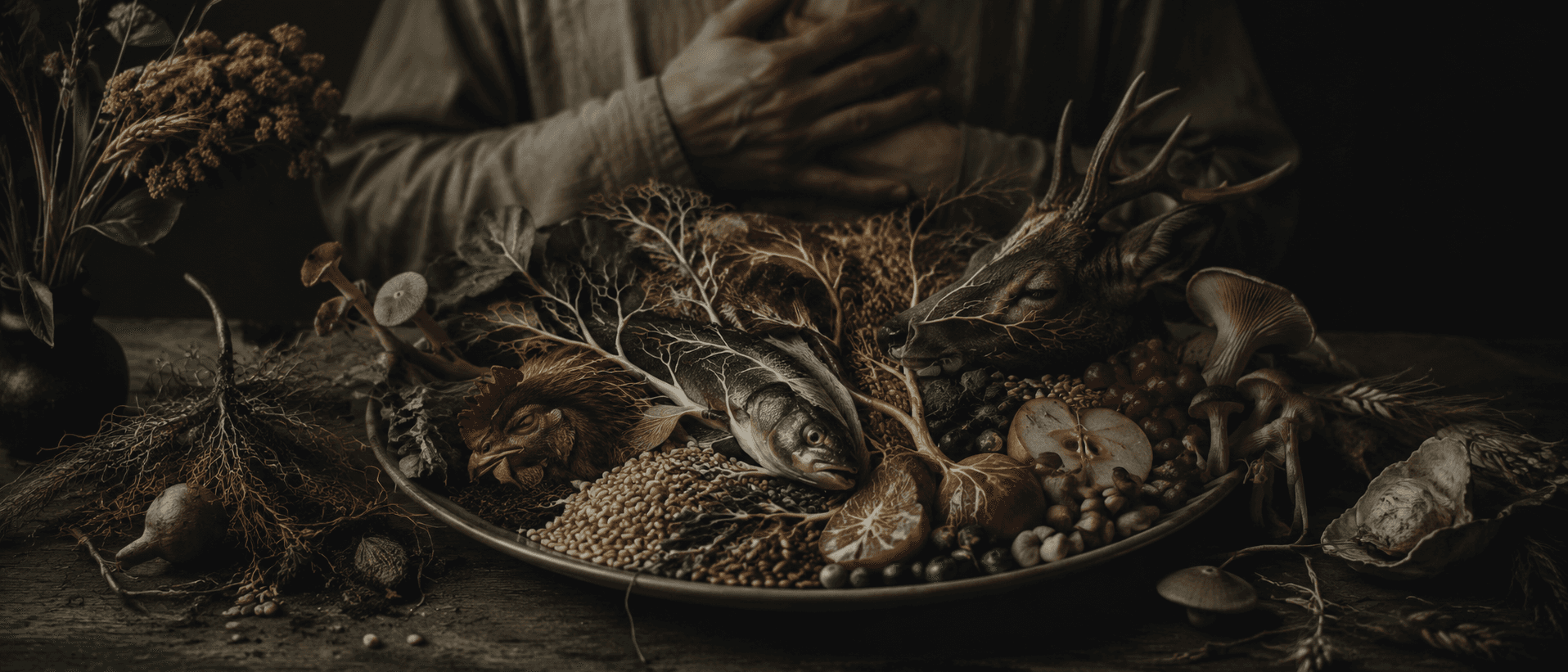
The polite version of the story is that some food is ethical and some food is not. Eat plants and you are clean. Eat animals and you are dirty. The polite version is comforting, easy to talk about at dinner, and not really true at the level the body actually operates on.
Every meal is a transfer of organic matter from a thing that was alive to a thing that wants to keep being alive. There is no honest version of that transfer that does not involve a cost on the giving side.
Start from the constraint. Your body is built from molecules that have to come in from outside. They cannot be conjured from sunlight, the way a plant does it. They cannot be conjured from rocks, the way some bacteria do. They have to come in already organized, already part of a living or recently living structure. That structure is the body of something that, until recently, was running its own life.
This is true whether the something is a cow, a fish, a mushroom, a head of lettuce, or a grain of rice. All of them were organisms. All of them were doing something. All of them stopped, in part because you were going to eat them. Calling some of those stops gentle and others brutal is mostly a story we tell to make the necessary feel optional.
What we know about plants
The comfortable story leans hard on the assumption that plants do not feel anything. The science is no longer cooperating with that assumption. Plants have electrical signaling systems that respond to damage [2, 5]. They release chemical alarm signals to neighboring plants when they are wounded [3]. They alter their growth in response to repeated injury [1]. They produce stress hormones. When a leaf is cut, the plant's whole body responds, in measurable ways, with what looks structurally like a pain signal [2, 5].
It is true that plants do not have brains, and so whatever they are experiencing, if they are experiencing anything, is not pain in the way you or a dog experiences pain. But that is a different statement than "they feel nothing." We do not actually know what they feel. We know that they react. We know that the reactions are organized, selective, and responsive to context [3, 6]. We know that they prefer to remain intact. The honest position is not that plants are clean to eat. The honest position is that plants might also be paying a cost we have not bothered to measure, because measuring it would be inconvenient.
Where the story breaks
So now you are stuck. You cannot run your body without organic matter. Organic matter only exists inside organisms. Organisms, all of them, in their own way, prefer to keep being organisms. Every meal is, at some level, a transfer of life from something that was using it to you, who needs it. There is no escape route. Vegan, omnivore, raw, cooked, foraged, farmed, every option lands in the same structural place. Something that was alive is now in your stomach. The differences between options are real and matter, but they are differences in cost, not the elimination of cost.
The closest thing to a clean meal would be eating something that was already dead of natural causes and would have decomposed otherwise. Even there, you are competing with the bacteria and fungi that would have eaten it instead. They were also alive. Their meal is now your meal.
Why this matters
It is tempting to read this as either nihilism or as a permission slip. Neither is right. The point is not "since you cannot win, eat whatever you want." The point is "since you cannot win, stop pretending the goal is winning." The goal is not to find a meal with no cost. The goal is to relate honestly to the meal you actually eat.
Honest relation looks like this. You acknowledge that the food in front of you was something. You take more than you need only when the taking is itself part of a larger sustaining cycle. You waste as little as you can, because waste is the part where the cost is paid and nothing is given back. You eat with attention, because eating with attention is one of the only ways to register, in your own body, that an exchange just happened. You stop using your diet as a moral identity, because moral identity is what makes the topic too charged to think about clearly.
The point
There is no meal that does not require a death. There is no body that does not require meals. Therefore there is no version of being a living human that does not, daily, ride on the deaths of other living things. This is not an indictment of humans. It is an indictment of the fantasy that we get to be alive without anything paying for it. Once you stop asking for that fantasy, eating becomes a different kind of activity. Less righteous, more grateful, much more aware. It is not clean. It is just real. And being real about it is the only thing that comes close to honoring the cost.
Sources
- Gagliano, M., Mancuso, S., & Robert, D. (2012). "Towards understanding plant bioacoustics." Trends in Plant Science 17(6): 323-325.
- Karban, R. (2015). Plant Sensing and Communication. University of Chicago Press. Survey of plant signaling and damage response.
- Trewavas, A. (2014). Plant Behaviour and Intelligence. Oxford University Press.
- Wohlleben, P. (2016). The Hidden Life of Trees. Greystone. Popular synthesis of plant communication research.
- Chamovitz, D. (2012). What a Plant Knows. Scientific American/Farrar, Straus and Giroux.
- Simard, S. (2021). Finding the Mother Tree. Knopf. On forest-wide signaling networks.