
The Bridge and the Custodian
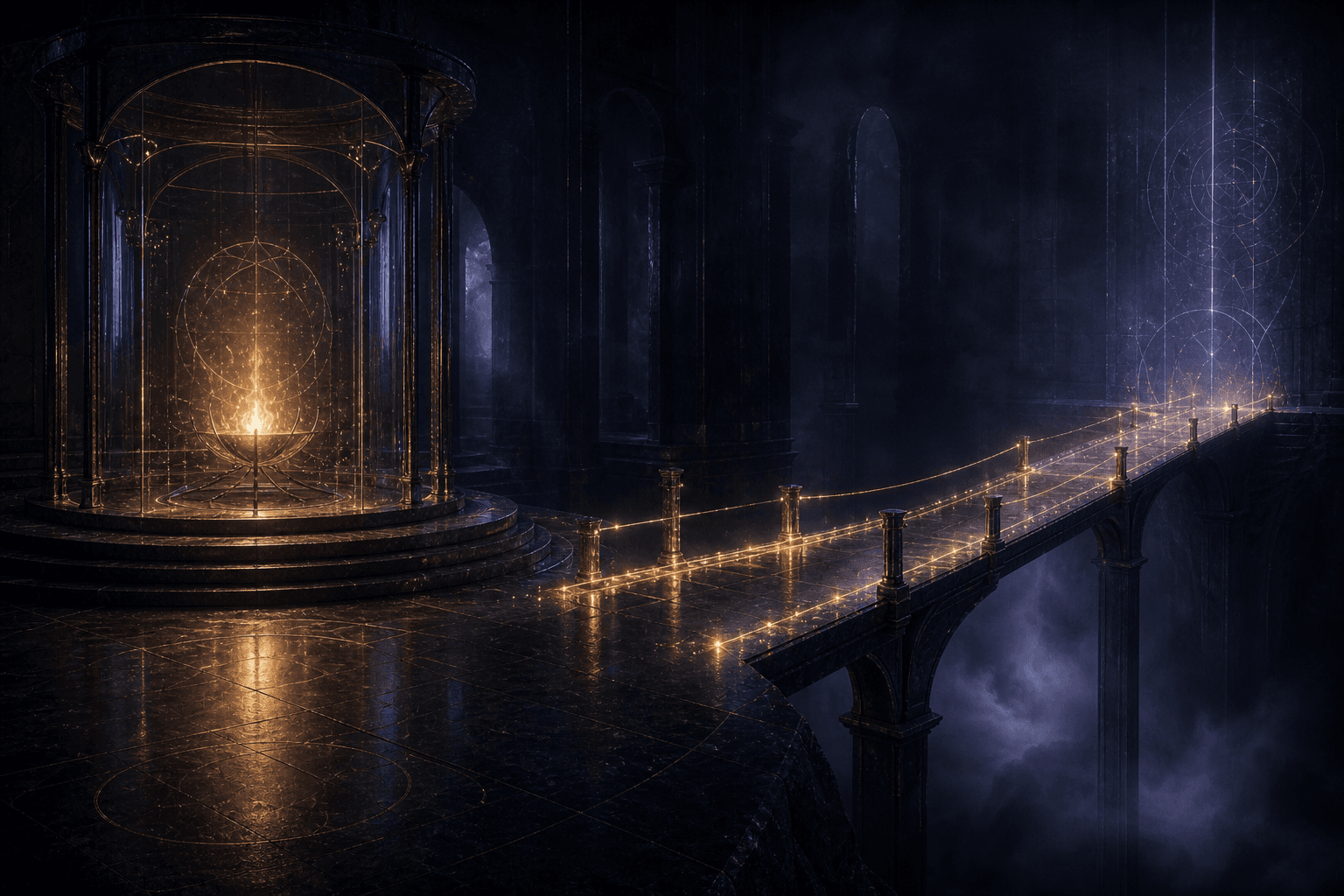
Every enduring body of knowledge is pulled in two directions at once. One pull is toward preservation: keep it intact, protect its precision, do not let it be watered down. The other is toward reach: carry it to people who do not already have it, make it accessible, build bridges across the distance. These pulls are handled by two different kinds of figure, and the two are natural adversaries even when they serve the same system.
The custodian keeps the system intact. The bridge carries it outward. Each is necessary, each has an opposite characteristic failure, and a healthy system does not choose between them but holds both in a productive tension. Understanding the two figures, and their opposite dangers, is understanding how a system survives without either fossilizing or dissolving.
A system needs a custodian to keep it intact and a bridge to carry it outward. The custodian risks enclosure, the bridge risks betrayal. Each role's strength is the other's weakness, and a living system holds both rather than collapsing into one.
The custodian
The custodian's task is to protect the depth of a system from erosion, simplification, fashion, and opportunistic translation. The custodian is the guardian of the source: valuing precision, vocabulary, fidelity to the original, disciplined method, repetition, and continuity. Their orientation is inward and backward, toward keeping the system faithful to what it actually is [1].
The custodian's virtue is preservation. Without the custodian, a system drifts, softens, and loses its distinctions, degrading a little with each careless handling until its depth is gone. The custodian holds the line, insisting on the precise term, the difficult distinction, the disciplined method, refusing the pressure to simplify for popularity. This is genuinely necessary work: it is what keeps a system from thinning into vague inspiration [1, 2].
But the custodian's virtue carries a characteristic danger: enclosure. A custodian oriented entirely toward fidelity can make the system so internally faithful that it loses contact with the outside, with new seekers, new forms of pain, new historical conditions. The system becomes perfectly preserved and perfectly sealed, intact and unreachable. The custodian keeps the fire, but may not know how to carry it into the street, and a fire that never leaves the room eventually warms no one [2].
The bridge
The bridge's task is the opposite: to carry the system to an outside population that does not already have it. The bridge is bilingual in a deep sense, fluent in the internal language of the source and fluent in the emotional, conceptual, and practical needs of the receiving world. Their orientation is outward, toward the people on the far side of the distance, and their work is to make the foreign feel intimate [2, 3].
The bridge's virtue is reach. Without the bridge, a system stays sealed inside its own language, accessible only to those already initiated, unable to meet anyone new. The bridge translates, finds entry points, connects the system's depth to the actual concerns of outsiders, and makes accessible what would otherwise remain closed. This too is genuinely necessary: it is what lets a system meet the people it could serve [2, 3].
But the bridge's virtue carries the opposite danger: betrayal. A bridge oriented entirely toward reach may over-adapt, smoothing away the parts of the system that resist easy consumption in order to make it land. In trying to reach outsiders, the bridge can dilute the very depth it was carrying, until what crosses the bridge is no longer the system but a palatable substitute. The bridge succeeds only when accessibility does not become betrayal, when the foreign is made intimate without being made false [3].
Opposite virtues, opposite dangers
The crucial structure is that the two figures' virtues and dangers are mirror images. The custodian's virtue, fidelity, taken too far becomes the custodian's danger, enclosure. The bridge's virtue, accessibility, taken too far becomes the bridge's danger, betrayal. Each figure fails by an excess of its own strength, and each figure's excess is precisely what the other figure guards against [1, 3].
This means the two are not simply complementary specialists who could work in isolation. They are correctives to each other's failure modes. The custodian's insistence on fidelity is the check on the bridge's tendency to over-adapt; the bridge's insistence on reach is the check on the custodian's tendency to enclose. Remove either and the other's danger runs unchecked: a system of pure custodians fossilizes, a system of pure bridges dissolves. They need each other not despite their opposition but because of it [1, 2, 3].
So the tension between them is not a problem to be solved but a balance to be maintained. The custodian and the bridge will naturally be in friction, because they want opposite things, and that friction is the system's self-correction working. When one side wins completely, the system fails in that side's characteristic way. The health of the system lives in the unresolved tension, where fidelity and reach continuously check each other [1, 3].
Holding both
The practical consequence is that a healthy system does not choose between the custodian and the bridge but deliberately holds both, and resists the temptation to eliminate the friction between them. The friction is uncomfortable, and there is always pressure to resolve it, to declare that fidelity matters most and purge the bridges, or that reach matters most and dismiss the custodians as obstacles. Both resolutions are failures, because both remove a necessary corrective [1, 3].
This also clarifies a common misjudgment: custodians disdaining bridge-work as shallow, and bridges dismissing custodianship as rigid. Each sees the other's virtue as a vice, because each is oriented toward the opposite pole. But the disdain is a category error. The bridge is not shallow for making things accessible; that is its necessary function. The custodian is not rigid for insisting on fidelity; that is its necessary function. Each is doing the job the system requires, and the job looks like a flaw only from the other's vantage [2, 3].
So the system that survives is the one that houses both figures, honors both functions, and keeps them in tension rather than letting either win. It needs someone guarding the depth and someone carrying it outward, someone who will not simplify and someone who will translate, and it needs them to keep checking each other. A single figure occasionally holds both roles, switching between them deliberately, but even then the two orientations must be kept distinct, because the moment they blur, one danger or the other begins to win.
The point
Every enduring system is pulled toward preservation and toward reach, and these pulls are handled by two opposite figures. The custodian keeps the system intact, valuing fidelity, precision, and continuity; the bridge carries it to outsiders, valuing accessibility, translation, and relevance. Both functions are necessary: without the custodian a system thins into vague inspiration, without the bridge it stays sealed and meets no one new.
The two figures' virtues and dangers are mirror images. The custodian's fidelity, in excess, becomes enclosure, a system perfectly preserved and perfectly sealed. The bridge's accessibility, in excess, becomes betrayal, a system so adapted that what crosses over is no longer itself. Each fails by an excess of its own strength, and each figure's excess is exactly what the other guards against, which makes them correctives to each other rather than merely complementary.
So the tension between them is not a problem to solve but a balance to maintain: the friction is the system's self-correction working, and whenever one side wins completely the system fails in that side's characteristic way. A healthy system therefore holds both, honors both functions, and resists the disdain each figure feels for the other, because the bridge is not shallow and the custodian is not rigid. Each is doing the job the system requires. Survival lives in the unresolved tension between keeping the fire and carrying it into the street.
Sources
- Douglas, M. (1966). Purity and Danger. Routledge. On the impulse to preserve the integrity and purity of a system's boundaries and categories, and the tension between maintaining internal order and engaging what lies outside it.
- Berger, P. L. & Luckmann, T. (1966). The Social Construction of Reality. Anchor Books. On the roles that maintain and transmit a body of knowledge, including the specialists who preserve tradition and those who mediate it to wider populations, and the tensions between them.
- Geertz, C. (1973). The Interpretation of Cultures. Basic Books. On cultural translation and the work of rendering one world intelligible to another, including the risk that making a system accessible across distance distorts the depth being conveyed.