
Mass Trauma Becomes Atmosphere
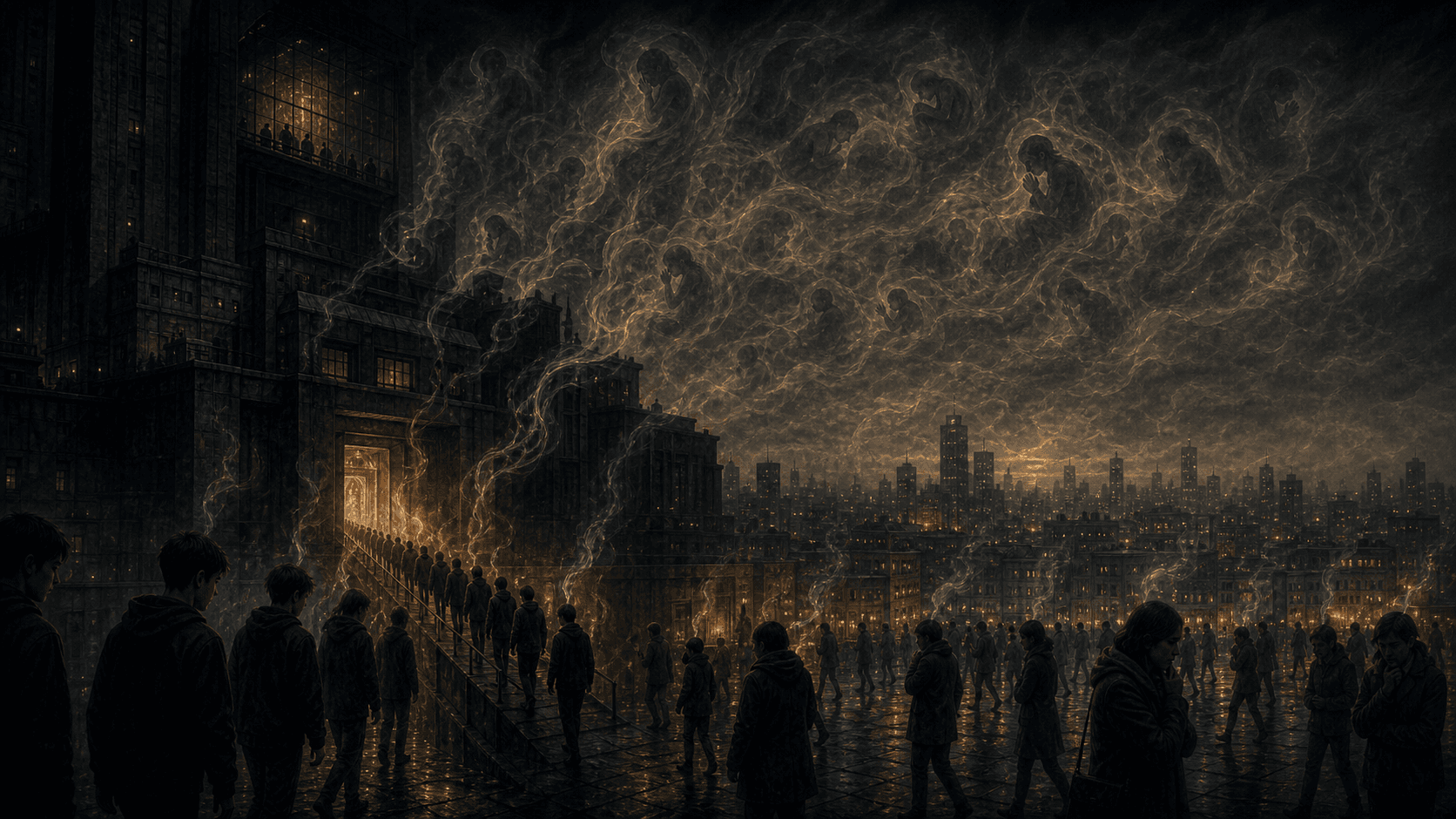
You meet people from a particular society and notice a shared quality in how they carry themselves: a certain toughness, a scanning alertness, a compression around vulnerability, more comfort in groups than in soft one-on-one depth. It is not any one person's personality. It is too consistent for that. Something in the society itself seems to have shaped a common emotional baseline.
One mechanism that produces this is the mass routing of young people through a shared institution built on threat, hierarchy, and emotional suppression. When most of a generation passes through the same intense formative structure, the trauma does not stay individual. It aggregates into an atmosphere the whole society breathes.
When a society routes its youth at scale through a shared institution of threat and suppression, private trauma aggregates into a collective emotional grammar. Even those not consciously traumatized inherit a baseline trained for survival rather than reception.
From individual trauma to collective grammar
We usually think of trauma as individual: a particular person carrying the marks of a particular experience. But when a formative institution processes a large share of a generation, something happens that individual-level thinking misses. The experience becomes shared, and shared experience at scale does not just produce many separate trauma cases. It produces a common set of learned dispositions that the whole society comes to hold [1].
A demanding formative institution teaches a specific set of adaptations: scan for danger, trust your unit, be fast, be tough, do not over-explain, do not collapse, do not indulge softness, keep moving, keep functioning. These are adaptive inside the institution's reality. But when most of a generation learns them at the same developmental threshold, they do not stay confined to that reality. They are carried out into ordinary social life and become part of how the society at large operates [1, 2].
The result is that the institution becomes more than an institution. It becomes an emotional grammar: a shared, largely unspoken system for what strength is, what weakness is, who has paid the price, who is naive, who is serious, who is too much. This grammar is held collectively, by people who went through the institution and, through them, by the society they shape. It becomes the ambient emotional language, not a private condition [2].
The baseline shifts
The key consequence is that the society's emotional baseline moves. It is not that everyone is visibly traumatized. Many people come through such institutions bonded, matured, competent, even emotionally deepened. The point is not universal damage. It is that the center of gravity of the whole emotional field shifts toward the adaptations the institution taught [1, 3].
When threat-awareness, toughness, speed, loyalty, and suppression are trained into a large share of the population at a formative age, those qualities become the normal, the default, the assumed. Softness, slowness, open vulnerability, and unhurried emotional exploration become the marked cases, the exceptions that stand out against a baseline organized around survival. The society does not have to decide to value these things. The mass formation makes them the water everyone swims in [2, 3].
This is why the shared quality you notice in people from such a society is not reducible to individual personalities. It is a baseline effect. Each person is somewhat different, but they are all deviations around a common center, and the common center was set by the shared formative institution. You are not only meeting individuals. You are meeting, through individuals, the residue of a collective machine [1].
Survival crowds out reception
The specific cost of this baseline shows up most in intimacy. The adaptations that a threat-based institution trains are survival adaptations, and survival and reception are different, partly opposed, modes of the nervous system [3].
A nervous system trained for survival is oriented outward and defensively: scanning, assessing, staying ready, not dropping its guard, not lingering in states that would slow response. Reception, the capacity to be present with another person's inner world, to be curious about it, to let it land and stay a while, requires the opposite: lowering the guard, slowing down, tolerating softness, being unhurried. A system tuned for the first is not tuned for the second, and may experience the second as inefficient, excessive, or even unsafe [3].
So when survival adaptations become the collective baseline, ordinary intimacy becomes harder across the society, not because people do not want connection, but because the nervous system was trained for a different task. There can be less patience for vulnerability, less curiosity about another's interior, more comfort with the group than with deep one-on-one contact, a tendency to treat emotional complexity as something to be managed or bypassed rather than entered. The training for survival crowds out the capacity for reception [2, 3].
Holding the pattern without flattening it
This kind of analysis has to be held carefully, because it is easy to turn into a crude verdict on a whole population. That would be a misuse of it. The claim is structural, not a judgment about individuals. Any given person may be reflective, tender, emotionally deep, or shaped in non-obvious directions by the same institution. The baseline is a center of gravity, not a description of everyone [1, 3].
The accurate version is narrower and more useful. It says: a mass formative institution built on threat and suppression exerts a real pull on a society's emotional baseline, and that pull is detectable as a shared tendency, while remaining fully compatible with enormous individual variation. When you sense a common quality in people from such a society, you may be detecting the pull, not defining the people. The structure is real; it does not erase the individuals moving within it [1].
This distinction matters because it keeps the observation honest. The residue of a collective machine can be present inside individuals without the individuals being reducible to it. Naming the structural pull explains a real pattern without flattening the people who carry it into that pattern alone.
The point
Trauma is usually thought of as individual, but when a society routes a large share of its young people through the same intense formative institution, built on threat, hierarchy, and emotional suppression, the trauma does not stay individual. It aggregates into a collective emotional grammar: a shared, largely unspoken system of what strength and weakness are, held by the whole society through the generation that passed through the institution.
The effect is a shift in the emotional baseline. Not universal damage, but a move of the whole field's center of gravity toward the adaptations the institution taught: scanning, toughness, speed, loyalty, suppression. Those become the default, and softness and open vulnerability become the marked exceptions. This is why a shared quality can be sensed in people from such a society; it is a baseline effect, not a sum of personalities.
The deepest cost appears in intimacy, because survival and reception are opposed modes of the nervous system, and a baseline trained for survival crowds out the capacity for reception. This must be held as a structural pull, not a verdict on individuals, who vary enormously within it. Mass militarization, and any comparable mass formation, turns private trauma into public atmosphere: even those who were never consciously wounded end up breathing an air organized around survival rather than around being received.
Sources
- Alexander, J. C. et al. (2004). Cultural Trauma and Collective Identity. University of California Press. On how trauma operates at the collective level, becoming embedded in a group's shared identity and emotional life rather than remaining a set of individual injuries.
- Elias, N. (1939). The Civilizing Process. Blackwell. On how the institutions a society routes its members through shape a shared emotional and behavioral structure, producing a collective "habitus" that individuals carry without conscious choice.
- van der Kolk, B. (2014). The Body Keeps the Score. Viking. On how trauma trains the nervous system toward threat-detection and defensive readiness, and how these survival adaptations impair the capacity for calm, open, receptive connection with others.