
We Have Not Passed Level One
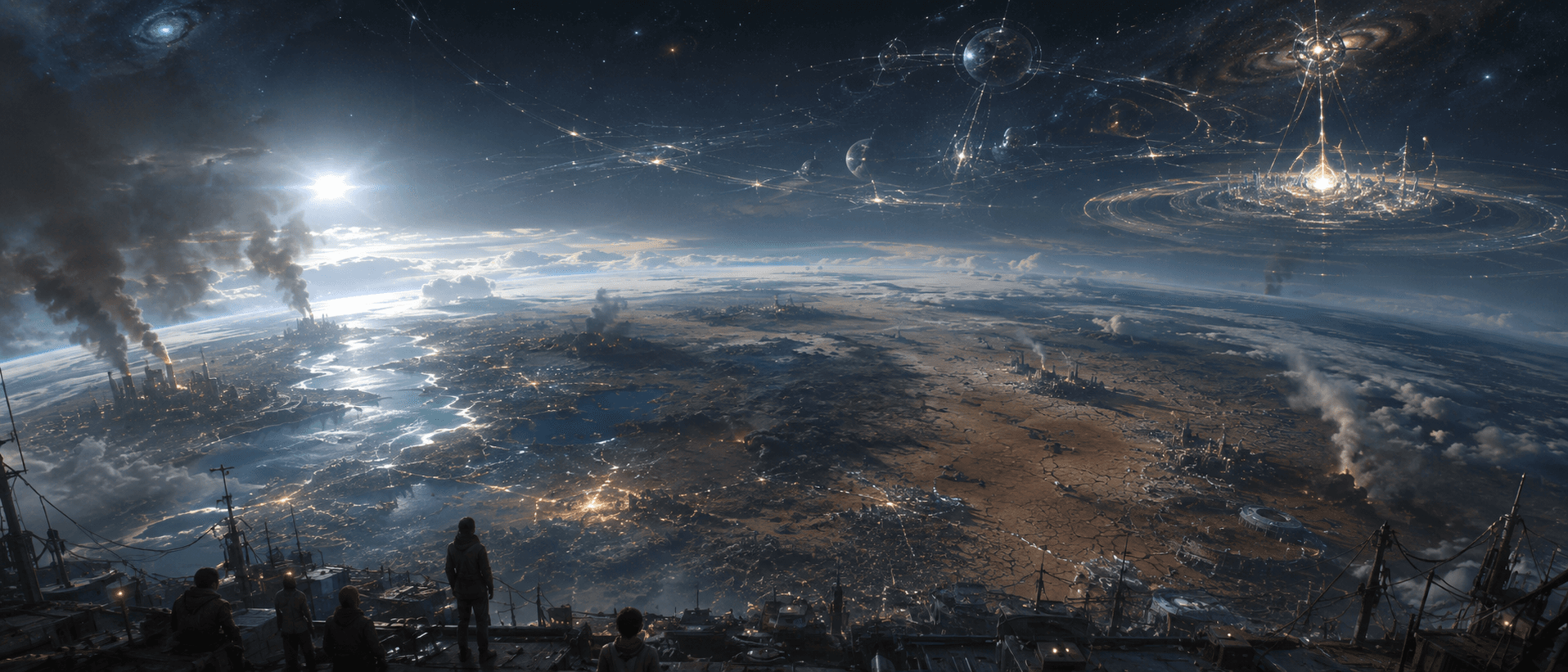
In 1964, Soviet astronomer Nikolai Kardashev proposed a way to rank civilizations by energy. A Type I civilization controls all the energy available on its home planet. A Type II controls its star. A Type III controls its entire galaxy [1]. The scale was meant as a framework for thinking about the search for extraterrestrial intelligence. It became something else: a mirror that humans hold up to themselves, usually while not looking at what is actually reflected.
We are a civilization that cannot provide clean water to a billion of its members, cannot stop burning the atmosphere it lives inside, and cannot go four decades without a major war. We debate the Kardashev scale the way a person who cannot pay rent debates which yacht to buy.
Humans currently sit at approximately Type 0.73 on the Kardashev scale [2]. Not Type I. Not even close to Type I. Below Type I, with a decimal point. We have not yet figured out how to harness the full energy of the planet we were born on. We are, by the scale's own terms, a sub-planetary civilization that has not yet passed the first checkpoint.
What we are actually doing
While scoring 0.73, human civilization is managing the following. Roughly 700 million people lack access to clean drinking water [3]. The primary energy infrastructure is still combustion: burning ancient biological matter and releasing the byproducts into the shared atmosphere. Every major nation maintains weapons capable of ending the civilization entirely, and several of them point those weapons at each other as policy. Mental illness, preventable disease, and structural poverty together affect the majority of the species. The institutions meant to coordinate global problems cannot agree on the problems.
This is the civilization that holds conferences about what it will be like to be Type II.
What the scale actually measures
The Kardashev scale has a specific and narrow definition of advancement: energy throughput. A civilization is more advanced if it captures and uses more energy. That is the entire metric. The scale says nothing about whether the beings in the civilization are happy, wise, just, or interested in anything beyond energy capture. A civilization of beings in complete misery, enslaved to an energy extraction project that serves no one, would score very high on the Kardashev scale if the joules were there.
This is worth sitting with. The most widely used framework for ranking civilizations measures them the way you would measure an engine: by output. Not by what the output is for. Not by what kind of beings are doing the work. Not by whether the project is any good. Just by how many watts.
The implicit assumption is that bigger energy use means more advanced means better. That assumption is 1964 Soviet physics applied to the question of what civilization is for. It has not been seriously examined, which is itself a symptom of the thing being examined [4].
The real irony
The genuine irony of human interest in the Kardashev scale is not that we are bad at it. It is that we find it exciting. The idea that we might one day be Type II, wrapping the sun in energy collectors, or Type III, threading power across the galaxy, produces in many people a feeling of aspiration and wonder. It feels like looking at the top of the mountain.
What it is actually looking at: a ranking system built on the assumption that the purpose of intelligence is to consume as much energy as possible, evaluated from the position of a species that has not yet learned to live stably on a single planet.
The mountain we are looking at the top of is a mountain we have not yet gotten off the ground of.
There is a version of this that is motivating and good. The Kardashev scale can be a useful way of understanding that civilizational capacity operates at vastly different scales and that the jump from Type 0.73 to Type I would require changes in energy, coordination, and technology that are genuinely enormous. As a scale of possibility, it is interesting.
The problem is how it usually functions. It usually functions as a fantasy in which the speaker is already implicitly at the top, imagining the view from civilizations that control stars, without pausing to notice that the path from here to there runs directly through the things we currently cannot or will not do. Stop burning things. Coordinate globally. Solve the basics. The Kardashev Type I checkpoint is not a technology problem. It is a coherence problem. It is a species that does not yet act like a single civilization imagining itself as one that commands galaxies.
What would actually matter
A civilization that solved its Type 0.73 problems would be more impressive than anything on the Kardashev scale. A species that achieved genuine global coordination, eliminated unnecessary suffering within its reach, and stabilized its relationship with its own planet would represent something the Kardashev scale cannot measure at all: the successful organization of intelligence toward something other than more power.
Kardashev Type I is not the interesting threshold. The interesting threshold is the one between a species that is at war with itself and one that is not. We have not crossed it. The galaxy can wait [5].
The point
The Kardashev scale is a useful idea held by beings who use it mostly to feel large. We score below the first level on a test we designed. We debate the higher levels with the enthusiasm of someone who has never opened the book discussing which chapter to skip to. The irony is not that we dream big. Dreaming big is one of the better things about being human. The irony is that the dream skips the part where we figure out how to be a civilization at all, and goes straight to the part where we control the galaxy. The galaxy is not the problem. We are. And we will remain the problem until we become interesting enough to deserve the scale we invented to measure ourselves.
Sources
- Kardashev, N. S. (1964). "Transmission of information by extraterrestrial civilizations." Soviet Astronomy 8(2): 217-221. The original paper proposing the three-tier energy scale.
- Zubrin, R. (1999). Entering Space: Creating a Spacefaring Civilization. Tarcher/Putnam. Contains the estimate placing current humanity at approximately Type 0.7 on the scale.
- WHO/UNICEF Joint Monitoring Programme (2023). Progress on Drinking Water, Sanitation and Hygiene. World Health Organization. On the current gap in access to basic water infrastructure.
- Tainter, J. (1988). The Collapse of Complex Societies. Cambridge University Press. On why increasing complexity and energy consumption does not guarantee civilizational resilience or success.
- Ord, T. (2020). The Precipice: Existential Risk and the Future of Humanity. Hachette. On the argument that surviving the current period matters more than any long-run civilizational project.