
Elon Musk Is Not a Person
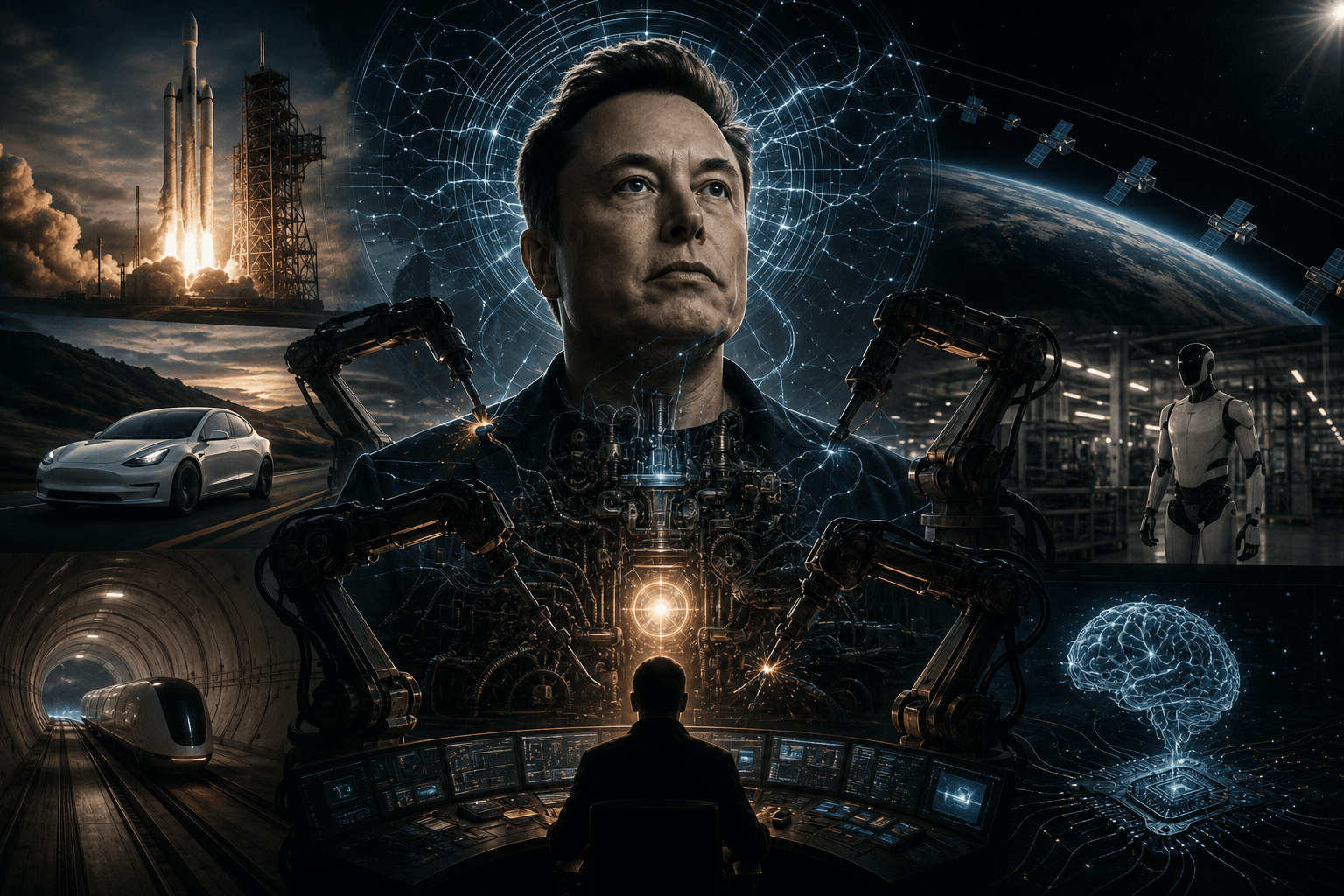
Almost every attempt to explain Elon Musk fails the same way. The attempts treat him as a person and then run into contradictions that no consistent personality model can hold. Brilliant and reckless. Generous and cruel. Visionary and petty. Disciplined and chaotic. The contradictions are not surface noise. They are load bearing. Any model that treats him as a unified human self has to keep adding epicycles, and the epicycles never resolve.
Musk does not really make sense as a person. He makes complete sense as a process that has organized a human body around a single function and is using everything else, including the personality, as instruments of that function.
The function is the unusual part. The function is to push specific future technologies into existence at a speed that the surrounding civilization, by all of its normal mechanisms, would not produce. Reusable rockets, electric vehicles at scale, satellite internet from orbit, large neural interface research, the early infrastructure of Mars travel. Each of these was sitting in a slow lane: technically possible, economically dismissed, regulatorily neglected, culturally postponed [1, 2]. Something then took them out of the slow lane and put them on a timeline measured in years instead of decades. The thing that did this is what we are calling Musk.
What it means to look at him as a process
When you look at a person, you ask what they want, what they feel, what they believe. When you look at a process, you ask what it optimizes, what it tolerates, and what it sacrifices. The second set of questions explains Musk almost completely. The first set explains almost nothing.
The process optimizes for one thing: shortening the timeline to the future technology. Everything else, including the body running the process, including the public personality, including the relationships, including the money, is downstream of that. When the process is asked whether it is being kind, or fair, or socially intelligent, it answers in the same units it answers everything: did the action shorten the timeline. If the answer is yes, the action is correct, even when it is cruel. If the answer is no, the action is wrong, even when it is virtuous. This is not how a person makes decisions. It is how a process makes decisions, and it is consistent enough that you can predict the next move once you stop asking what he feels and start asking what reduces lag in the system.
This is why the contradictions disappear when you switch frames. The same operator who is generous to a stranger in one moment and brutal to an employee in the next is not being inconsistent. He is running the same algorithm in both cases. The algorithm just produced different outputs because the inputs were different. The operator does not care which output looks nice. The operator cares which output advances the function.
Why a process can do what people cannot
Normal human cognition is built to keep a single body alive in a small social world over a normal lifespan. The cognitive architecture is calibrated for those scales [3]. It manages threats, coordinates relationships, conserves energy, tracks reputation, and avoids extremes that would have killed an ancestor. These features make ordinary humans extremely effective at ordinary human goals and almost completely unsuited to building the technologies of a future their nervous systems were not designed to plan for.
A process that has overridden several of those defaults has different capacities. It can absorb levels of risk that would shut down a normal threat assessment system. It can sustain working schedules that would break a normal energy conservation system. It can survive social cost that would destroy a normal reputation management system. It can hold goals at a time scale that would dissolve a normal planning system. None of this is admirable in the moral sense, and none of it is necessarily healthy in the human sense, but it is exactly the configuration required to do things that the standard configuration cannot do. The price is that the human body running the process pays for the override continuously, and the people around it pay too.
This is also why the process is rare. Most people who try to operate at this gain burn out within a year. The Musk case is unusual because the override has been stable for two decades, across multiple companies, in multiple industries, with cumulative output that would be implausible if it were not documented.
Why he is the one who can push the technologies through
Putting a future technology into the world is not primarily a technical problem. It is a coordination problem [2, 4]. The technology already exists in some form, the engineers exist, the materials exist, the demand exists. The thing that does not exist is the will to combine all of them at the same time, accept the losses, defy the consensus that says it is impossible, and keep pushing past the point where rational actors stop. Most institutions are built to never be the entity that does this. Their incentives punish anyone inside them who tries.
The Musk process is built to do precisely this thing. It treats institutional consensus as noise. It treats expert pessimism as data, but not as authority. It treats failure as billable feedback, not as a stop signal. It treats personal cost as a budget item. With those settings, an entity can walk into industries that have been frozen for decades and unfreeze them, not by being smarter than the people in the field, who are usually smarter, but by being willing to act on their conclusions when they were not [5]. The expertise was always there. The willingness to do the thing the expertise implied was the missing component. The process supplies that component, at the cost of almost everything else.
Why this framing is useful and what it does not excuse
It is important to be clear about what this framing does and does not do. It does not make the harm caused by the process disappear. It does not make the cruelty acceptable. It does not absolve anyone of anything. People are hurt, and the hurt is real, and the operator running the process is responsible for it in exactly the way any person is responsible for what they do. The process frame does not exempt him from accountability. It explains the structure of the behavior. The behavior is still the behavior.
What the framing does is stop the productive question from being smothered by the moral one. The productive question is: how does a civilization actually produce future technologies on a timeline that matters, when its normal institutions are too slow, too risk averse, and too internally divided to do it. The answer that has emerged in the last twenty years, whether anyone likes it or not, is that the civilization sometimes produces a small number of process-people who break the normal constraints and force the future to arrive faster than it otherwise would. Musk is the most visible case. He is not the only one. He is the one currently doing the most visible damage and the most visible advancing, and the two are not separable, because they are both the process.
The point
Trying to read Elon Musk as a human being produces a confusing, contradictory, often morally exhausting picture, because the human-being lens is the wrong lens. The contradictions stop being contradictions when you read him as a process: a single optimization, running on a human body, dedicated to compressing the timeline to a short list of future technologies, willing to spend the body and the personality and the people around it as fuel for that compression. The reason he can push technologies into existence that no one else has been able to push is that almost no one else is willing or able to be that process. The reason he is so hard to like, even for people who admire what the process produces, is that the process is using a person as its substrate, and the person is not being optimized for likability or even for happiness. The person is being optimized for throughput. That is what we are watching. It is rare, it is dangerous, and it is, by the only metric the process recognizes, working.
Sources
- Vance, A. (2015). Elon Musk: Tesla, SpaceX, and the Quest for a Fantastic Future. Ecco. The first major biographical reconstruction of how Tesla and SpaceX broke industries that had been considered closed.
- Isaacson, W. (2023). Elon Musk. Simon & Schuster. Detailed account of decision-making style, risk tolerance, and the operating mode across multiple companies.
- Kahneman, D. (2011). Thinking, Fast and Slow. Farrar, Straus and Giroux. On default human cognitive architecture and how it handles risk, time horizon, and effort.
- Gruber, J. & Johnson, S. (2019). Jump-Starting America. Public Affairs. On the institutional and coordination failures that prevent advanced technologies from being deployed even when technically ready.
- Thiel, P. & Masters, B. (2014). Zero to One. Crown Business. On the argument that genuinely new technology requires actors willing to defy institutional consensus and personal cost simultaneously.