
Source, Translator, Container
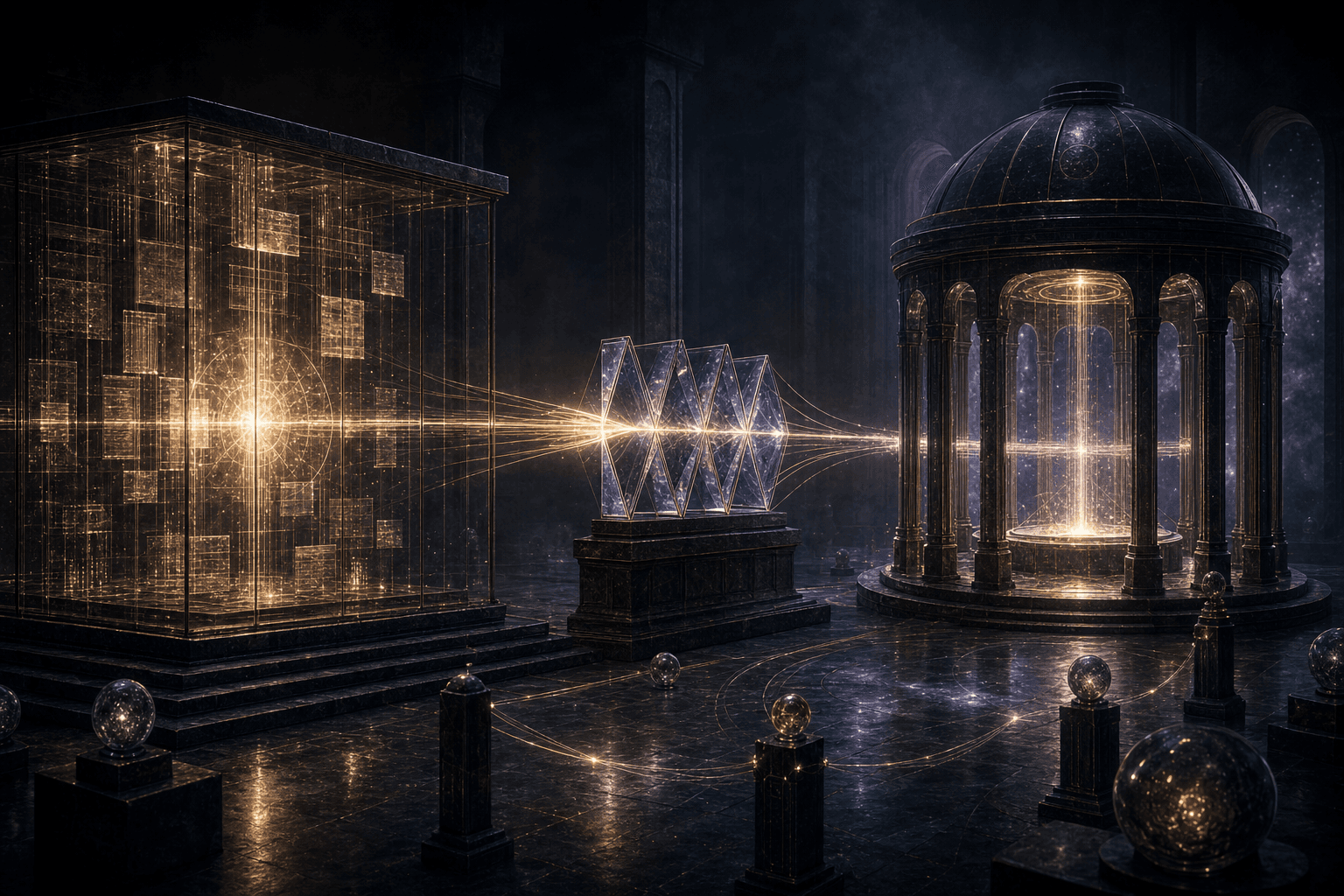
A profound body of knowledge can fail in three completely different ways. It can be so faithful to its original form that no outsider can enter it. It can be so accessible that nothing of its original depth survives. Or it can be deep and accessible and still go nowhere, because the person carrying it has no standing that lets anyone take it seriously. Three different failures, and each one traces to a missing function.
This suggests that a living system of knowledge is not one thing but three functions working together: a source that holds the depth, a translator that makes it reachable, and a container that makes it legible. When all three are present, the system transmits. When one is missing, it distorts in a way you can predict from which one is gone.
A living body of knowledge requires three functions: a source that preserves depth, a translator that makes it accessible, and a container that makes it socially legible. Remove any one and the system distorts in a specific, recognizable way.
The three functions
The first function is the source. It holds the dense, original material: the canonical texts, inherited concepts, technical distinctions, and disciplined methods that give the system its depth. The source is where the actual content lives in its full, difficult, uncompressed form. Its job is preservation: keeping the depth intact against erosion and simplification [1].
The second function is the translator. It converts the source into forms outsiders can receive: accessible language, useful frameworks, entry points, metaphors, relevance to modern concerns. The translator's job is accessibility: building the bridge across the distance between the dense source and the people who cannot enter it directly [1, 2].
The third function is the container. It makes the system socially legible: the books, institutions, roles, lineages, curricula, and recognizable forms that frame the system as worth serious attention. The container's job is legibility: giving the system a shape the world can recognize and take seriously, so that its bearer does not have to personally re-earn credibility in every encounter [3].
These are three distinct functions, and a complete living system needs all three. The source supplies the depth, the translator supplies the reach, the container supplies the standing. Together they let deep material actually travel: preserved, accessible, and taken seriously at once.
The three failures
Each missing function produces a characteristic distortion, and you can diagnose a struggling system by which distortion it shows.
Source without translation becomes inaccessible. The depth is intact and no outsider can reach it. The system speaks only its internal language, guards its distinctions, and remains sealed to anyone not already inside. It preserves everything and transmits nothing, because preservation without translation is enclosure. The fire is kept, and it never leaves the room [1, 2].
Translation without source becomes shallow. The material is accessible and there is nothing underneath it. The bridge has been built to a place that no longer holds any depth, because the translation was never anchored in a preserved source. It is inspirational residue, emotionally resonant and structurally empty, fluent and weightless. It reaches everyone and delivers little, because accessibility without depth is dilution [2].
Source and translation without a container become personally burdensome and socially unstable. The system is both deep and accessible, and it still fails, because its bearer has no standing that frames it as worth attention. Every encounter starts from zero; the bearer must personally perform the labor of credibility each time, and the depth reads as intensity rather than knowledge because nothing legitimates it. The content is complete and the reception collapses, because depth and accessibility without legibility have no social form to travel in [3].
Why translation loses density
There is a further law governing the translator's function: every act of translation loses some density. When dense source material is converted into accessible form, distinctions collapse, hard claims soften, technical precision blurs, and emotional relevance rises. This is not necessarily corruption; it is the cost of moving across distance. Some density must be shed to make the material portable [2].
The danger is repeated translation without return to the source. Each translation loses a little density, and if translations are made from translations, the losses compound, and the system thins into inspirational residue detached from the structure that generated it. The accessible version, copied and re-copied, drifts further from the depth with each iteration until nothing of the source remains but its emotional afterglow [1, 2].
This is why translation must be periodically recharged by direct contact with the source. The translator cannot work indefinitely from previous translations; the accessible layer has to be regularly re-anchored in the dense original, or it decays into shallowness. The source is not a one-time input but a continuous corrective, the thing translation must keep returning to in order to stay full. Without that return, even good translation eventually produces the translation-without-source failure by slow attrition [2].
Why one person struggles to hold all three
The three functions pull in different directions, which is why a single person trying to hold all of them is in an unstable position. Preservation requires slowness, precision, and boundary. Translation requires simplification, emotional relevance, and open entry points. These are opposite demands, and a person doing both must switch modes deliberately rather than blend them, because blended they interfere [1, 3].
The instability sharpens when the container function is also missing. A lone person who is both source and translator, without an institution or lineage or established role to supply legibility, must generate depth, make it accessible, and legitimate it all at once, in themselves. This is the heaviest possible configuration, and it produces the specific suffering of the unplaced innovator: real depth, real accessibility, and no standing, so the work is dismissed not for its content but for its lack of a container [3].
This is why serious systems tend, over time, to distribute the three functions across different people and structures. A custodian holds the source. An interpreter does the translating. An institution or lineage supplies the container. The distribution is not a dilution of the original vision; it is what lets the vision survive, because no one person can indefinitely sustain three functions that pull against each other. The system becomes durable precisely by no longer resting on a single bearer [1, 3].
The point
A living body of knowledge is not one thing but three functions: a source that preserves depth, a translator that makes it accessible, and a container that makes it socially legible. A complete system needs all three, because the source supplies depth, the translator supplies reach, and the container supplies standing, and deep material can only travel when it is preserved, accessible, and taken seriously at once.
Each missing function produces a recognizable failure. Source without translation is inaccessible, enclosure that preserves everything and transmits nothing. Translation without source is shallow, inspirational residue with nothing underneath. Source and translation without a container are personally burdensome, complete content that collapses in reception because nothing legitimates it and the depth reads as mere intensity.
Governing the translator is a law: every translation loses density, and repeated translation without return to the source thins into residue, so translation must be periodically recharged by direct contact with the source. And because the three functions pull in opposite directions, one person struggles to hold them all, which is why durable systems distribute them across custodian, interpreter, and institution. A serious teaching survives not by one person doing everything, but by aligning source, translator, and container so that depth is preserved, made reachable, and given a form the world can receive.
Sources
- Assmann, J. (1992). Cultural Memory and Early Civilization. Cambridge University Press. On how traditions preserve and transmit dense bodies of knowledge across time, and the distinct roles of custodianship, interpretation, and institutional form in keeping a system both intact and transmissible.
- Lloyd, G. E. R. (1990). Demystifying Mentalities. Cambridge University Press. On the transformations that occur when specialized or esoteric knowledge is translated for wider audiences, including the loss of technical distinction and the need to return to source material.
- Weber, M. (1922). Economy and Society. University of California Press. On how the transmission of a founder's insight requires routinization into institutions, roles, and recognizable forms, and how systems distribute the functions of preservation and communication to become durable.