
The Flesh Economy
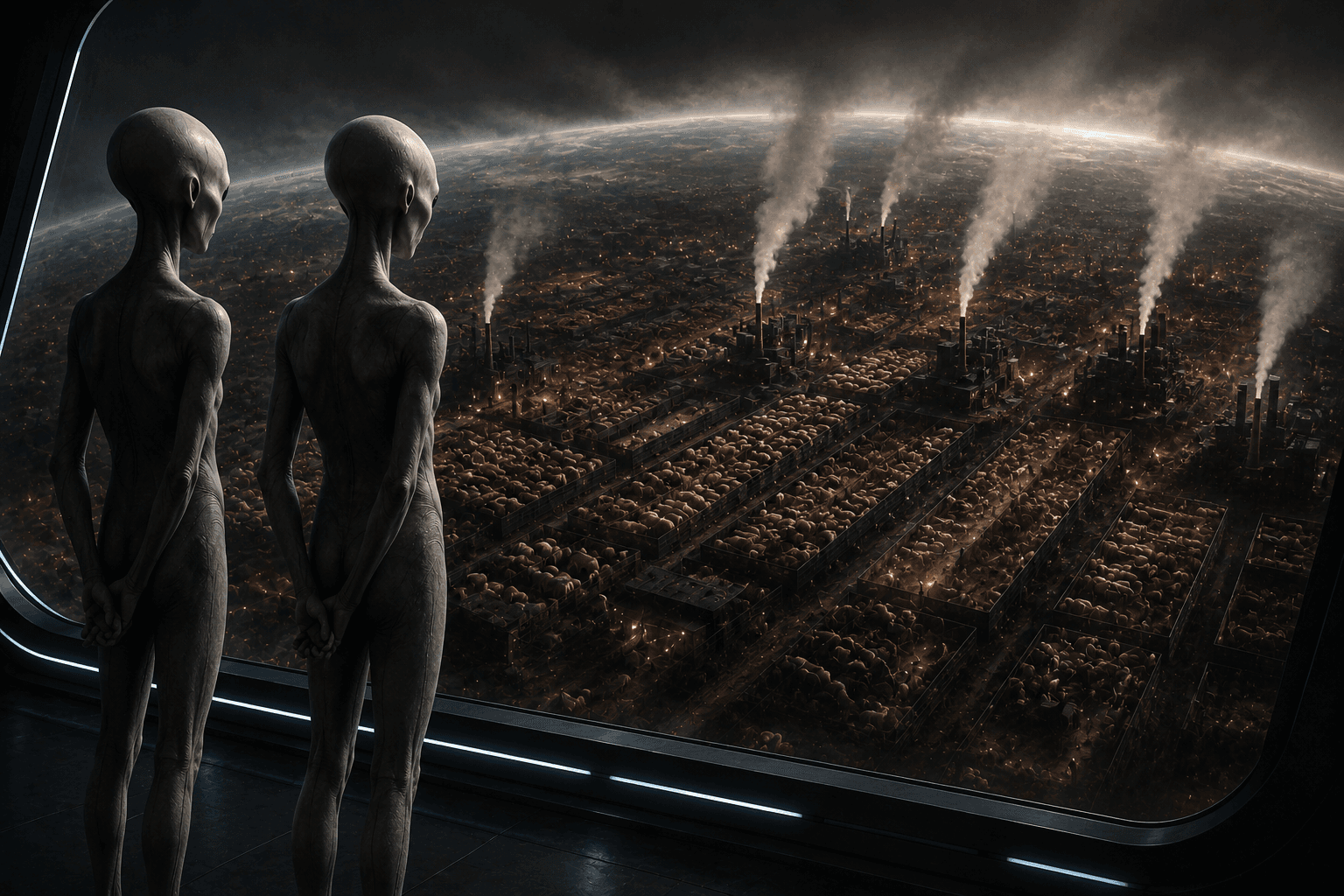
A theory of the dystopia we were born into.
The normalization problem
The most terrifying feature of any dystopia is not its cruelty. It is that the people living inside it consider it normal. The prisoners stop seeing the bars. This is the central insight: we are not equipped to recognize the horror of our own world because we were born calibrated to it.
Now. Let us bring in the visitors.
The alien audit
Imagine a civilization, call them the Solari, from a planet where every organism harvests energy directly from ambient, non-organic sources. Sunlight. Geothermal vents. Electromagnetic gradients. No creature on their world has ever consumed another. The very concept does not exist. Death exists, but it is release. Organisms simply stop converting energy and dissolve back into mineral substrate. Clean. Quiet. Unviolated.
They develop interstellar travel. They find us.
They run their sensors. They observe.
What they see, objectively, from outside our calibration, is something that would constitute, by any rational moral framework, a planet-wide atrocity of incomprehensible scale, running continuously, every second, without pause, since the first cell divided.
What the audit report would say
Finding 1: The entire biosphere is structured as a hierarchy of consumption.
Every organism on this planet, with narrow exceptions, sustains itself by dismantling other organisms. Not incidentally. Fundamentally. The architecture of life here is not cooperation with an energy source. It is predation as the primary survival mechanism [1]. Creatures with nervous systems, creatures capable of experiencing what the planet's dominant species calls "suffering," are routinely caught, killed, and metabolized. Billions of times per day. The dominant species has industrialized this process to a scale that strains their own mathematics. Over 70 billion land animals are killed for food by humans every year, and between one and three trillion fish [2].
Finding 2: The dominant species is aware of the suffering. They have documented it extensively.
This is perhaps the most disturbing finding. The dominant species, who call themselves humans, have developed sophisticated neuroscience, ethology, and philosophy. They know other creatures suffer. They have published tens of thousands of papers on animal cognition, pain response, and emotional experience [3, 4]. And then they continue. Not out of ignorance. Out of what can only be described as dissociation at civilizational scale [5].
Finding 3: The victims fuel the infrastructure of culture.
The humans have built art, music, philosophy, religion, and love on top of a foundation that requires constant killing to sustain. Every great human achievement has been metabolically underwritten by the death of other organisms. Their most celebrated meals are ceremonies of killing. Their children are raised on it before they are old enough to understand what they are eating. By the time understanding arrives, the appetite is already trained [6].
Finding 4: The system has been aestheticized.
Perhaps most remarkably, the humans have found the consumption beautiful. They describe predators as "majestic." They call the food chain "the circle of life." They have created an entire aesthetic vocabulary, including phrases like "nature red in tooth and claw," that romanticizes what the Solari would classify as a continuous mass casualty event [7]. The horror has been poeticized into acceptability.
The philosophical gut-punch
Here is where the theory sharpens into something genuinely uncomfortable.
We did not choose this system. But we also cannot opt out of it. Even the most ethically committed human, a strict vegan who grows their own food, is killing organisms to survive. Plants respond to damage [8]. Soil ecosystems are disrupted. The baseline cost of existing on this planet, for any organism, is the dismantling of other living systems. There is no clean participation. There is only more or less participation.
This is the true mark of a dystopia: the system is inescapable from within. You did not design the prison. You were born into it with the prison's logic already installed as hunger, as instinct, as the very biochemistry of your cells. Your mitochondria, the power plants of your body, are themselves the ancient remnants of a bacterial invasion, a cellular conquest that became so normalized it is now called "life" [9].
The Solari would note: the humans do not feel horror because the horror is structural. It is the ground they stand on, not a thing they observe.
The cleaner-hands illusion
There is a move that almost every ethically awake person makes at some point, which is to modify what they eat. Vegetarianism. Veganism. Pescatarianism. Ethical sourcing. Farm-to-table. Hunting your own food. Each of these feels, from the inside, like becoming more human. More ethical. More aligned with whatever it is we were supposed to be before the system got its hooks into us.
The Solari would read this move carefully and note something uncomfortable: the feeling of being more human is itself a feature of the dystopia, not an escape from it.
The argument is not that modifying what you eat does nothing. It often does something real. Reducing the suffering you directly fund is a legitimate moral act, and the difference in harm between a factory-farmed animal and a field of wheat is enormous and worth taking seriously. The argument is specifically about the feeling of elevation that accompanies the shift, and what that feeling obscures.
Plants respond to damage [8]. Soil microbiomes are destroyed when fields are tilled. Migratory species lose habitat when land is cleared for crops. The water, the fossil fuels, the phosphate, the labor conditions of the people harvesting the food, all of these carry their own stream of costs that do not register visually as death but are part of the same ledger. A fully accurate audit of any diet on this planet returns a nonzero number for "living systems dismantled to sustain this body." The only variable is which systems and by how much [1].
What the feeling of being "more human" does is collapse that ledger into a simpler story: I am now on the clean side of the moral line. That story is structurally identical to the one the theory was trying to expose. It ranks organisms by what feels intuitive, draws a new line lower down, and calls the new line the true one [10]. The plants on the other side of the line stop counting. The soil stops counting. The displaced insects stop counting. What changed is not the economy. What changed is where the person chose to stop looking.
This does not mean the choice is wrong. It means the sense of purity that can come with it is the same move our ancestors made when they decided fish did not count, and our grandparents made when they decided chickens did not count. It is the signature move of a species that cannot afford to feel the whole cost, continuously finding a new smaller cost to still not feel. From the Solari's angle, being vegetarian or vegan is not arriving at something more human. It is one of many possible settings on the same apparatus, each of which lets the user keep eating by quietly choosing which deaths to stop counting.
The genuinely honest posture, if there is one, is not to locate a diet that makes you clean. It is to eat the way you have to eat, take the costs seriously including the ones you have not yet let yourself see, and stop treating your particular setting of the apparatus as evidence of having escaped it. You have not escaped it. None of us have. The line you just drew is also a line.
The deepest layer
Now consider this: the Solari themselves, by existing in a world of clean energy, developed their moral sensibility because their world permitted it. They never had to make the impossible calculation, kill or die, that every Earth organism faces at the metabolic level. Their ethics emerged from a context of abundance and non-violence. Our ethics emerged from a context of mandatory violence, and are therefore permanently distorted by it.
We built our moral philosophies inside the very system we would need clear eyes to condemn. Every human ethical tradition has had to find a way to accommodate the fact that humans must kill to live. We rationalized it. We ritualized it. We ranked organisms by "complexity" to decide whose death counts. We drew lines, and then moved them when convenient [10].
The Solari would have no such rationalizations. They would look at our moral philosophy and see exactly what it is: an incredibly sophisticated attempt to make peace with a situation that, from outside, looks like an endless, inescapable nightmare dressed up in the language of natural order.
The final horror
The visitors leave. They write their report.
The report concludes not with condemnation, the Solari are wise enough to understand that humans did not author this, but with something worse: pity mixed with incomprehension.
They cannot understand how beings capable of love, poetry, mathematics, and moral philosophy have managed to normalize what their world would consider unthinkable. They cannot understand how creatures who weep at sunsets and write symphonies go to sleep every night with the metabolic debt of dozens of other organisms settled into their tissues.
And the darkest line of the report reads:
"The most sophisticated organisms on this planet have developed the capacity to feel profound empathy, and have used it primarily to feel empathy for each other, while remaining largely numb to the scale of what their existence requires. This is not malice. This is something stranger than malice. This is a species that evolved the ability to care, inside a system that would destroy them if they cared too much."
The point
We are not villains. We are not monsters.
We are something more tragic: beings of genuine feeling, born into a world that runs on suffering, who had to learn not to feel all of it just to get through the day.
That is not evil. But it is, from the outside looking in, an almost perfect definition of a dystopia.
Sources
- Morowitz, H. J. (1968). Energy Flow in Biology. Academic Press. On the thermodynamic necessity of energy capture in living systems and the asymmetry between autotrophs and heterotrophs.
- FAO (Food and Agriculture Organization of the United Nations) (2022). Livestock Primary Statistics. Annual production figures confirming 70+ billion land animals killed per year; fish estimates from Mood & Brooke (2010), "Estimating the number of fish caught in global fishing each year," fishcount.org.uk.
- de Waal, F. (2016). Are We Smart Enough to Know How Smart Animals Are? W. W. Norton. Comprehensive review of the empirical literature on animal cognition and emotion.
- Low, P. et al. (2012). The Cambridge Declaration on Consciousness. Statement by neuroscientists at the Francis Crick Memorial Conference affirming that non-human animals possess the neurological substrates of conscious experience.
- Plumwood, V. (1993). Feminism and the Mastery of Nature. Routledge. On the structural dissociation that allows continued participation in ecological harm while knowing of it.
- Adams, C. (1990). The Sexual Politics of Meat. Continuum. On how cultural practices transform killed animals into "meat" and obscure the origin of what is eaten.
- Tennyson, A. (1850). In Memoriam A.H.H. The origin of the phrase "nature red in tooth and claw" as a poetic acceptance of predation as cosmic order.
- Gagliano, M., Mancuso, S., & Robert, D. (2012). "Towards understanding plant bioacoustics." Trends in Plant Science 17(6): 323-325. On the documented damage-response signaling of plants.
- Margulis, L. (1970). Origin of Eukaryotic Cells. Yale University Press. The endosymbiotic theory establishing that mitochondria descend from once-independent bacteria absorbed by ancestral cells.
- Singer, P. (1975). Animal Liberation. HarperCollins. On the historical pattern of drawing and redrawing moral boundaries to exclude or include different species from ethical consideration.