
The Universe Is Fractal
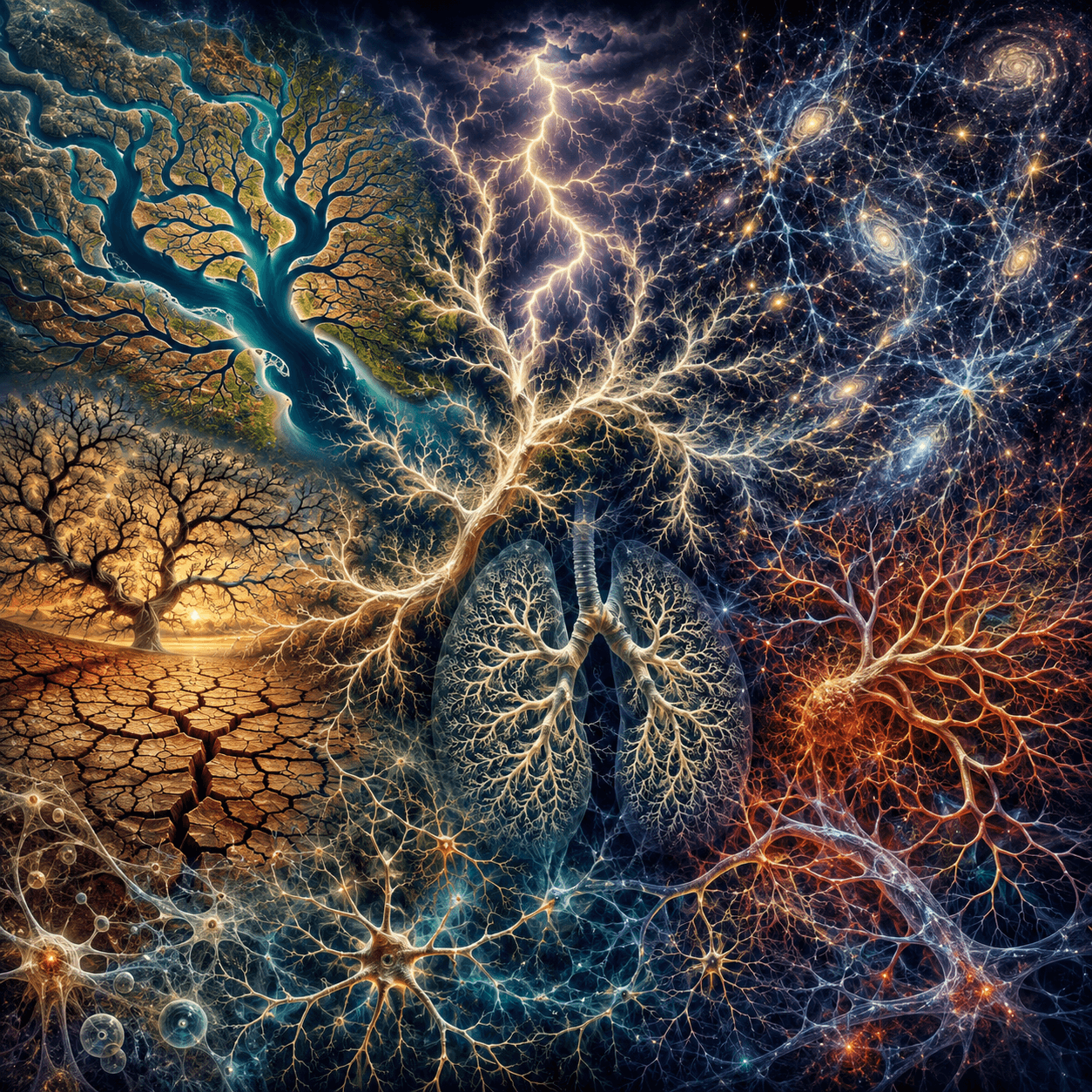
Look at a satellite photo of a river delta. Then look at a photo of a lightning strike. Then look at a diagram of the human bronchial tree. Then look at the cracks in a dried mud flat. Then look at a slow motion image of how blood vessels grow in a fertilized egg. Then look at a map of dark matter filaments connecting galaxies across hundreds of millions of light years.
The same shape keeps showing up in places that have nothing in common except that they all exist. That is not an accident. That is a fingerprint.
The scientific name for this is fractal geometry, and the formal definition is that a fractal is a structure whose pattern repeats at every scale [1]. Zoom in and you see the same shape. Zoom in again and you see it again. There is no privileged level. The detail is endless because the rule is recursive, not the parts.
The interesting question is why the universe is doing this so much, in so many places, with so little variation. Once you start looking, the fractal is almost everywhere.
Where it shows up
The branching of trees. The branching of rivers. The branching of lightning. The branching of blood vessels. The branching of your bronchi. The branching of neurons. The branching of cracks in glass. The branching of cosmic structure. All of these are the same shape, generated by very different physical systems, separated by twenty orders of magnitude in size.
The clustering of stars in galaxies, of galaxies in clusters, of clusters in superclusters, of superclusters in walls and filaments. The same kind of clumping, with the same kind of voids, at every level you look [4, 5].
The shape of coastlines and the shape of cell membranes, the shape of mountain ranges and the shape of crumpled paper, the shape of clouds and the shape of broccoli, the shape of stock market charts and the shape of heart beats [1, 2]. None of these systems are aware of each other. They have no causal contact. They keep producing the same family of geometries anyway.
Why this is a clue
If you saw a single complicated pattern repeating in two unrelated places, you would shrug. If you saw it in three, you would be a little curious. When you see it in literally every domain you look at, from the quantum to the cosmological, from the geological to the biological, you have to start asking what is going on.
Two answers people usually give. The first is that fractals are just what happens when a system has feedback and energy flow [3]. Whenever something is being driven by energy and the parts are talking to themselves recursively, you get this kind of geometry. That is true and it is part of the answer. But it does not really explain why every system in the universe seems to be a system with feedback and energy flow at every scale. That is the bigger question.
The second answer is that the universe might be a single recursive process expressing itself at different magnifications, and the reason the same shape shows up at galactic and at cellular scales is that it is, in some real sense, the same process running at different levels, with the same generative rule. If that is true, then the fractal is not a coincidence about how matter happens to organize. It is a hint about what the underlying generator is. The generator is something that, when it runs, produces that family of forms. We see them at every scale because at every scale we are looking at the output of the same generator.
This is closer to physics than to mysticism. People working on emergent gravity, holographic models, and the relationship between information and spacetime are starting to take seriously that the universe might be doing one thing, and the many "scales" we observe might be different views of that one thing, the way a coastline looks like the same coastline whether you are a meter or a mile or a hundred kilometers above it.
What it implies
If this is right, then a few things follow. First, the boundaries between fields are softer than they look. Biology, geology, cosmology, and neuroscience are all describing different magnifications of the same generator. They will turn out to share more equations than anyone currently expects, because they are studying the same machine from different angles.
Second, the question "what scale is the right scale to look at this universe" stops making sense. There is no privileged scale. Every level is equally a window onto the underlying rule. The cellular and the galactic are not opposites in a hierarchy. They are two readings of the same instrument.
Third, and maybe most importantly, you, sitting there reading this, are not separate from the fractal. The branching in your lungs is the same shape as the branching of the cosmic web. Not because of some New Age symbolism, but because the same generative process is running through you that is running through the largest known structures in the universe. You are not a small thing inside a big universe. You are a particular magnification of the universe, doing what it does at your scale, in the same shape it does everywhere else.
The point
The repetition is the message. The universe is not a collection of unrelated things that happen to look similar. It is a single recursive process whose output, at every magnification, has the same fingerprint. The fingerprint is the clue. We do not yet have the equation that fully describes the generator, but we know what its output looks like, because its output is everything we have ever seen. And the fact that everything we have ever seen has the same shape is the most important thing nobody is talking about.
Sources
- Mandelbrot, B. (1982). The Fractal Geometry of Nature. W. H. Freeman. Foundational work that named and formalized the pattern across domains.
- West, G. (2017). Scale: The Universal Laws of Life, Growth, and Death in Organisms, Cities, and Companies. Penguin. On scaling laws that span biology, urbanism, and physics.
- Bak, P. (1996). How Nature Works: The Science of Self-Organized Criticality. Springer. On why feedback systems with energy flow generate scale-invariant structure.
- Sylos Labini, F., Vasilyev, N. L., Pietronero, L., & Baryshev, Y. V. (2009). "Absence of self-averaging and of homogeneity in the large scale galaxy distribution." Europhysics Letters 86: 49001. On fractal structure in cosmological data.
- Note: cosmic-scale fractality is contested at the largest scales; the strong claim in the theory should be read as suggestive, not consensus.