
You Did Not Choose Your First Thought
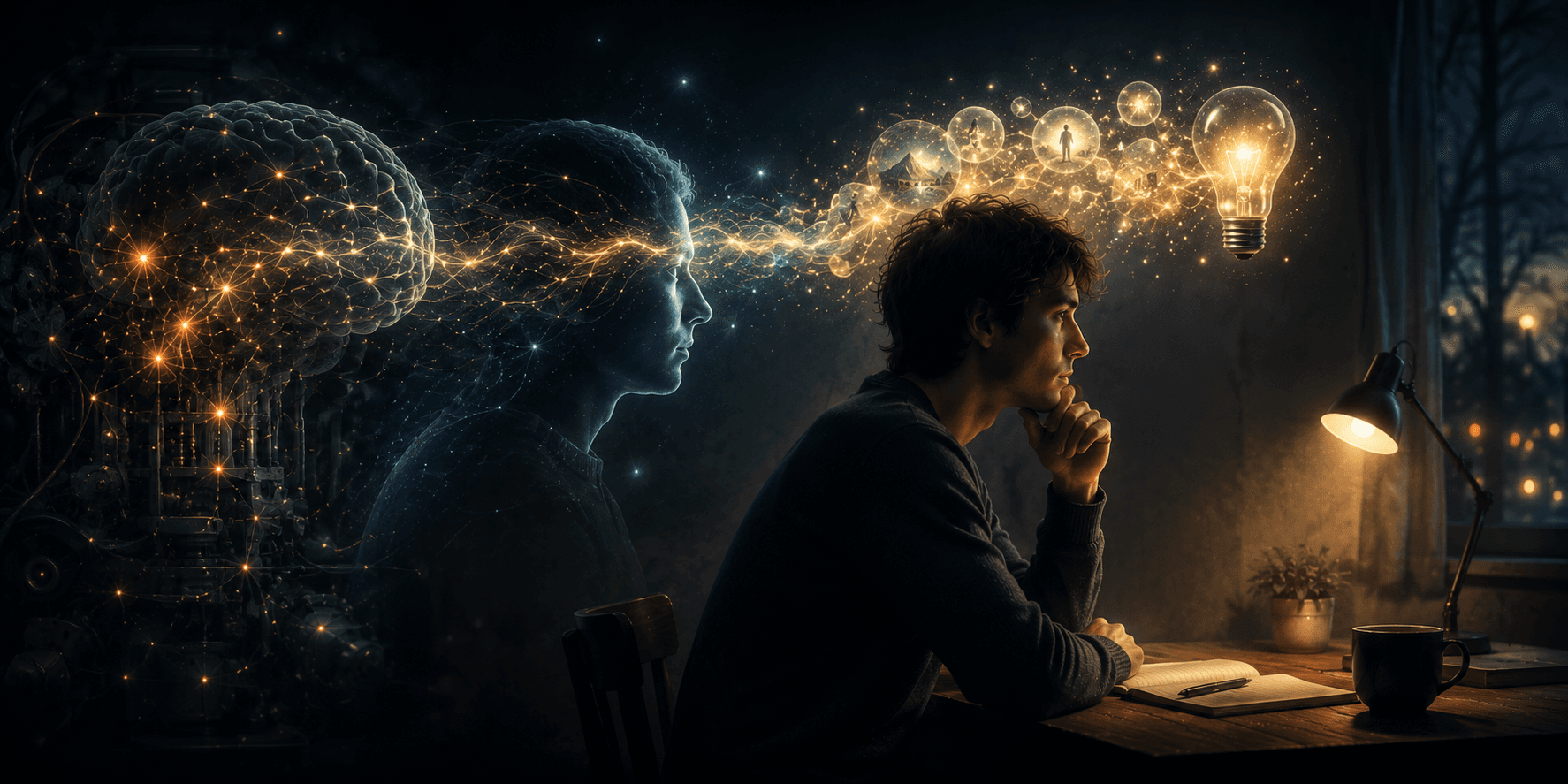
Right now, without planning it, a thought is arriving in your mind. Maybe it is about this sentence. Maybe it is about something else entirely. You did not summon it. You did not decide to have it before having it. It came, and then you became aware of it, and then, if you are like most people, you experienced it as yours.
This is the thing worth looking at. Not the thought itself. The sequence. The thought arrived first. The awareness of it arrived second. The sense that you chose to have it arrived third, if it arrived at all.
Free will, in the way most people imagine it, requires that the chooser be upstream of the choice. That you, the self, the agent, initiate the action and the brain carries it out. The neuroscience suggests the sequence runs the other way. The brain initiates. The self observes. And then, remarkably, the self often reports having been in charge all along.
You did not choose your first thought. You watched it arrive. The chooser is downstream of the process it believes it is running.
What the experiment showed
In the early 1980s, Benjamin Libet designed a now-famous experiment [1]. Participants watched a clock and were asked to flick their wrist whenever they felt like it, noting the clock position at the moment they felt the urge to move. Meanwhile, electrodes measured their brain activity.
The result was unsettling. The brain showed a measurable build-up of electrical activity, called the readiness potential, roughly 550 milliseconds before the movement occurred. The participants reported becoming consciously aware of their intention to move roughly 200 milliseconds before the movement. The brain had already begun preparing the action 350 milliseconds before the person knew they had decided to act.
The decision was already underway before the self showed up to make it.
Later work extended this further. In 2008, researchers using brain imaging found they could predict which hand a participant would choose to press a button with up to seven to ten seconds before the participant was consciously aware of their decision [2]. The choice was legible in the brain before it appeared in the mind. Whatever was doing the choosing, it was not the conscious self.
The authorship illusion
The psychologist Daniel Wegner spent years studying the sense of conscious will and came to a specific conclusion: the feeling that you caused your own actions is real as a feeling, but it is not accurate as a causal account [3].
The feeling of will arrives after the process that produces the action. It is a report, not a command. The brain acts, and then constructs the experience of having chosen to act, and the construction is so fast and so seamless that the report feels like it preceded the action. You feel like the author because authorship is the story the brain tells about what just happened. But the story is written after the fact.
This is not a peripheral quirk. It applies to the most important choices a person makes: what to say in a difficult conversation, whether to reach for another drink, whether to end a relationship. In all of these, the process that generates the action is running below the level of conscious awareness. The conscious self encounters the output and calls it a decision.
What this means for who you are
The usual response to this is despair or denial. Either it means nothing matters and no one is responsible for anything, or the experiments must be wrong because they contradict something that feels irreducibly true about experience.
Both responses miss what is actually interesting.
The question is not whether the conscious self is the initiator of action. It appears not to be. The question is what the conscious self actually is and what it actually does.
One answer is this: the self is not the source of behavior. It is the integrating layer that receives behavior, reflects on it, makes meaning of it, and over time shapes the conditions from which future behavior emerges [4]. You did not choose your first thought. But by what you attend to, what you practice, what you expose yourself to, what you return to, you are continuously shaping the substrate that generates the next thought. The self is not the author of individual actions. It is the gardener of the system that produces them.
This is a different kind of agency than the one we normally imagine. Not moment-to-moment initiation of action from a position of pure freedom. Something slower and more structural: the ongoing work of changing what kind of processes run in you, which changes what emerges from you, which changes what arrives in consciousness and gets called a choice.
The feeling that remains
There is something that does not dissolve even after the neuroscience.
Right now, you are reading this. Something in you is following the argument, questioning it, accepting or resisting pieces of it. That activity, whatever its neural substrate, is happening. There is a process of reflection occurring. And that process, even if it is not the ultimate initiator of your actions, is causally real. It changes things. It feeds back into the system. The brain that reflects on determinism is not identical to the brain that has never encountered the idea [5].
This is the compatibilist insight, and it matters: the absence of a self that stands outside the causal chain and initiates action from nowhere does not mean that deliberation, attention, and reflection are causally inert. They are part of the chain. They are real causes. The fact that they are themselves caused does not make them not causes.
You are not free in the way the naive picture imagines: a self hovering above the machinery of the brain, pulling levers from a position of pure uncaused choice. But you are also not merely a spectator. You are a process that reflects on itself, and that reflection changes the process. That is not nothing. It may be what freedom actually is, once you strip away the picture that was never accurate.
The point
The question of free will has been framed, almost always, as a binary: either you are the uncaused cause of your own actions, or you are a puppet of prior causes. That framing makes the question unanswerable and the answer irrelevant either way.
The more useful frame is this: the self is real, reflection is real, and deliberation is causally effective, but none of these are what we imagined when we imagined a ghost in the machine making choices from outside the causal order. The chooser is part of the system. It did not build the system. It did not choose to be the kind of chooser it is. And yet it is here, choosing, and the choosing matters, because the process is shaped by what it does with itself.
You did not choose your first thought. But what you do with what arrives, where you put your attention, what you practice returning to, that shapes what arrives next. That is the only freedom that has ever been available. It turns out to be enough.
Sources
- Libet, B., Gleason, C. A., Wright, E. W., & Pearl, D. K. (1983). "Time of conscious intention to act in relation to onset of cerebral activity." Brain 106(3): 623-642. The foundational experiment measuring the readiness potential and its relationship to conscious awareness of intention.
- Soon, C. S., Brass, M., Heinze, H. J., & Haynes, J. D. (2008). "Unconscious determinants of free decisions in the human brain." Nature Neuroscience 11(5): 543-545. Brain imaging study showing predictable choice-related activity up to ten seconds before conscious decision awareness.
- Wegner, D. M. (2002). The Illusion of Conscious Will. MIT Press. The comprehensive psychological account of why the feeling of authorship is a construction rather than an accurate causal report.
- Sapolsky, R. M. (2023). Determined: A Science of Life Without Free Will. Penguin Press. The most recent and thorough scientific case for determinism, with extended treatment of what moral responsibility means in its absence.
- Dennett, D. C. (2003). Freedom Evolves. Viking. The compatibilist account: how determinism and meaningful freedom are not contradictory, and why the kind of freedom that matters is the kind that evolution produced.