
The Wound With No Nerve
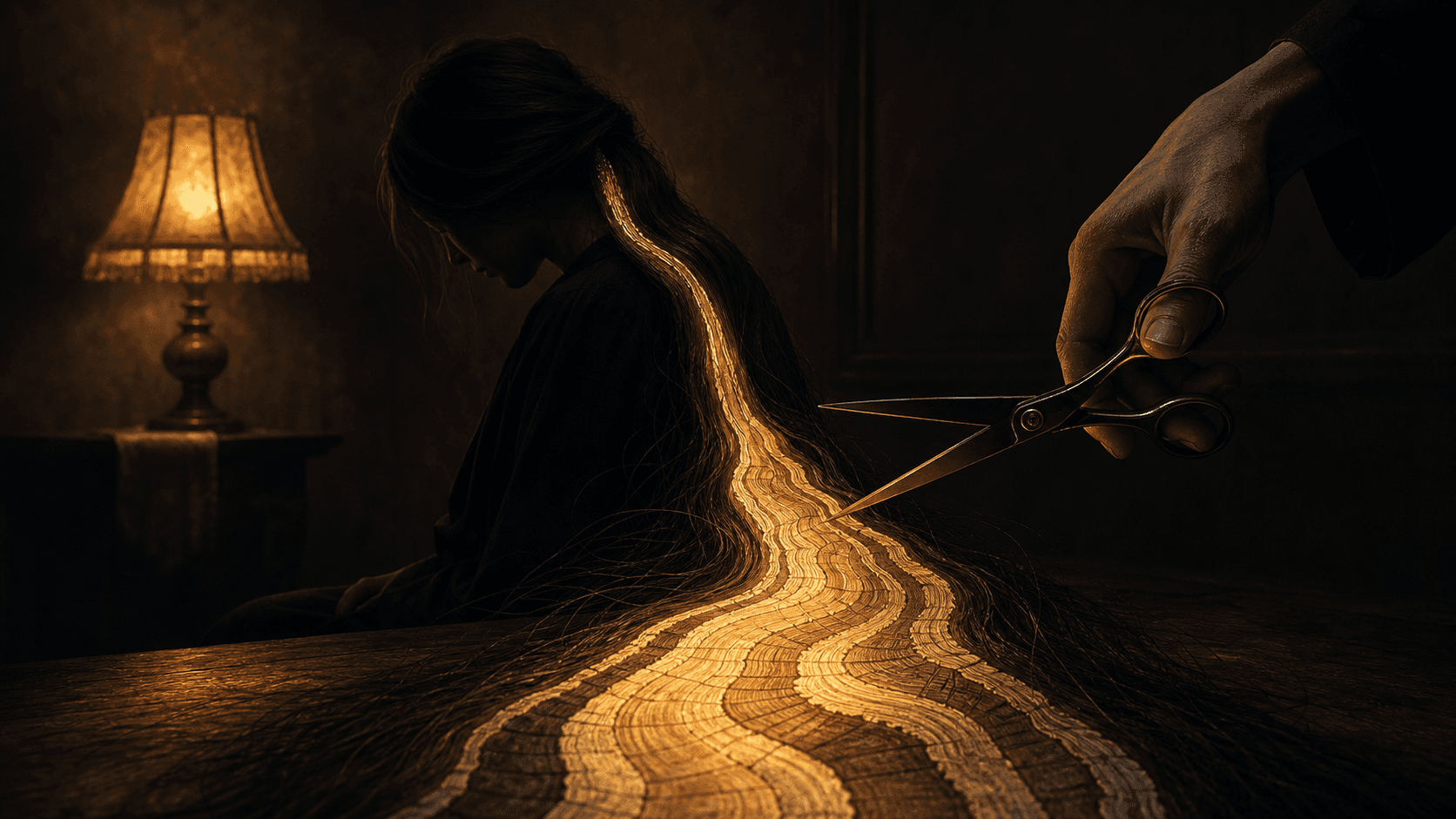
You can cut a person's long hair and cause no physical pain at all. The hair shaft has no nerves. The blades pass through, the length falls away, and the body feels nothing. By the logic of physical sensation, nothing has been harmed.
And yet a forced haircut can be devastating. It can feel like a violation, an erasure, a theft. The injury is real and severe, and it is located nowhere in the nervous system. This points at something about the self: parts of it can be removed without physical pain but with profound harm, because what they hold is not sensation. It is accumulated time and identity.
Some parts of the self carry no nerves but enormous meaning. They can be removed painlessly and still constitute a deep wound, because the injury is not in the tissue. It is in ownership, continuity, and the time the thing contains.
Hair contains duration
Long hair is not only a feature of appearance. It is a record of time. Hair down the back represents years of growth, years of being a particular person presenting in a particular way. It is one of the few parts of the body that visibly accumulates duration. You cannot fake long hair. It has to be lived into existence, slowly, over a span you cannot compress [1].
When it is cut, what is lost is not the physical material, which is dead tissue with no sensation. What is lost is the time the material represented. The years cannot be put back the way a removed object can be replaced. They have to be lived again. Cutting long hair does not just change an appearance. It deletes an accumulation and forces the person to start the accumulation over [1, 2].
This is why the loss can feel disproportionate to anyone thinking only in physical terms. They see hair, a renewable feature that grows back. The person experiencing the loss feels years erased, an identity-marker that took a long time to build removed in minutes. Both are looking at the same act. One is counting material. The other is counting time.
The injury is in ownership
The second thing a forced haircut removes is control over self-presentation. Hair is part of how a person tells the world who they are. It carries gender, subculture, belief, history, sexuality, defiance, belonging. To have it cut against your will is to have that self-authorship taken away. Someone else has decided how your body will signify [2, 3].
This is why the violence of the act does not depend on physical pain. The wound is in the seizure of ownership. A part of the self that was yours to shape has been shaped by someone else, by force. The message of the act is not "you have been hurt" in the bodily sense. It is "your self-presentation is no longer yours to control." That message is the injury, and it lands regardless of whether a single nerve was touched [3].
The body registers this even though the skin felt nothing. The nervous system was not the site of the wound. The site was the relationship between the person and their own capacity to author how they appear. That relationship was overridden, and the override is the harm.
Why domination rituals reach for it
This explains a pattern that appears across prisons, militaries, coercive institutions, punishments, and rituals of submission throughout history: the forced cutting of hair. It is one of the most common acts of imposed control, and it recurs because it is uniquely efficient. It inflicts a serious identity wound while leaving no physical mark and causing no physical pain [4].
A system that wants to assert total control over a person needs to demonstrate that even the person's body and self-presentation now belong to the system. Forced hair-cutting accomplishes exactly this. It says: your continuity is ours to interrupt, your self-image is ours to revise, your body is ours to alter at will. And it says all of this without leaving the kind of injury that would register as physical brutality [3, 4].
The act is legible to everyone involved. The person being shorn understands they have been subjugated. Observers understand it too. The power being demonstrated is precisely the power to wound the self without touching the body, which is a deeper and more total claim than physical pain alone would make.
Consent reverses everything
The same act, chosen, becomes something entirely different. People cut their hair voluntarily to mark a transition, shed an old identity, grieve, begin again. Here the cutting is not a violation but a release. The years are not stolen; they are deliberately set down. The self-presentation is not seized; it is reauthored by the person themselves [2].
This reversal confirms where the wound actually lives. If the harm were in the physical act, consent could not transform it so completely. The same blades, the same hair, the same loss of length produce liberation in one case and devastation in the other. The variable is ownership. When the person directs the act, it expresses their authorship. When the act is forced, it overrides it. The hair is identical. The meaning is opposite, because meaning is where the wound was always located.
The point
There are parts of the self that can be removed without any physical pain and still constitute a deep injury, because what they carry is not sensation but accumulated time and the authority to present oneself. Long hair is the clearest example. Cutting it hurts nothing in the body and can devastate the person, because it erases duration and seizes self-authorship.
This is why forced hair-cutting appears in domination rituals across history. It is the efficient delivery of an identity wound with no physical trace, a way to demonstrate total control over a person while touching no nerve. And it is why the same act, freely chosen, becomes liberation rather than violation. The wound was never in the tissue. It was in ownership and continuity, in the time the thing held and the right to decide what it means. Remove those by force and you have inflicted real harm on a part of the self the nervous system cannot feel.
Sources
- Synnott, A. (1987). "Shame and glory: A sociology of hair." British Journal of Sociology, 38(3): 381-413. On hair as a primary symbol of self and identity, accumulating personal and social meaning over time, and functioning as a marker of continuity that cannot be quickly reconstituted.
- Weitz, R. (2001). "Women and their hair: Seeking power through resistance and accommodation." Gender & Society, 15(5): 667-686. On hair as a site of identity, self-presentation, and the exercise or loss of personal control, including the distinct meanings of chosen versus imposed changes.
- Goffman, E. (1961). Asylums: Essays on the Social Situation of Mental Patients and Other Inmates. Anchor Books. On the "mortification of self" in total institutions, including the stripping of personal appearance and identity markers as a deliberate mechanism for asserting institutional control over the individual.
- Hallpike, C. R. (1969). "Social hair." Man, 4(2): 256-264. On the cross-cultural use of hair and its cutting as symbols of social control, submission, and the relationship between the individual and the powers that regulate them.