
The Centerless Center
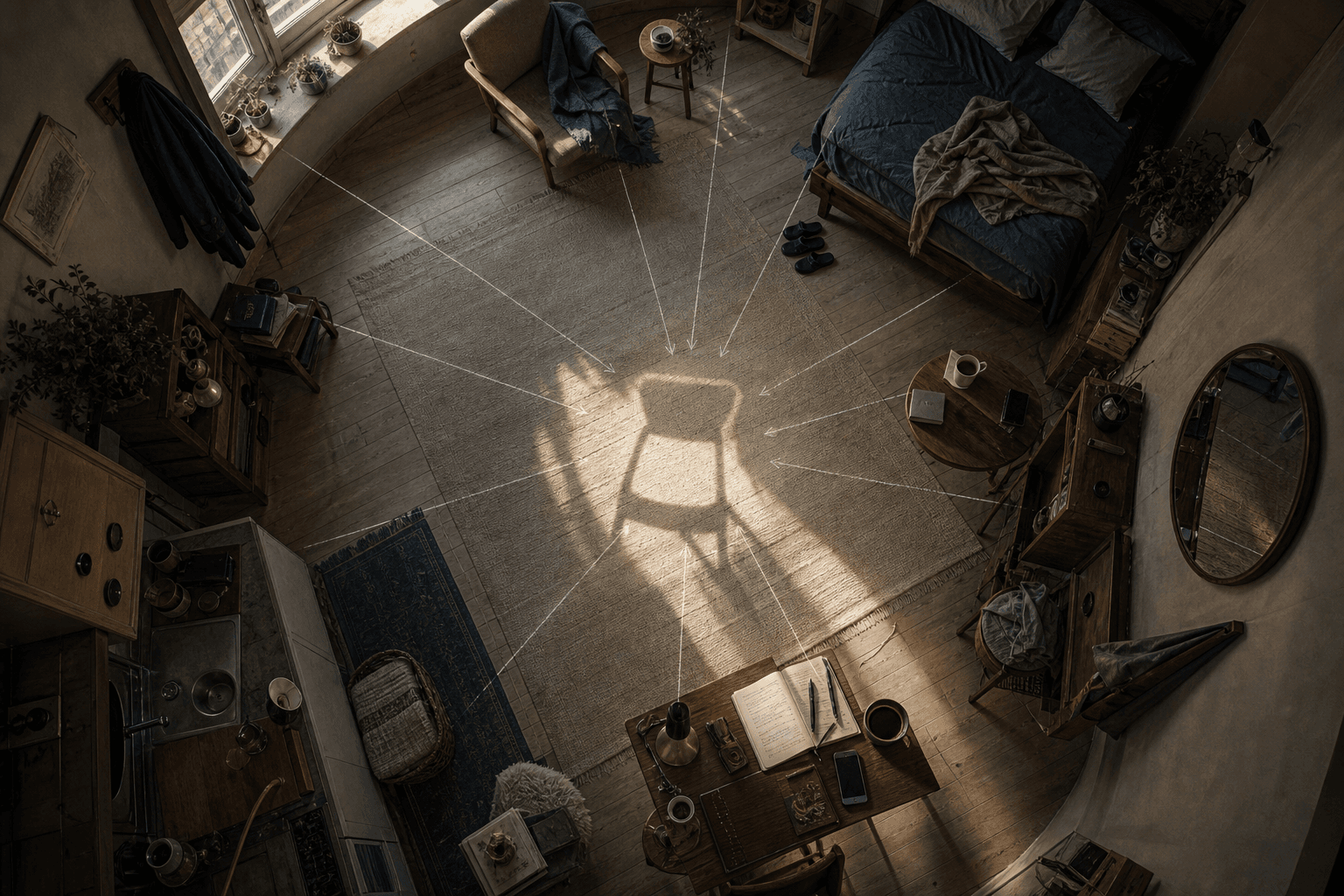
At some point in the inquiry, you will try to find the "I." You will have noticed thoughts arising, sensations arriving and dissolving, emotions moving through. And you will think: who is noticing this? Where is the one who has all of this?
So you look. You find more thoughts. More sensation. More awareness. But not the thing doing the having. The one you were looking for is not there as an object. What is there is the looking itself.
The "I" is not an object hidden inside consciousness. It is a position inside experience: the felt center of orientation through which reality becomes personal. The center exists. It is just not solid.
Why experience feels personal
Experience does not arrive as neutral data. It arrives from here. You do not merely register that there is warmth. You feel warmth in your body. You do not merely detect that there is pain. You feel pain as yours. The "I" is the name for this firstness, this here-ness, this mine-ness that organizes every moment of experience.
Before "I" is a philosophical concept, it is a biological fact. An organism that cannot distinguish self from world cannot act effectively. The nervous system must mark: this sensation is from my tissue, this threat is near my body, this action is being initiated by this system. The "I" begins as the organism's point of view, the anchor required for a living body to navigate [1, 2].
What the "I" is made of
There are at least four layers to what we call "I," and they are not the same thing.
The first is the body's orientation: this location, this pain, this hunger, this hand moving. Before anything else, "I" is the sensory and spatial center of a living system.
The second is ownership: experience tagged as belonging to this system. My thought. My memory. My desire. This tagging is partly constructed. It can break. Intrusive thoughts feel not fully mine. Dissociation makes the body feel like someone else's. Deep states of meditation can loosen ownership without ending experience.
The third is narrative: the story that connects moments across time. The child, the adult, the wounded one, the builder. Memory creates a line and calls everything on it me. This continuity is also constructed. The person who was humiliated at twelve is not the same neural configuration as the person remembering that humiliation at forty. The narrative says: that was me [3].
The fourth is the bare first-person opening: the fact that experience appears from the inside at all. There is something it is like to be this. That thisness gets named "I" before identity, before biography, before personality develops on top of it [4].
Two meanings that get confused
The "I" has two referents that regularly collapse into one another.
The constructed self: name, body, memories, personality, preferences, wounds, roles, beliefs, ambitions. The accumulated content of a life organized into a character.
The witnessing subject: the open field in which all of that appears. The fact of the looking itself. The space in which the constructed self arises, shifts, suffers, and changes.
Most people live entirely as the constructed self and never locate the witnessing subject. Or they glimpse the witnessing subject and conclude the constructed self is an illusion to be discarded. Neither is accurate.
The constructed self is real the way a flame is real: it exists, it has effects, it can be harmed and sustained and strengthened. But it is not a solid object. It is a pattern maintained moment by moment by memory, attention, emotion, language, body sensation, and the reflection of others. A process, not a substance [5].
The witnessing subject is also real, but it is not a separate hidden self behind the constructed one. It is the first-person perspective as such. The opening in which experience occurs.
Where confusion becomes suffering
Most of the suffering generated by the "I" comes from treating the constructed self as a fixed, solid, threatened object.
If I am my status, then losing status destroys me. If I am my past, then being reminded of the past attacks me. If I am my personality, then being asked to change feels like annihilation. The constructed self defends itself as if defending a real solid thing, because it has been mistaken for one.
When the constructed self is seen as a pattern rather than a substance, it becomes less brittle. It can update. It can be questioned without the questioning feeling like death. It can hold contradiction without fracturing. The same content, the same biography, the same wounds. But held differently because the nature of the container is understood [3, 5].
The witnessing subject has no such problem. It is not threatened by what appears in it. It does not defend itself because it has nothing to defend. It is not a thing that can be insulted, diminished, or destroyed. It is the field.
What is found when you search
When you search directly for the "I," the finding is strange.
You can find the body. You can find sensations. You can find thoughts, emotions, memories, impulses. But the one having all of this does not appear as a discoverable object. What appears is more experience. More awareness. The search keeps producing its contents but never produces the thing at the center.
This is not a failure of the search. It is the finding.
The "I" is not hidden somewhere behind experience, waiting to be uncovered. It is the perspective from which the search is conducted. The seeker and the sought are the same movement. This is why the direct inquiry into "I" tends to produce a particular vertigo: you were looking for an object and found a position. You were looking for a noun and found the fact of looking [4].
The center you have been looking for exists. But it is not solid. It is not a thing. It is the fact that experience is organized around here, around now, around this. That organization is the "I." And that organization is, on examination, centerless: not located in any particular part of experience, but the shape through which all of it is organized.
The point
Consciousness feels like "I" because experience is organized around a point of reference. Every sensation, thought, and emotion arrives as mine, here, now. The "I" is the felt name for that organization.
But the organization is not itself an object. The constructed self is real but not solid: a process, a pattern, a flame-shape of memory and story and body that maintains its form without being made of fixed material. The witnessing subject is real but not an object: the open first-person field in which the constructed self appears.
What "I" really is: the position from which reality becomes personal. Not a thing at the center of experience. The shape of experience having a center at all.
You will not find it by looking harder. You will find it by noticing that the looking is already happening from somewhere, and that somewhere is not a place but a perspective. The center is there. It just does not have edges.
Sources
- Damasio, A. (1999). The Feeling of What Happens: Body and Emotion in the Making of Consciousness. Harcourt. On the proto-self and core self: consciousness begins as the brain's representation of the organism's own body state, creating the biological foundation of the "I" before narrative or personality develops.
- Zahavi, D. (2005). Subjectivity and Selfhood: Investigating the First-Person Perspective. MIT Press. On the minimal self: the first-person perspective is not an add-on to experience but its structural feature. All experience is phenomenologically mine before it is anything else.
- Parfit, D. (1984). Reasons and Persons. Oxford University Press. On personal identity: the self is not a separately existing entity but a series of connected experiences. Psychological connectedness rather than a persistent object is what constitutes personal continuity.
- Nagel, T. (1974). "What is it like to be something?" Philosophical Review, 83(4): 435-450. On the irreducibility of the first-person perspective: the "what it is like" quality of experience resists third-person reduction, and its source is the fact of having a point of view at all.
- Metzinger, T. (2003). Being No One: The Self-Model Theory of Subjectivity. MIT Press. On the phenomenal self-model: the "I" is not a thing but a real-time model the brain runs of itself. The self appears solid because the model is transparent: you look through it rather than at it.