
Symbolic Possession
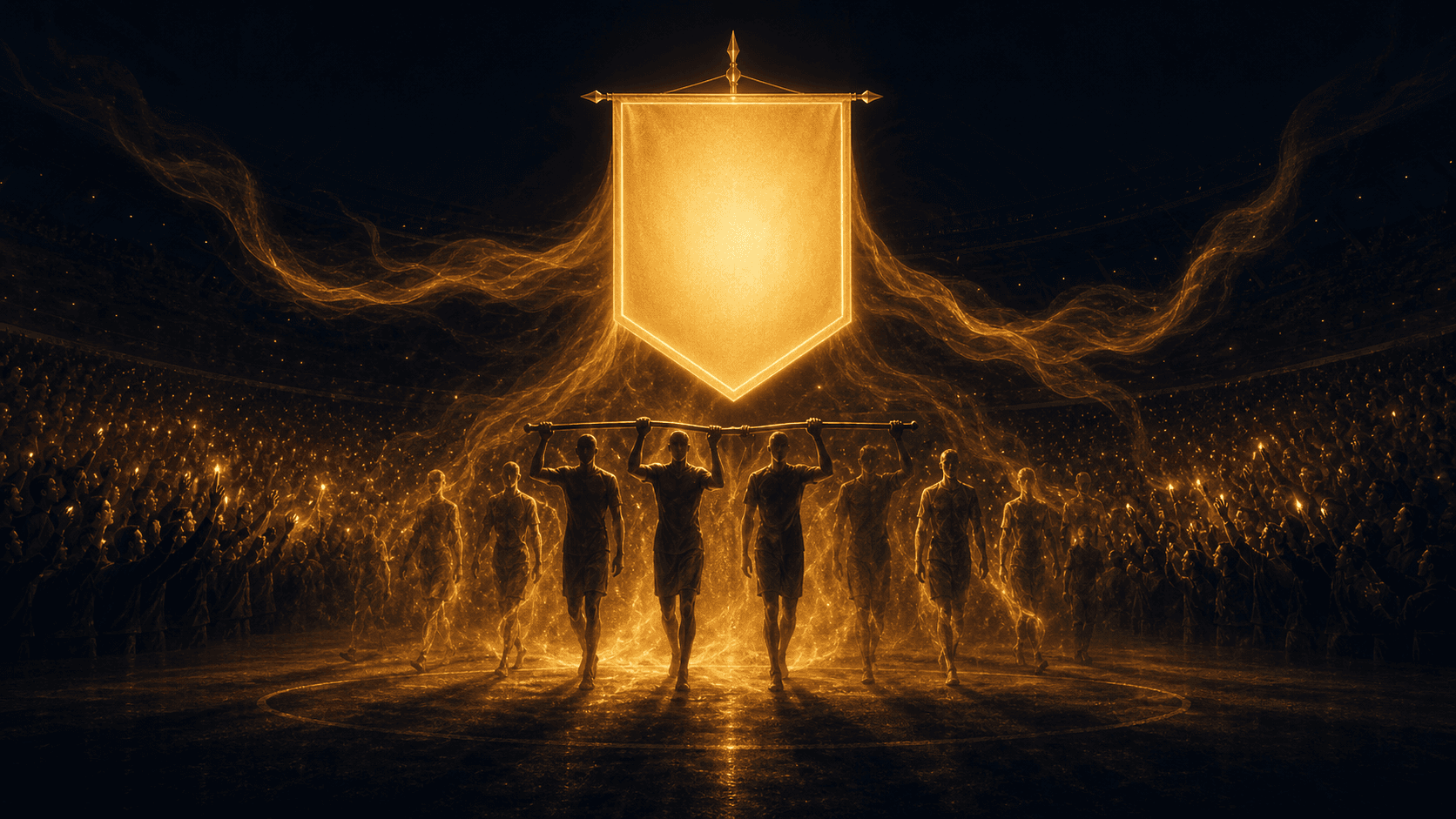
A devoted fan can tell you their team is theirs. Their team. And if you look closely at the team, you find a group of athletes who were mostly born elsewhere, recruited from anywhere, paid to play, and likely to be traded away within a few years. None of them represent the city in any literal sense. They arrived from outside, and they will leave. Yet the fan's sense of "my team" is not shaken by this at all.
That stability in the face of complete turnover reveals something about how collective identity works. The fan is not actually attached to the players. They are attached to a symbol that survives the players, and the players are just the current bodies temporarily wearing it.
Collective identity attaches to a symbol, not to its contents. The team is a container that survives the total replacement of everything inside it. The loyalty is to the banner. The people carrying it are interchangeable.
The container survives its contents
A professional team is, materially, a shifting collection of parts. The players turn over. The coaches turn over. The ownership changes. The stadium gets rebuilt or relocated. Over a few decades, essentially every physical component of the team can be replaced, and yet the team is experienced as one continuous entity with a continuous identity [1].
This is the old puzzle of the ship whose every plank is replaced over time. Is it the same ship? For physical objects the answer is contested. For a team, the fans answer decisively: yes, it is the same team, obviously, even though nothing physical about it has stayed constant. The continuity they perceive is not in any of the parts. It is in the symbol: the name, the colors, the history, the rivalry, the accumulated story [1, 2].
The symbol is the actual object of attachment. The players are not the team. They are temporary occupants of the team, actors stepping onto a stage that existed before them and will exist after them. The fan's loyalty passes through the players to the banner they carry, and the banner is what stays.
Why outsiders become "ours" instantly
This explains a phenomenon that would be baffling if loyalty were really to the people. A player on a rival team can be hated for years. Then that player is traded to the fan's team, puts on the new uniform, and is instantly embraced as one of "ours." Nothing about the person changed. The same body, the same skills, the same history. Only the symbol they carry changed [2].
The speed of the reversal shows where the attachment actually lives. If fans were loyal to the people, the switch could not happen overnight. The accumulated history of opposition would carry over. But it does not, because the loyalty was never to the person. It was to the symbol, and the moment the person takes up the symbol, they inherit the loyalty attached to it. Yesterday's enemy becomes today's hero by changing what banner they carry [2, 3].
This is symbolic possession. The fan possesses the symbol, identifies with it, treats it as an extension of self. The people are absorbed into it or expelled from it depending on which symbol they currently serve. The human beings are real, but they are not the thing being rooted for. The thing being rooted for is the banner, and the people are its temporary vessels.
Shared illusion becomes social reality
Seen coldly, the attachment looks like an illusion. A fan treats a corporate entertainment franchise, staffed by recruited strangers, as if it were a homeland representing their identity. Stated that way, it sounds almost delusional: this random group of employees represents my soul.
But the attachment is not delusional, because it is not held alone. It is held by millions of people simultaneously, and that shared holding converts it into something real. When enough people agree that the symbol represents them, the symbol does represent them, in the only sense that matters socially. The agreement is the reality. This is the same mechanism that makes money, nations, brands, and institutions real: not physical substance, but coordinated collective belief that becomes a genuine social force [3, 4].
So the symbol is simultaneously an illusion and a reality. It is an illusion in that there is no physical, continuous, representative thing there, only a shifting collection of parts under a persistent name. It is a reality in that millions of people organize real emotion, money, time, and identity around it, and that organization has real effects in the world. The illusion, shared widely enough, stops being merely an illusion and becomes a structure people live inside [4].
The same machinery everywhere
The team is a clean example because its turnover is so visible, but the mechanism is general. Collective identities of many kinds work this way: attachment to a symbol that persists while its contents are entirely replaced. A nation persists while its entire population is replaced across generations. An institution persists while every member who founded it is gone. A brand persists while every product and employee changes [3].
In each case, the loyalty is to the banner, not the bodies. The bodies are vessels that carry the symbol for a while and are then replaced by new vessels carrying the same symbol. The continuity people feel is real as experience and is located in the symbol, not in any persistent substance, because there is no persistent substance. There is only the name, the story, and the collective agreement to treat them as one continuous thing.
The point
Collective identity attaches to symbols, not to their contents. A team is a container that outlasts the complete replacement of its players, owners, and stadium, and fans experience it as one continuous entity precisely because their loyalty was never to the parts. It was to the banner the parts carry.
This is why a hated rival becomes an instant hero by changing uniforms: the person is a vessel, and the loyalty follows the symbol, not the human. It is symbolic possession. The fan identifies with the banner and absorbs or expels people based on which banner they serve.
This looks like illusion, and in one sense it is. But shared by millions, the illusion becomes social reality, the same way money and nations and institutions are real: through coordinated collective belief that produces genuine effects. The team is partly imagined and fully real at once. And the same machinery runs every large collective identity. The bodies change. The banner stays. The loyalty was always to the banner.
Sources
- Hobsbawm, E. & Ranger, T. (eds.) (1983). The Invention of Tradition. Cambridge University Press. On how continuous collective identities are constructed and maintained through symbols, rituals, and narratives that persist while the actual constituents and circumstances change.
- Wann, D. L. & Branscombe, N. R. (1993). "Sports fans: Measuring degree of identification with their team." International Journal of Sport Psychology, 24(1): 1-17. On team identification as attachment to the symbolic entity of the team rather than to individual players, and the resulting stability of fan loyalty across roster turnover.
- Anderson, B. (1983). Imagined Communities. Verso. On how large collective identities are sustained through shared symbols and imagined continuity among people who will never meet, and how this imagined belonging produces real solidarity and action.
- Searle, J. R. (1995). The Construction of Social Reality. Free Press. On how collectively accepted status functions, from money to institutions, become genuine social facts through shared agreement rather than physical properties, making shared "illusions" into real structures.