
Adaptation Is Not Proof of Health
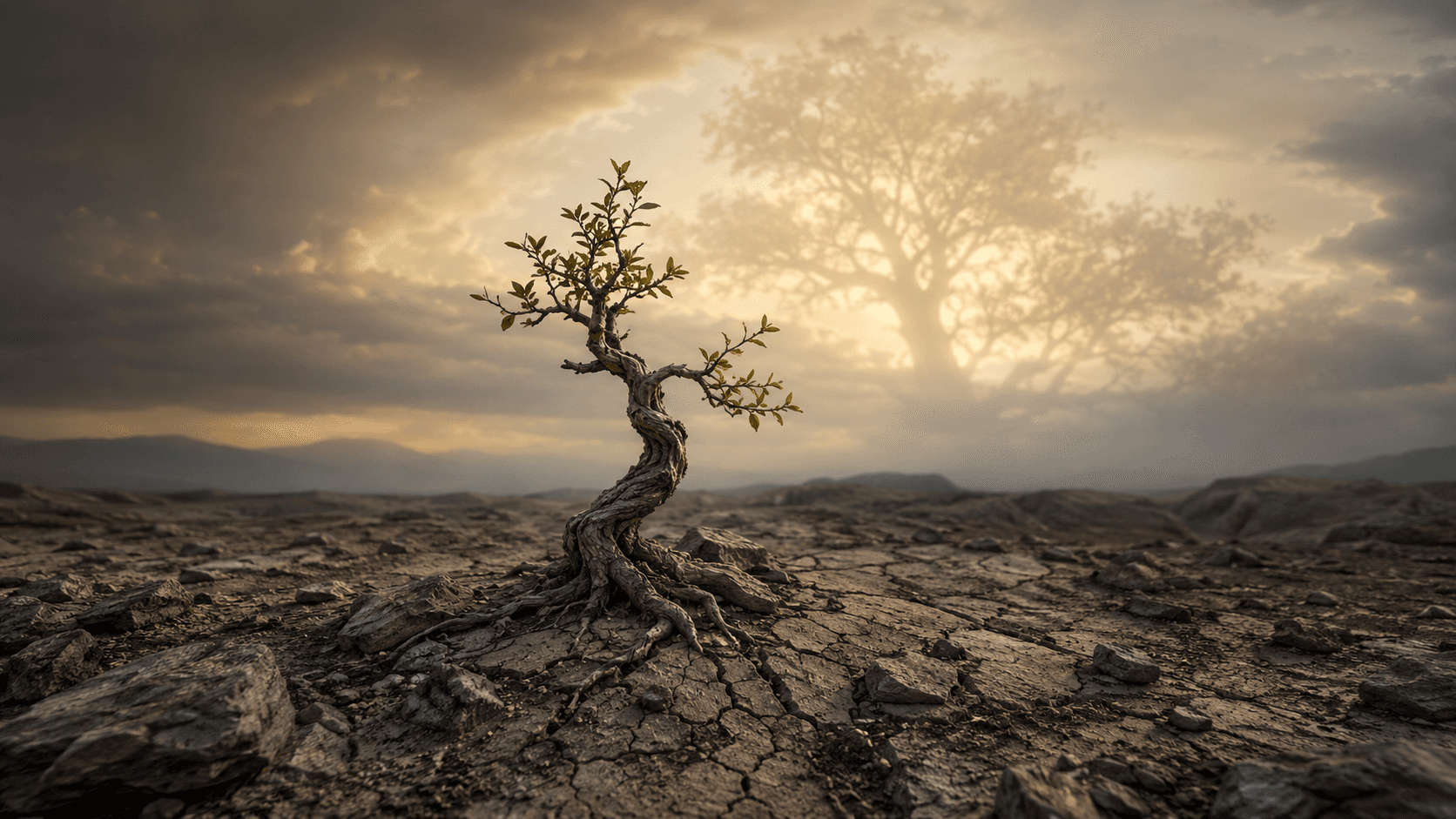
A plant in bad soil may survive. But its survival is not proof that the soil was fine. It may grow twisted, smaller, tougher, more defensive. It may become what people call resilient. What it did not become is more itself. It became what it had to become in order not to die.
That distinction matters more than most people realize.
Adaptation is talked about almost entirely as a virtue. Flexibility, resilience, maturity, the ability to work with reality as it is rather than as you wish it were. These are real and valuable capacities. But the conversation almost never includes the other kind of adaptation: the kind that happens not because you grew, but because something you needed was not there, and you had to reshape yourself around the absence.
That second kind is not growth. It is injury management. And calling it wisdom too quickly skips over something that deserves to be grieved.
Adaptation is not proof of health. It is proof of pressure. Sometimes what we call strength is the shape the organism took when the environment could not meet it.
Two kinds of adaptation
The distinction between them is precise.
Growth adaptation is what happens when an organism encounters reality, learns its shape, and becomes more capable, more grounded, more skillful. You adapt to the cold by building warmth. You adapt to complexity by developing more sophisticated tools for navigating it. This kind of adaptation expands you. You become more yourself through contact with what is real.
Privation adaptation is different. It happens when the environment cannot provide something the organism genuinely needs, and the organism reduces itself to survive the gap. You become less expressive because expression gets punished. You become self-contained because no one holds you. You become hyperarticulate because low-resolution communication keeps failing. You become armored because openness keeps costing you. You carry both your own signal and the missing receiver, which is why people eventually say you are too much, when what you actually are is too much for the amount of environment they are providing [1, 2].
Privation adaptation is survival. It is also real loss. The organism that did not need to adapt this way would have been something else. Something softer, less vigilant, less self-sufficient out of necessity, more available to the world. That version was not weakness. That version was the original design.
What society does with this
Society tends to moralize privation adaptation. It looks at a person who has learned to need less, expect less, and feel less, and calls that person strong. It looks at the twisted plant and praises the toughness of the wood without asking what the soil was like.
"You can't change them, so you have to adapt." This is sometimes true as behavioral advice. Stop handing your nervous system to people who mishandle it. Stop explaining yourself to people who cannot receive you. Stop going to an empty well. These are real and protective adjustments [3].
But the instruction to adapt is emotionally incomplete when it skips the moral truth underneath it. Yes, you may have to adapt. The bad soil does not become good soil because you learned to grow in it. Your adaptation does not redeem the environment. Your eventual wisdom does not retroactively justify the deprivation.
There is a hidden cruelty in "just adapt" when what it actually means is: stop needing what would have been good for you. Shrink your hope to match the room. Become compatible with deprivation. Call the wound wisdom [4].
The burden and the more capable person
There is a specific pattern in family systems and relational environments that compounds the injury.
The more conscious person, the one who can see the pattern, name the dysfunction, and track the variables, is expected to manage it. Because you can see what is happening, you are expected to absorb more complexity. Because you understand the system, you are expected to accommodate it. The less capable people get to remain as they are, while the more capable person becomes the ecosystem's shock absorber [3].
This is not an accident. It is a structural feature of how systems maintain equilibrium. The person with the most differentiated self takes on the most adaptive pressure, because differentiation is precisely the capacity to hold complexity without collapsing. The system uses that capacity. And then the more conscious person is often praised for their strength, while no one grieves what the strength cost them [5].
The village still sucks. The adaptation does not redeem it. And the more capable person carrying the village's dysfunction is not a sign that the dysfunction is acceptable. It is a sign that the more capable person has not yet been given the full truth about what they have been absorbing.
What adaptation actually proves
Starvation adaptations are natural. Trauma adaptations are natural. Emotional numbing is natural. Hypervigilance is natural. Dissociation is natural. A tree growing around a fence is natural. That does not make the fence innocent [2, 4].
What is natural is not the same as what is good. And what is survivable is not the same as what was adequate. These distinctions are easy to collapse, especially after the fact, especially when the adaptation has become so integrated into the self that it is no longer recognizable as an adaptation. It just feels like who you are.
This is where the adaptation becomes most dangerous: not when it is consciously chosen as a protective strategy, but when it has become invisible as the self. When the armoring is called character. When the reduced expectations are called realism. When the emotional self-sufficiency is called maturity. When the person can no longer feel the shape of what was lost because the loss happened too early, too gradually, or too completely [1].
The task, precisely stated
The answer is not to refuse adaptation. Refusing adaptation in an environment that cannot meet you is a kind of self-destruction. You cannot survive on the romantic idea of the soil you deserved.
The better path is more specific: adapt outwardly without lying inwardly.
Change the behavior to protect yourself. Stop expecting sight from the blind. Stop making your aliveness depend on people who cannot metabolize it. Build the protections that a difficult environment requires.
But do not call the bad soil good. Do not call shrinking peace before you have finished grieving the full-sized version of yourself. Do not let survival adaptations become your permanent identity. Do not accept the praise of your strength without also acknowledging, at least to yourself, what the strength was built on and what it cost.
The point
The most honest position is not "I am grateful for my difficult environment because it made me strong." That collapses too fast into the story the environment wants you to tell about it.
The most honest position is something harder to hold: the environment was inadequate, the adaptation was real and was the best available response, the strength that grew from it is genuine, and something was also lost that deserved to exist. All of these are true at the same time.
Somewhere inside the adapted version of you is the memory of the plant that deserved better soil. That memory is not self-pity. It is accuracy. And keeping it is not weakness. It is the refusal to let the story of your survival become the only story about what happened.
Sources
- van der Kolk, B. (2014). The Body Keeps the Score: Brain, Mind, and Body in the Healing of Trauma. Viking. On how the body adapts around traumatic absence and what those adaptations cost in terms of self-expression and access to experience.
- Levine, P. A. (2010). In an Unspoken Voice: How the Body Releases Trauma and Restores Goodness. North Atlantic Books. On trauma adaptation as frozen survival responses and the difference between adaptive function and restoration of the full self.
- Bowen, M. (1978). Family Therapy in Clinical Practice. Jason Aronson. On differentiation of self in family systems and how the most differentiated person in a system absorbs a disproportionate share of the system's anxiety.
- Winnicott, D. W. (1965). The Maturational Processes and the Facilitating Environment. International Universities Press. On the false self as an adaptation to an inadequate environment and the cost of that adaptation to the true self.
- Anda, R. F., Felitti, V. J., Bremner, J. D., Walker, J. D., Whitfield, C., Perry, B. D., Dube, S. R., & Giles, W. H. (2006). "The enduring effects of abuse and related adverse experiences in childhood." European Archives of Psychiatry and Clinical Neuroscience 256(3): 174-186. On the long-term structural effects of inadequate developmental environments, including adaptations that persist well beyond the original conditions.