
The Armor Becomes the Cage
A person will tell you, with complete sincerity, that they are simply being themselves. Their guardedness, their need to control how they are seen, their avoidance of certain subjects, their reflexive toughness: all of it feels like personality, like free choice, like just how they are. And much of it is not free at all. It is obedience to something they cannot see, running a program set long ago.
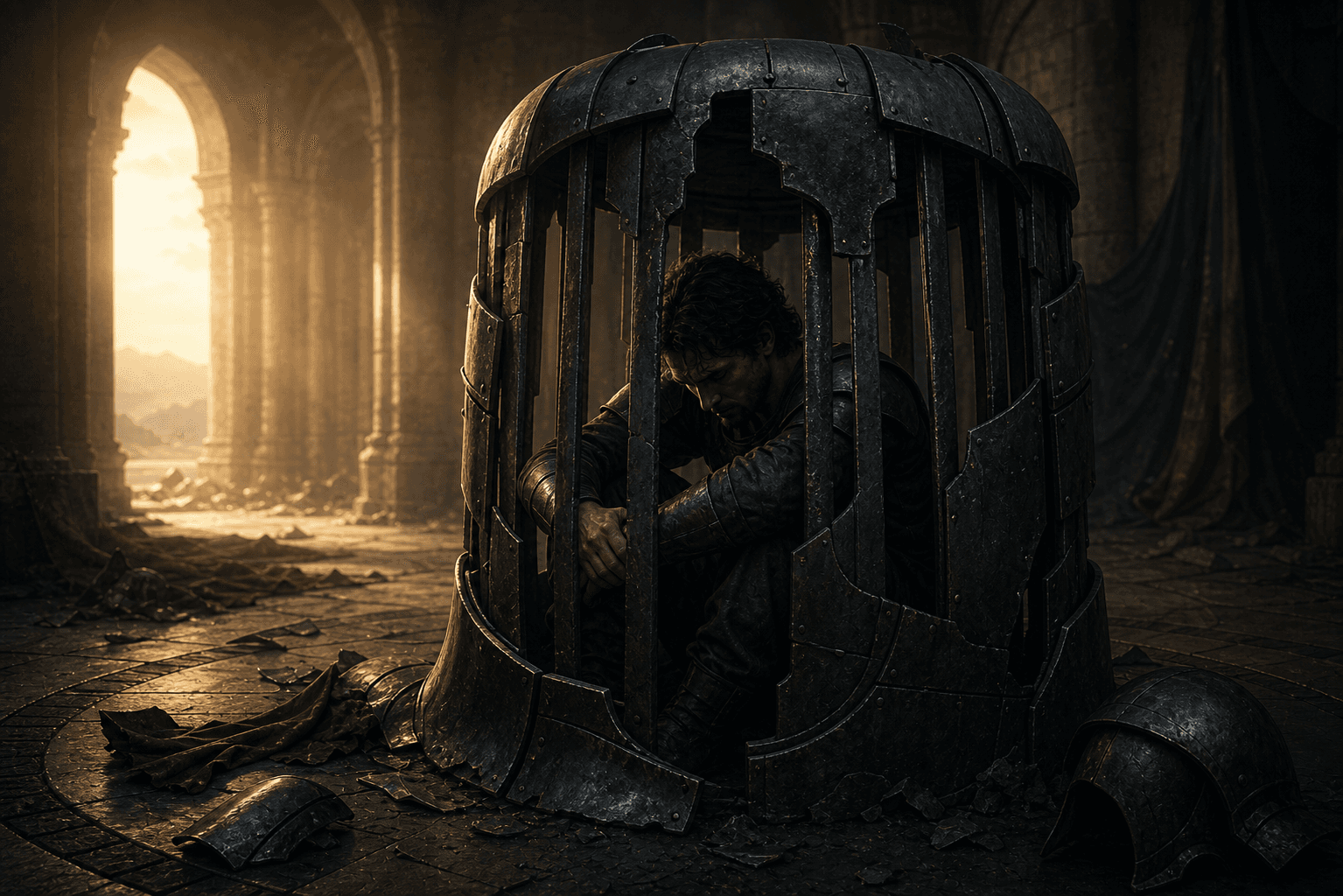
This is the strange condition of being a slave to yourself without knowing it. The choices feel free while being governed by unseen inner masters. And the masters are not random tyrants. They are old defenses that once protected something real and have long since hardened into the walls of a cage.
People obey unseen inner masters, pride, fear, avoidance, inherited scripts, while experiencing themselves as free. These defenses once protected something. Protection that outlives its threat becomes a prison, and it feels like simply being yourself.
The unseen masters
Much of what feels like free choice is actually obedience. A person believes they are deciding, but the decision is being shaped by forces they do not see operating: pride that cannot allow a certain admission, fear that steers them away from certain risks, avoidance that quietly removes certain options, inherited scripts that dictate certain responses. These operate below awareness, and their invisibility is what gives them power [1].
The person experiences the output of these forces as their own free preference. They do not feel pride deciding for them; they feel that they simply do not want to do the thing pride forbids. They do not feel fear steering them; they feel that the avoided path is genuinely undesirable. The master disguises itself as the self's own will, so that obeying it feels identical to choosing [1, 2].
This is why the enslavement is so hard to detect. There is no felt coercion, no sense of a force overriding your choice. The force has merged with the sense of choosing itself. You are a slave to yourself precisely because the master speaks in your own voice, and you have no reason to suspect that the voice is not simply you [2].
The defenses were once protective
The crucial thing about these inner masters is that they are not arbitrary. They are defenses, and defenses are built to protect. Each one was, at some earlier point, a survival architecture that guarded something vulnerable: a way of not being hurt again, not being exposed, not being overwhelmed, not being abandoned [2].
The guardedness protected a person who was once unsafe being open. The toughness protected a person who could not afford to be soft. The need for control protected a person who was once helpless. The avoidance protected a person from a pain they could not then bear. At the time, these were intelligent adaptations. They worked. They kept something intact that might otherwise have been destroyed [2, 3].
This origin matters because it means the defenses cannot simply be condemned as flaws. They are the residue of real protection, and they were once load-bearing. The person built them for good reason, and they did their job. The problem is not that they were built. The problem is what happens to protection after the threat it was built for is gone [3].
Protection outlives its threat
A defense is calibrated to a specific danger. But the defense does not automatically dissolve when the danger passes. It keeps running, because it was never given an off switch, and because by now it feels like part of the self. So the protection outlives the threat, and protection without a threat is no longer protection. It is just a wall standing where the danger used to be [3].
The wall that once kept something out now keeps the person in. The guardedness that protected a vulnerable child now prevents an adult from being known. The toughness that was necessary armor now blocks the softness the person actually wants. The control that saved a helpless person now strangles their relationships. The defense continues to do exactly what it was built to do, but the situation has changed, so the same action that was once protection is now imprisonment [2, 3].
This is the turn: the armor becomes the cage. The identical structure that was a shield in one era is a prison in the next, and nothing about the structure had to change for its meaning to invert. Only the context changed. The protection stayed the same and became its opposite, because a wall is protective only as long as there is something on the other side worth keeping out [3].
Why the cage is invisible
The final difficulty is that the person inside the cage usually cannot see it, because the bars feel like personality. The defense has been running so long that it has been absorbed into the sense of self. This is just who I am. I am a private person. I am not the sharing type. I like to keep control. These self-descriptions feel like identity, and they are actually the walls of the old protection, renamed as character [1, 2].
Because the cage is experienced as identity, questioning it feels like an attack on the self rather than an examination of a defense. The person defends the bars as though defending their freedom, when the bars are the opposite of freedom. The very thing that constrains them is felt as the thing that defines them, so they guard it, and the guarding keeps the cage in place [2].
Seeing the cage requires the difficult move of distinguishing between the self and the defenses the self has been mistaking for itself. It means recognizing that "just how I am" may be "how I once had to be," and that the danger that required it may be long gone while the requirement keeps running. The armor felt like me because it has been with me so long. But armor worn after the war is over is not identity. It is a cage that has learned to call itself a self.
The point
Much of what feels like free choice is obedience to unseen inner masters: pride, fear, avoidance, inherited scripts that operate below awareness and disguise themselves as the self's own will. This is what it means to be a slave to yourself without knowing it. The coercion is invisible because the master speaks in your own voice, so obeying it feels identical to choosing.
These masters are old defenses, and the defenses were once real protection: survival architecture built to guard something vulnerable, intelligent adaptations that worked at the time. They cannot simply be condemned, because they were load-bearing. But a defense is calibrated to a specific threat, and it does not dissolve when the threat passes. It keeps running, and protection that outlives its threat becomes a prison. The armor becomes the cage, the same structure inverting from shield to prison as the context changes around it.
And the cage is invisible because its bars feel like personality. "Just how I am" is often "how I once had to be," the old protection renamed as character and defended as identity. Freedom begins with the hard distinction between the self and the defenses it has mistaken for itself, recognizing that the armor felt like you only because you wore it so long, and that armor worn after the war is over is not who you are. It is a cage that learned to call itself a self.
Sources
- Freud, A. (1936). The Ego and the Mechanisms of Defense. International Universities Press. On the defense mechanisms the mind deploys below awareness, and how these protective operations shape behavior while remaining invisible to the person enacting them.
- Reich, W. (1933). Character Analysis. Farrar, Straus and Giroux. On "character armor": how chronic defensive patterns become embedded in the personality, experienced as identity rather than as the protective structures they originally were.
- Bowlby, J. (1980). Attachment and Loss, Vol. 3: Loss. Basic Books. On how early protective adaptations to threat and loss persist into contexts where they are no longer adaptive, continuing to govern behavior long after the conditions that produced them have changed.