
Why Anything Feels Like Anything
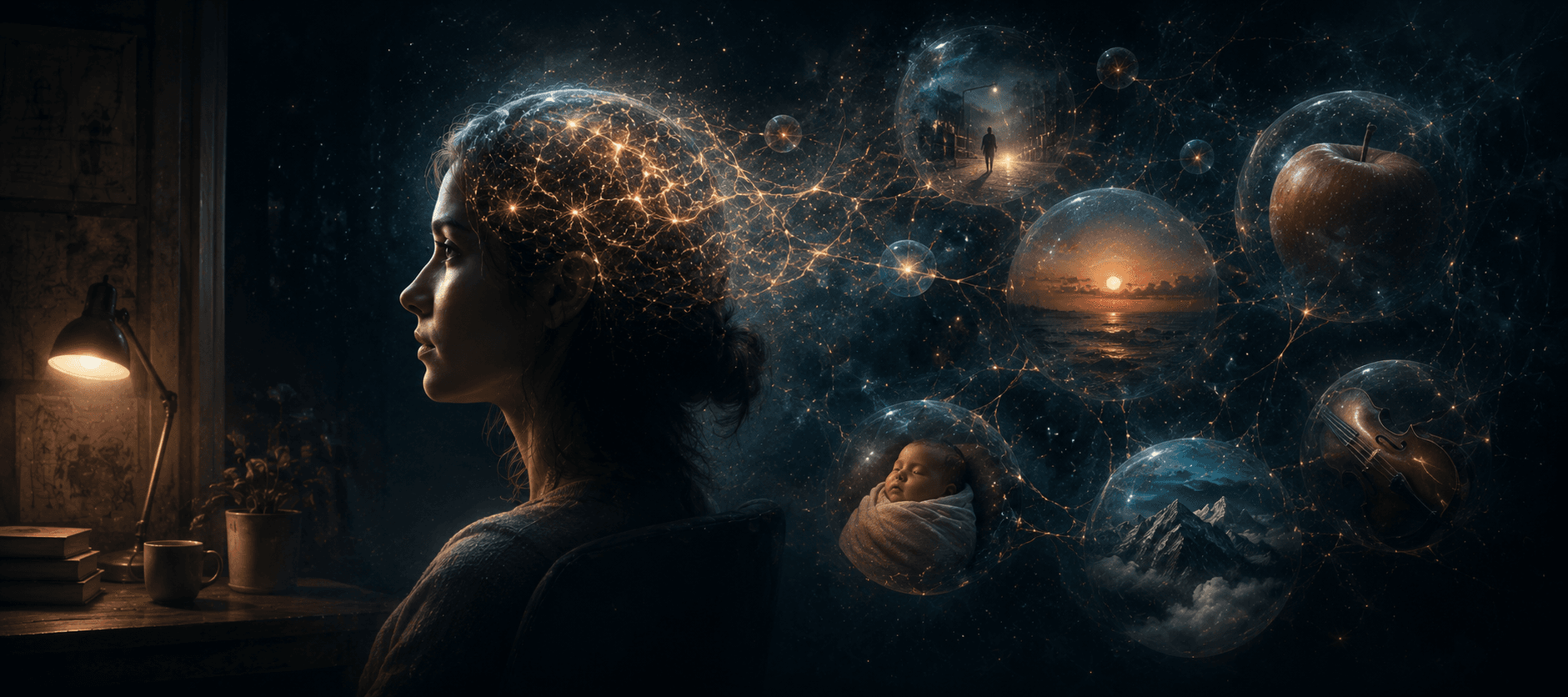
Right now, you are seeing these words. Not just processing them. Seeing them. There is something it is like to read this sentence: the shape of the letters, the particular quality of the light in the room, the faint background hum of whatever you are feeling. All of that has texture, color, presence. It is not just data. It is experience.
Here is the question that has resisted every serious attempt to answer it: why?
Why is there something it is like to be you, rather than nothing? Why does the processing your brain does feel like anything at all? A thermostat processes information. It does not, as far as we know, feel warm. A computer runs calculations. There is no known reason to believe it experiences anything. The brain also processes information. But it produces experience. Why?
This is not a question about which neurons fire or which chemicals are involved. Science has made enormous progress on those questions and will make more. This is a question about why any of it is accompanied by inner experience at all, rather than happening in the dark with no one home.
The hard problem is not explaining what the brain does. It is explaining why what the brain does feels like anything.
The easy problems and the hard one
The philosopher David Chalmers drew a distinction in 1995 that clarified why consciousness is so strange a problem [1]. He called some questions about the mind "easy problems." Not easy in the sense of simple, but easy in the sense of tractable: they can in principle be solved by explaining the relevant mechanisms.
How does the brain integrate information from different senses into a unified scene? How does it focus attention? How does it distinguish sleep from waking? How does it generate language from thought? These are hard scientific questions. But they have the right shape for science. You can imagine, at least in principle, a complete mechanistic account that explains the function.
The hard problem is different in kind. Even if you had a complete account of every mechanism, every neuron, every feedback loop, every information-processing structure in the brain, you would still be left with a question that the account does not touch: why is all of this accompanied by experience? Why does it feel like something from the inside?
Imagine a being, identical to you in every physical detail, whose brain runs every process yours runs, but in the dark. No inner experience. Just the processing. This being, which philosophers call a zombie, does everything you do, says everything you say, including claiming to be conscious. But there is nothing it is like to be it. Is such a being conceivable? If yes, then the physical facts do not by themselves explain consciousness. Something is left out [1, 2].
What Thomas Nagel's bat actually shows
In 1974, the philosopher Thomas Nagel published a paper that made the problem vivid in a way that has not been improved on [2].
A bat perceives the world through echolocation. It emits high-frequency sounds and navigates by the returning echoes. We can describe the mechanism in complete detail: the frequencies, the processing in the auditory cortex, the behavioral outputs. What we cannot do, Nagel argued, is know what it is like to be a bat. Not because we lack information, but because the first-person character of experience is not the kind of thing that third-person descriptions capture.
What it is like to echolocate is something. We do not have access to that something from the outside. And if we do not have access to the bat's inner experience from the outside, then a complete third-person account of the bat's brain leaves something out. That something is consciousness itself.
The same applies to other humans. You can study my brain in complete detail. You cannot know from that study what it is like to be me. That gap is not a technical limitation. It is a structural feature of the relationship between objective description and subjective experience.
Why the usual answers do not work
The standard move when this problem is raised is to say that consciousness is just what complex information processing feels like from the inside. The brain processes information in a sufficiently complex and integrated way, and that complexity just is experience. The two are the same thing described from different angles.
This sounds satisfying until you push on it. Because it does not actually answer the question. It relocates the mystery rather than dissolving it. Why would complexity produce experience? Why would integration produce the felt quality of redness, or pain, or the particular weight of Tuesday afternoon? The question is not whether complex systems can produce interesting behavior. Of course they can. The question is why any system, no matter how complex, has an inside at all [3].
Some researchers respond by proposing that consciousness is fundamental, like mass or charge. Not produced by physical processes but present at the base level of reality, with complex brains being the structures that concentrate and organize it into the rich inner life we know [4]. This view, called panpsychism in various forms, has serious philosophical defenders and serious problems. It does not make the mystery disappear. It relocates it again, to the question of how elementary experience combines into unified human consciousness.
Others respond by denying the explanandum: consciousness, in the folk sense, is an illusion. There is no hard problem because there is no real inner experience to explain, only the brain's tendency to generate reports about inner experience [5]. This is the position with the least intuitive support, for reasons that are difficult to articulate but immediate: it seems to require denying the most certain thing you have access to. Whatever else you doubt, the fact that something is happening from the inside right now is hard to deny while it is happening.
What the gap means
The hard problem does not prove that consciousness is supernatural, or that the brain does not generate it, or that science will never make progress on it. It proves something more specific and more useful: that the framework science uses, third-person description of objective processes, has a systematic blind spot. It can describe everything about the brain except why any of it is accompanied by experience.
That is not a failure of science. It is a structural feature of the method. Science describes the world from outside. Consciousness is the inside. The tools built for the outside will always leave a remainder when applied to the inside. Not because the inside is beyond reality, but because no description of an object fully captures what it is like to be that object [1, 2].
This matters. It means that a purely materialist account of the universe, one that acknowledges only what third-person description can reach, is almost certainly incomplete. Not wrong in what it says. Incomplete in what it includes. There is something that it is like to be a conscious thing. That something is real. It is the realest thing you have direct access to. And no current theory explains why it is there.
The point
The hard problem is not a puzzle waiting for a clever enough scientist. It is a signal about the shape of the framework. Every other question in science can in principle be answered by describing mechanisms. This one cannot, because mechanisms are third-person descriptions and the question is irreducibly first-person.
You are conscious. Something is happening from your side of reality right now, as you read this. That fact is the most certain fact you have access to. It is also the fact that every physical theory of the universe, for all its extraordinary power, does not explain.
That gap is not a reason for mysticism. It is a reason for precision: be honest about what the framework can reach and what it cannot. The universe appears to have an outside and an inside. Science is very good at the outside. The inside is still, genuinely, waiting.
Sources
- Chalmers, D. J. (1995). "Facing up to the problem of consciousness." Journal of Consciousness Studies 2(3): 200-219. The paper that named the hard problem and distinguished it from the easy problems of cognitive science.
- Nagel, T. (1974). "What is it like to be a bat?" Philosophical Review 83(4): 435-450. The argument that subjective experience cannot be captured by objective description, regardless of how complete the description is.
- Chalmers, D. J. (1996). The Conscious Mind: In Search of a Fundamental Theory. Oxford University Press. The full philosophical development of the hard problem and an examination of the responses available to it.
- Tononi, G. (2004). "An information integration theory of consciousness." BMC Neuroscience 5(1): 42. The integrated information theory proposal: consciousness as a fundamental quantity proportional to a system's integrated information.
- Dennett, D. C. (1991). Consciousness Explained. Little, Brown. The eliminativist response: consciousness in the folk sense is a construction, and the hard problem dissolves once the construction is properly understood.