
Cities Are Materialized Imagination
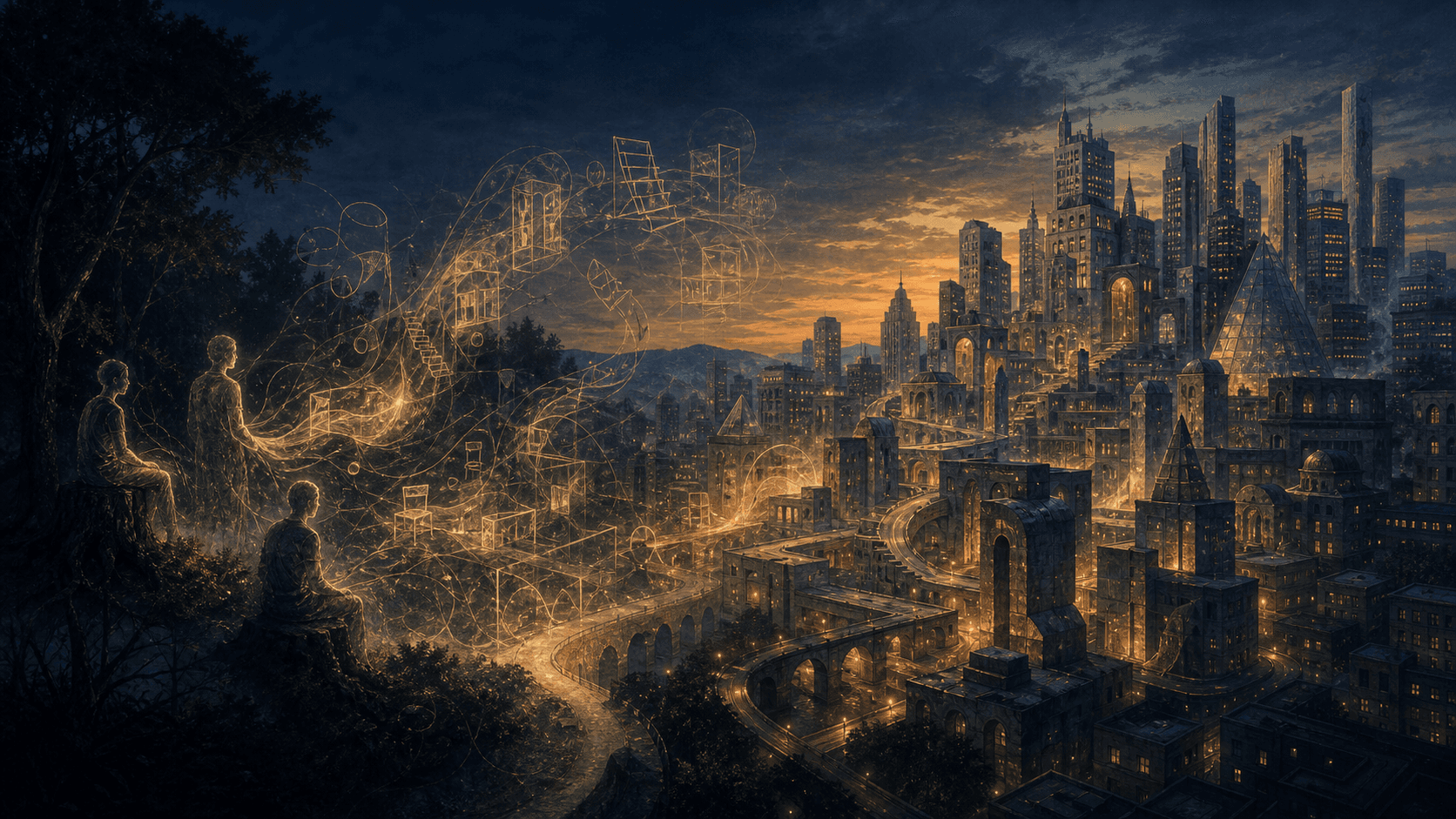
Stand in a forest and everything around you grew. The trees, the soil, the insects, the weather. None of it was designed. It emerged from physics, chemistry, and selection, with no intention behind any of it. Now stand on a city street. The walls, the signs, the chairs, the antennas, the painted lines on the road, the clothing on every person. None of it grew. Every single object was first imagined by a mind and then forced into matter.
That is the difference between nature and civilization, and it is more profound than it first appears. A city is not simply a denser, more artificial kind of nature. It is a different category of thing. It is imagination made solid.
A city is imagination forced into matter. Every built thing was first a mental form: an imagined boundary, an imagined path, an imagined identity, made into resistance, permanence, and visibility. To walk through a city is to walk through externalized minds.
Two ways forms come into being
Forms in nature arise from impersonal processes. A river carves a valley through erosion. A species develops a wing through selection. A crystal grows according to the geometry of its molecules. None of these forms required a mind to imagine them first. They are the output of physics and biology running without intention [1].
Forms in civilization arise the opposite way. A chair does not grow. It begins as an imagined sitting-shape in a mind, and then that mental form is imposed on wood or metal. A road begins as an imagined path and is then made permanent. A wall begins as an imagined boundary and is then made into physical resistance. Every built object traces back to a mental form that preceded it. The imagination came first, and the matter was shaped to fit it [2].
This means a city is a vast collection of mental forms that escaped their minds and took on physical bodies. The objects are not natural facts. They are intentions that hardened.
Imagination that became enforceable
The most striking version of this is the objects that have no physical force at all in nature but govern behavior completely inside the human field.
A painted line on a basketball court has no power in physics. Nothing in nature makes that line a boundary. But inside the shared symbolic field of the game, the line governs movement absolutely. Players obey it as if it were a wall. A stop sign has no physical force. A dollar bill is paper. A property line is invisible. A badge is metal. None of these have power in nature. All of them have enormous power inside the human imagination once enough minds agree to treat them as real [3].
This is imagination that became not just visible but enforceable. A boundary that exists only because it was collectively imagined, and then was backed by agreement strong enough to make it function like a physical law. The line, the sign, the bill, the badge: these are mental forms that millions of minds agreed to obey, and the agreement made them as binding as gravity within the human world [3].
So a city is not only physicalized imagination. It is collectively enforced imagination. Mental forms that became binding because the imagining was shared widely enough to become a structure people live inside.
Stacked, not singular
A city is not one person's imagination. It is the imagination of millions of minds across time, layered on top of each other. The street you walk on was imagined by people now dead. The building was imagined by an architect, modified by builders, repurposed by owners, regulated by officials, decorated by tenants. The clothing was imagined by designers, manufactured by workers, chosen by wearers [2].
Every object is the sediment of stacked intention. It is not a single dream made solid but a negotiation among many dreams: competing, inheriting, copying, enforcing, forgetting. A city is a fossil bed of human wants, accumulated over generations, each layer pressed onto the ones before it. It is dream sediment, hardened into infrastructure.
This is why walking through a city is a strange experience if you slow down enough to notice it. Every object is quietly saying: someone wanted this. Someone feared something and built a wall. Someone wanted profit and put up a sign. Someone wanted order and painted a line. Someone wanted beauty, comfort, status, control, belonging. The city is the externalized record of what human minds wanted, made permanent enough to outlast the wanting [2, 4].
Inhabited by externalized minds
The deepest version of the observation is that a city is not only inhabited by people. It is inhabited by their externalized minds. The objects are mental contents that left their skulls and became furniture, architecture, infrastructure, choreography.
A human mind does not stay private. It escapes, constantly, into matter. It becomes the building, the law, the logo, the uniform, the weapon, the entertainment, the road. The city is where this escape becomes total: a space built almost entirely out of mental forms that took on physical bodies. The people move through a landscape made of their own and their predecessors' imaginations, mostly without noticing that this is what it is [2, 4].
Nature is the place where forms grew without minds. The city is the place where minds grew forms. To be in a city is to be inside imagination that became load-bearing.
The point
Nature grows its forms out of impersonal processes: physics, chemistry, selection, with no intention behind them. Civilization grows its forms the opposite way: every built thing begins as a mental form and is then forced into matter. A city is imagination made solid.
Some of that imagination became not just physical but enforceable: lines, signs, currencies, and badges that have no power in nature but govern behavior completely once minds agree to treat them as real. These are mental forms that became binding through shared belief, as compelling within the human world as physical law.
And it is not one mind but millions, stacked across time. A city is dream sediment, a fossil bed of accumulated human wants, each object quietly recording that someone wanted, feared, or intended something. To walk through a city is to walk through externalized minds, through imagination that left the skull and became load-bearing. Nature is forms without minds. The city is minds become form.
Sources
- Kauffman, S. (1995). At Home in the Universe: The Search for the Laws of Self-Organization and Complexity. Oxford University Press. On how natural forms arise from self-organizing processes without design or intention, in contrast to the intentional origin of artifacts.
- Simon, H. A. (1969). The Sciences of the Artificial. MIT Press. On the artificial as the realm of things shaped by human purpose: artifacts are mental designs imposed on matter, distinguishing the made world from the natural world by the intention that precedes them.
- Searle, J. R. (1995). The Construction of Social Reality. Free Press. On status functions and collective intentionality: how objects like money, boundaries, and signs acquire powers they do not possess physically, through collective agreement that makes imagined functions enforceable.
- Lefebvre, H. (1974). The Production of Space. Anthropos. On how social space is produced rather than given: the built environment as the materialization of human intentions, social relations, and accumulated decisions across time.