
Nature Becomes Psychological
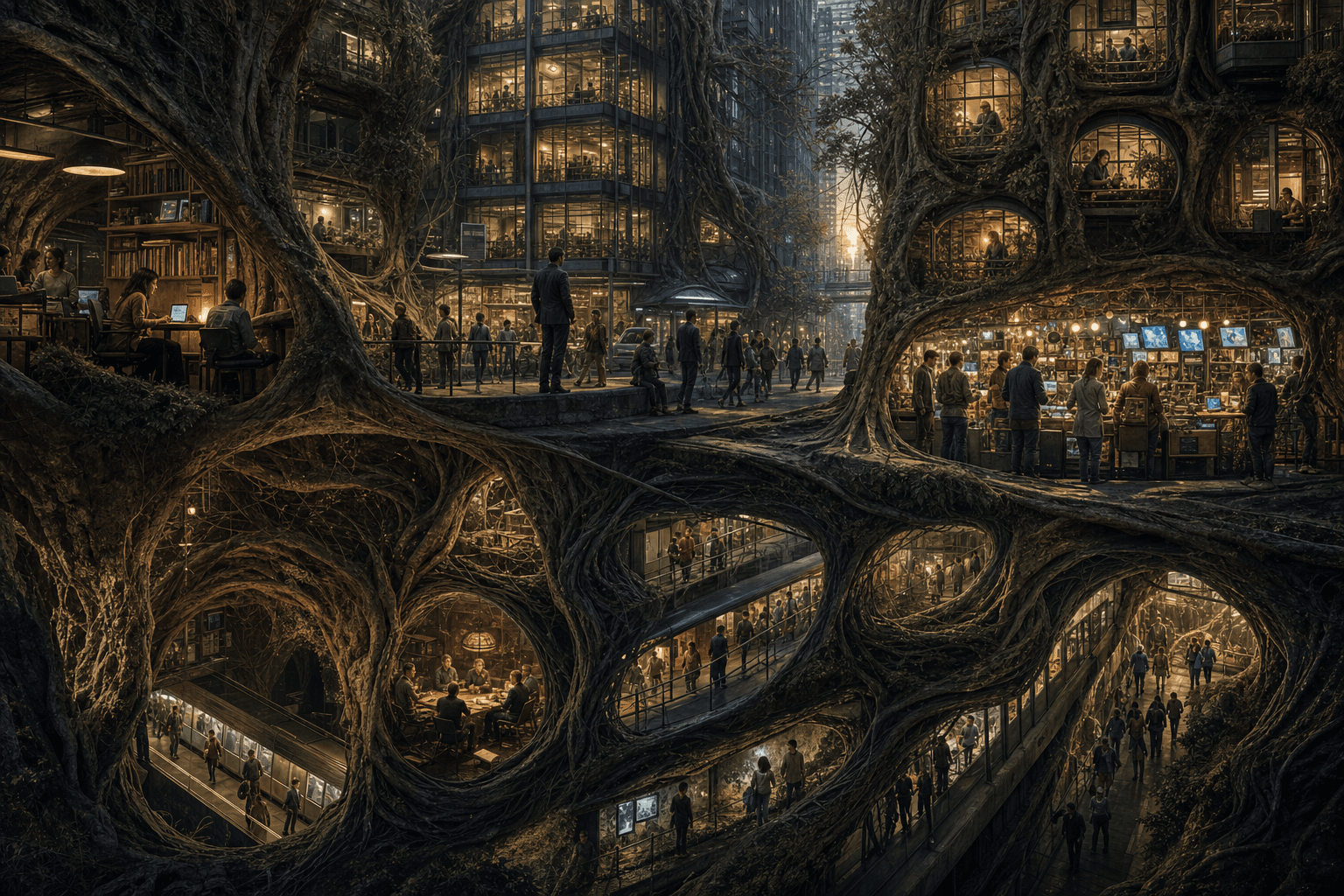
People say they need to get out into nature, and they mean forests, mountains, rivers, animals, the world before the city. The city is treated as the opposite of nature, an artificial thing laid on top of the natural one. But a person in a city full of cars and towers and screens is not outside nature. A worm gets eaten by a bird. A man has a mother who cannot meet him. Both are nature. One is just filtered through a nervous system complex enough to make it hurt in a different way.
This is the mistake in the ordinary picture. Civilization is not an escape from nature; it is nature becoming psychological. Nature did not disappear when cities appeared. It became apartments, traffic, hospitals, money, loneliness, status, and memory. A highway is not less natural than a beehive once you see humans as animals who build. What moved was not the presence of nature but the location of its suffering, from the body to the mind.
Civilization is not an escape from nature. It is nature becoming psychological. The city, the family, the market, and the wound are as natural as predation, and what changes is not that suffering ends but that it relocates from the body to meaning.
The split that does not exist
The common frame sets nature and human life against each other. Nature is wilderness, instinct, animals, the non-human world. Human civilization is culture, technology, artifice, the thing that separated us from nature. On this frame, to return to nature is to leave the human-made world behind, as though the human-made world were built somewhere other than inside nature [1].
But the split does not survive scrutiny. A human being is an animal, and everything an animal builds is part of nature. A bird's nest is nature; a city is nature. A beehive is nature; a market is nature. The only way to call the city unnatural is to first decide that humans are exempt from the natural world, and there is no ground for that decision except the human wish to feel exceptional. Remove the exemption and the split collapses [1, 2].
So the city is nature filtered through human cognition, language, engineering, and desire. It is not a departure from the natural order but an expression of it, the same order that produces nests and hives and hunts, now running through a different kind of animal. The forest and the freeway are on the same side of the line. There was never a line, only a story that put humans on the far side of one [2].
What moved when the suffering moved inward
If the city is nature, then the suffering inside the city is natural too, which is harder to accept. A worm eaten by a bird is nature. A child ignored by a parent is nature. These are not different universes; they are different regions of the same one. But something real does distinguish them, and it is not that one is natural and the other is not. It is the medium of the suffering [3].
Animals suffer largely through the body: hunger, cold, infection, predation, injury. Their pain is acute and physical and tends to end when the physical cause ends. Humans suffer through meaning: rejection, misattunement, invisibility, humiliation, unmet longing, distorted identity, the absence of a witness. Our nervous systems convert relational and symbolic events into a kind of internal weather that can persist long after any physical threat is gone. The suffering did not become less natural. It became psychological [3].
This is the actual content of the phrase. When nature became human, it did not shed its capacity for suffering; it moved that capacity inward, from teeth and hunger to memory and meaning. The animal is chased and then, if it survives, returns to eating and sleeping. The human is wounded by a sentence and then constructs a metaphysics around the wound. Same nature, deeper interior, and the depth is exactly where the new suffering lives [3].
Safe and destroyed at once
The strangest consequence is that a human can be completely safe and still be in enormous pain, and this is not a malfunction but the signature of nature having gone psychological. An animal in a warm, fed, unthreatened state is generally not suffering. A human in a warm room, fed and unthreatened, can be destroyed by one remembered sentence from a parent. The body is safe; the meaning is not [3].
This looks like a paradox only if suffering is assumed to track physical threat. Once suffering runs on meaning, it detaches from physical safety. The battlefield is no longer the environment; it is the interior. A person can have every bodily need met and be at war inside, because the war is symbolic, fought over recognition, love, worth, and history rather than over food or shelter. Physical safety does not touch it, because it is not a physical problem [3].
So the fact that human suffering can occur in total physical safety does not make it imaginary or self-indulgent. It makes it precisely what it is: nature's suffering, relocated to the only place complex enough to hold it. The animal suffers where the danger is. The human suffers where the meaning is, and the meaning is inside, which is why safety and devastation can occupy the same warm room at the same time [1, 3].
Natural does not mean right
There is one thing that changes when nature becomes psychological, and it is not the suffering but the observer of it. Once an animal has consciousness, language, reflection, and moral imagination, it can do something no worm can do: it can say that what happened, though natural, was not right. The capacity that made the suffering deeper also made judgment of the suffering possible [1].
This matters because "it is nature" is often heard as "it is acceptable," and the two do not follow. Predation is natural and not a moral event. A parent's failure to see a child is natural in the same broad sense, produced by the same order, but it lands on a creature capable of moral evaluation, and that creature can hold it as wrong even while understanding it as natural. Nature explains the wound. Nature does not excuse it, because the same nature produced the moral imagination that judges it [1, 2].
So the full shape of the idea is this. Civilization is nature becoming psychological, which means the suffering is natural, which means it is not imaginary, and also means it is not thereby justified. The human is the animal in whom nature became able to suffer symbolically and, at the same moment, became able to say that some of what it suffers should not have been done. The interior that deepened the pain is the same interior that can name it unjust. That double capacity is what it is to be nature, turned inward, and awake.
The point
Nature and civilization are not opposites. A human is an animal, and everything an animal builds is natural, so the city, the family, the market, and the wound are as much a part of nature as a nest or a hunt. The split between wilderness and the human-made world rests only on a wish to feel exceptional, and once that exemption is dropped, the city is simply nature filtered through human cognition and desire.
What distinguishes human suffering from animal suffering is not that one is natural and the other is not. Both are natural. It is the medium. Animals suffer through the body, acutely and physically, and the pain tends to end when its cause ends. Humans suffer through meaning, and the nervous system turns relational and symbolic events into a lasting interior weather. Nature did not become less real when it became human. It became psychological, moving its suffering from teeth and hunger to memory and meaning.
This is why a person can be perfectly safe and still be destroyed, because the battlefield moved inward and physical safety does not reach it. And it is why "it is nature" does not mean "it is acceptable." The same complexity that deepened the suffering produced the moral imagination that can judge it. Nature explains the wound and does not excuse it. To be human is to be nature turned inward and awake, capable at once of suffering symbolically and of saying that some of what it suffers was wrong.
Sources
- Wilson, E. O. (1978). On Human Nature. Harvard University Press. On the continuity between human behavior and the rest of the natural world, and the mistake of treating culture and civilization as exempt from biological nature.
- Becker, E. (1973). The Denial of Death. Free Press. On the human being as a symbolic animal whose distinctive suffering arises from meaning, self-awareness, and the need to matter, layered on an animal body.
- Sapolsky, R. M. (2004). Why Zebras Don't Get Ulcers. Holt. On how humans, unlike most animals, suffer from psychological and anticipatory stressors rather than only physical ones, generating prolonged internal distress in the absence of any physical threat.