
Truth Is What Survives Every Perspective
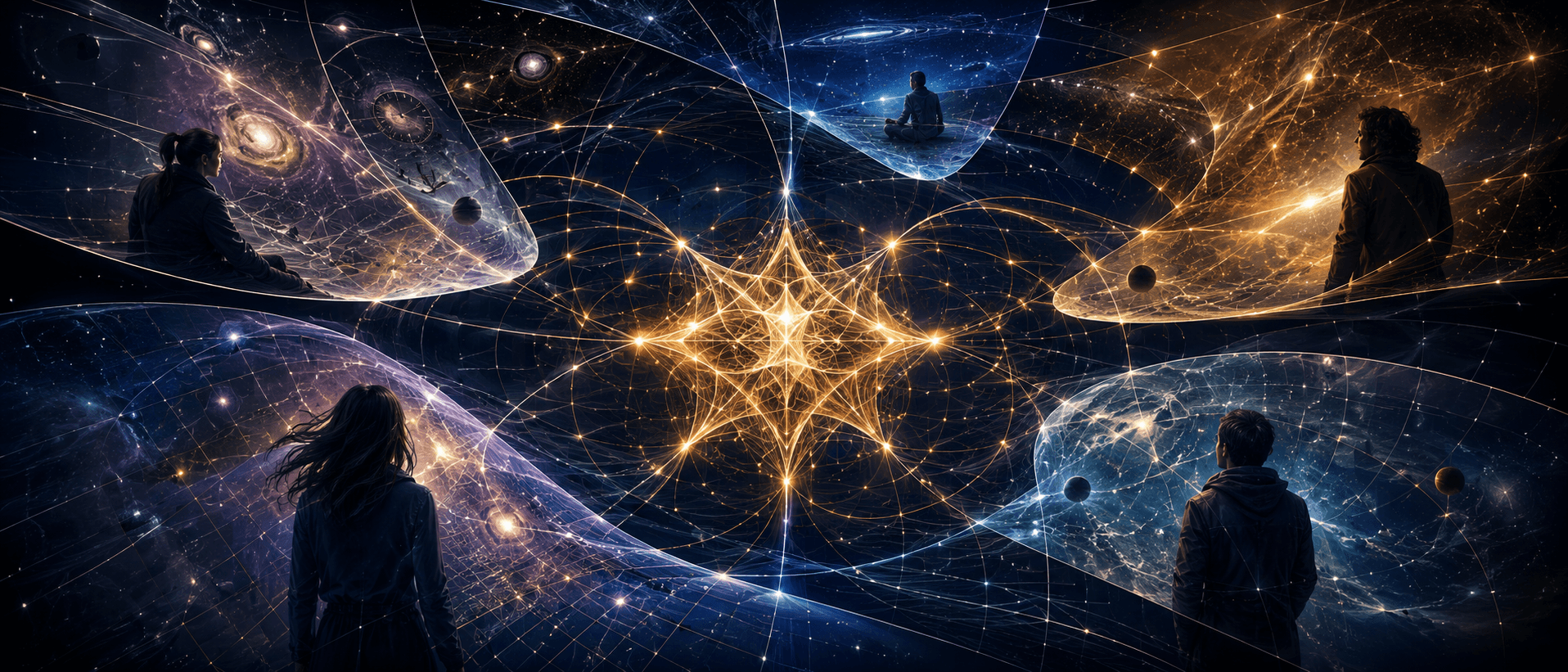
You carry a picture of the world inside you. It is so basic you have never had to form it consciously. Things exist. They are located somewhere in space. They change over time. Space is the container. Time is the river. You are a thing moving through both.
This picture is wrong. Not approximately wrong. Structurally wrong, at the level of its most basic assumptions.
Einstein did not discover that everything is relative. That is the popular version and it misses the point almost entirely. What Einstein discovered is almost the opposite: that beneath all the differences in what observers measure, beneath all the disagreements about length and duration and simultaneity, something remains constant. Something survives every transformation of viewpoint. The work was not to say that truth is perspectival. The work was to find what is not.
Reality is not the world as it appears from inside one nervous system. Reality is the invariant structure that remains when every local perspective has been accounted for, transformed, and survived.
What the picture gets wrong
The ordinary model of reality puts objects first. There are things. They sit in space. Time moves around them. This feels so self-evident that questioning it seems perverse.
But space and time are not the container. They are part of what gets shaped. Mass tells spacetime how to curve, and curved spacetime tells matter how to move [1, 2]. What we call gravity is not a force reaching across empty space to pull objects toward each other. It is the geometry of spacetime becoming non-flat around mass, so that what looks like falling is actually a body following the straightest possible path through a bent reality. You are not pulled toward the Earth. You are moving naturally through curved spacetime, and the ground is what stops you from completing that path.
Even standing still is not as still as it feels. The Earth pushes up against your feet to prevent you from following your natural trajectory through spacetime. You experience that push as weight.
The thing about now
The most disturbing single result in relativity is this: there is no universal present moment [3].
Not in the sense that clocks disagree, though they do. In a deeper sense. Two observers moving differently relative to each other can genuinely disagree about which events are simultaneous, and neither is wrong. The events that are happening "right now" for one observer are not the same set of events that are happening "right now" for another observer moving at a different velocity. This is not a measurement error. It is not a limitation of their instruments. It is the structure of reality.
Your consciousness produces a vivid, compelling, absolutely certain sense of a present moment. A knife-edge of now. The feeling that only this instant is real, that the past is gone and the future has not arrived. Physics says that knife-edge is local, not universal. It is something your nervous system generates because it has to navigate, not something the universe is built around [4]. The present is real for you. It is not a feature of reality at large.
This does not mean fatalism. It means something more precise. Your feeling that only the present is real may be a property of consciousness, not a property of spacetime. In the four-dimensional structure physicists call the block universe, your birth, this sentence, and your death are not all happening simultaneously. But they are all part of one structured totality, with definite relations to each other, none more real than any other by virtue of being "now" [3, 5].
What light is actually doing
Light is the thing that makes all of this visible, and it is stranger than almost any description of it captures.
Light travels at the same speed for every observer, regardless of how fast the observer is moving [1]. This is not an empirical coincidence. It is the structure from which everything else follows. Because the speed of light is constant for all observers, and because motion through space and motion through time trade off against each other, observers in different states of motion experience different rates of time passage. A clock on a fast-moving spacecraft runs slow relative to a clock on the ground. Not because the mechanism is affected. Because time itself is path-dependent.
Light defines the causal structure of reality. Nothing can travel faster than light, which means light sets the limit of what can influence what. The speed of light is not merely a fast speed. It is the conversion factor between space and time. It is what connects them into spacetime rather than leaving them as two separate things [2, 6].
Along a photon's own path through spacetime, what physicists call the null interval, the proper time elapsed is zero. You cannot correctly say the photon experiences this, because a photon has no valid rest frame. But the implication reaches beyond the technicality: light is not something moving inside time. Light is part of the structure that defines what time and distance mean.
What remains when perspective is removed
Here is what Einstein's actual move was.
Different observers measure different values for length, duration, and the order of events. This sounds like chaos. It is not. Einstein found the quantities that every observer agrees on regardless of their motion. The spacetime interval between two events. The laws of physics. The speed of light. These are invariants: true from every frame, surviving every transformation of viewpoint [1, 2].
The shallow reading of relativity is: everything is relative, so truth is subjective. The actual reading is the opposite: the goal is to find what is not relative. Truth is not what any one observer sees. Truth is what remains after you account for every observer's perspective and find what they all agree on. That is an extremely demanding standard for truth. It is also a more honest one.
This principle extends beyond physics. In any situation, a reading that is only visible from one emotional frame is not yet reality. It may be accurate perception. It is not yet invariant. A pattern that remains visible across multiple perspectives, across time, across changes in the observer's state, is stronger. What survives transformation of viewpoint is what is real.
Things are events
One more layer. At the level where physics operates, objects are not the fundamental unit [4, 5].
A chair is not primarily a static object. It is a stability pattern across an enormous number of events: atoms, fields, forces, interactions, light reflecting, neural interpretation completing the picture. The "object" is what appears when a pattern persists long enough for a mind like yours to label it as a thing. Thingness is a convenience that stability creates. The deeper unit is not the object. It is the event and the relation between events.
This applies to you. You are not a thing moving through time. You are a worldline: a structured continuity of events, body, memory, metabolism, interpretation, and relation [3]. Identity is not located at one instant. It is the pattern that persists across change. Memory is not something you have. Memory is part of the continuity that makes you you. Without integration, causal inheritance, and retained structure, there is no stable self. There are only unconnected flashes of registration.
Trauma is real because it constrains future perception. Love is real when it constrains behavior, not merely when it appears as feeling. Gravity is real because it constrains motion. The same structure operates at every scale: what is real is not merely what appears, but what constrains possible appearances.
The point
Reality is not obligated to be intuitive to the organism inside it. Your intuition evolved for medium-sized objects, moderate speeds, Earth gravity, social survival, and language. It did not evolve to perceive spacetime curvature, the relativity of simultaneity, or the absence of a universal now. So "feels real" is not the same as "is real." And "unimaginable" does not mean false.
The mistake is not that you have a limited perspective. Every observer has a limited perspective. The mistake is thinking your perspective is the one that reality is organized around.
Einstein's level of seeing begins when you stop asking reality to look human and start asking what remains when every human frame of reference is corrected, transformed, and compared. What survives that process is the structure underneath. Not the appearance. Not the feeling. The invariant.
That is what reality is made of.
Sources
- Einstein, A. (1905). "Zur Elektrodynamik bewegter Korper." Annalen der Physik 17: 891-921. The original special relativity paper: the constancy of the speed of light and the relativity of simultaneity.
- Einstein, A. (1916). "Die Grundlage der allgemeinen Relativitatstheorie." Annalen der Physik 49(7): 769-822. The field equations of general relativity: mass-energy curves spacetime, curved spacetime governs motion.
- Rovelli, C. (2018). The Order of Time. Translated by Simon Carnell and Erica Segre, Riverhead Books. The most precise non-technical account of what time is and is not in modern physics, including the block universe and the local nature of the present.
- Whitehead, A. N. (1929). Process and Reality. Macmillan. The philosophical account of events and relations as more fundamental than objects, anticipating the process-relational structure implied by relativistic physics.
- Barbour, J. (1999). The End of Time: The Next Revolution in Physics. Oxford University Press. On the timeless formulation of physics and the block universe: why the four-dimensional structure of events may be more fundamental than the experience of time passing.
- Minkowski, H. (1908). "Raum und Zeit." Address delivered at the 80th Assembly of German Natural Scientists and Physicians. The formulation of four-dimensional spacetime as a unified structure, and the light cone as the boundary of causal contact.