
The Object Gate
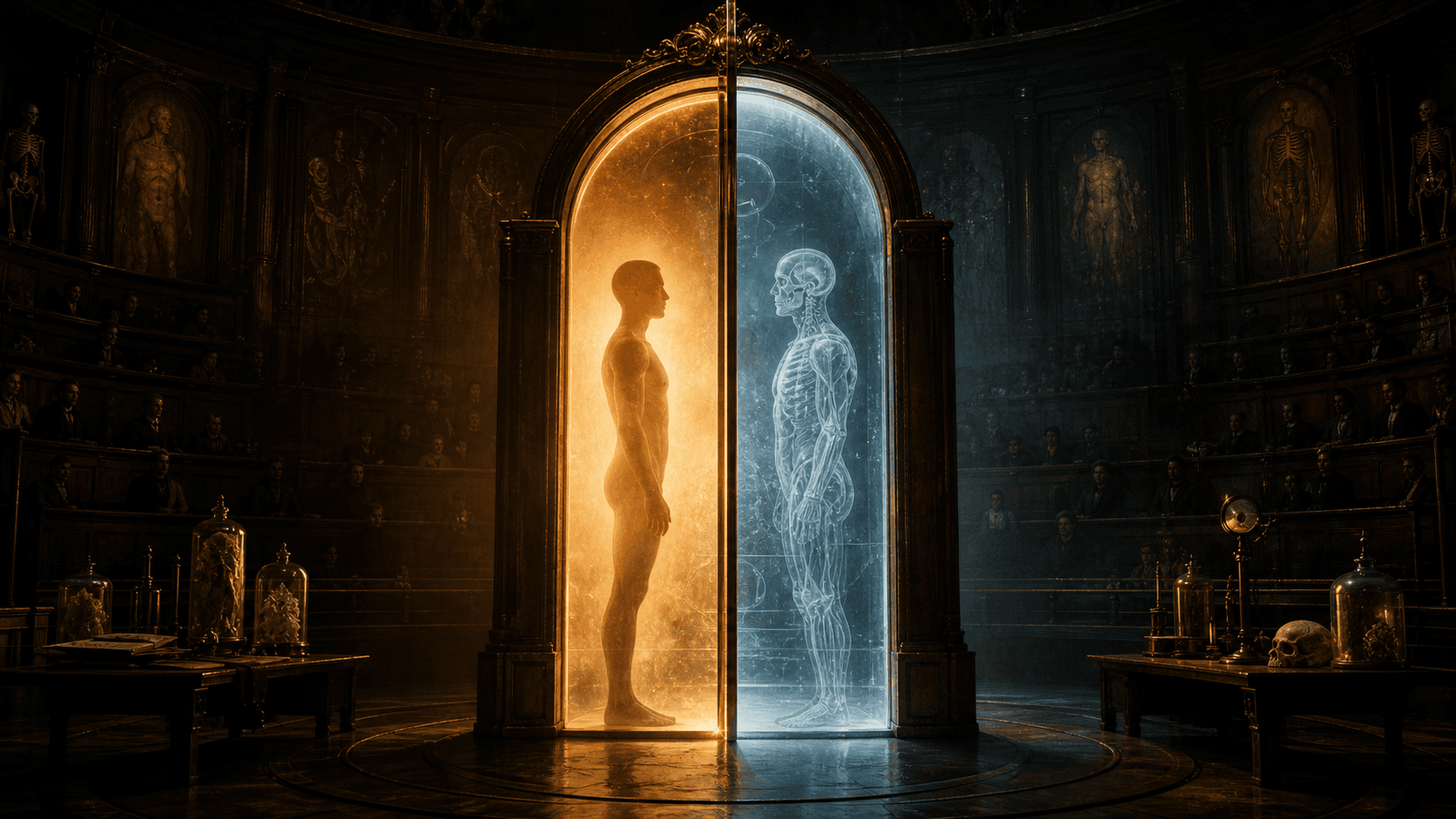
For most of human history, people lived inside bodies they could not look into. They felt hunger, fever, pain, the slow failures of age, and they had almost no map of what produced any of it. The inside of the body was not merely unknown. It was forbidden. To open a corpse and look was not a technical problem first. It was a moral one.
The delay in understanding human anatomy was not mostly about lacking tools or curiosity. It was about a threshold that had to be crossed first: the dead body had to stop being a someone and become a something. Only an object can be studied. And turning a person into an object is a violent act, even when it is done in the service of truth.
To study something, you must first pass it through a gate that converts it from a subject into an object. Knowledge requires that conversion. The conversion is morally violent. This is why some kinds of knowledge come so late and so hard.
Why anatomy took so long
The human body was not opened for systematic study for most of recorded history. Not because no one was curious about what was inside, but because the corpse was protected by an overlapping set of barriers: it was sacred, it belonged to family and ritual, it was tied to ideas of the afterlife and the dignity of the dead, and cutting it open felt like desecration [1].
These barriers were not irrational superstition standing in the way of obvious progress. They were expressions of the fact that the body was still experienced as a person, even in death. The corpse carried the identity of the one who had lived. To dissect it was to treat a someone as a specimen, and that treatment was, and still is, viscerally disturbing to most people.
Knowledge of the body's interior had to wait until the body could be reclassified. Until a dead human could be approached not as the remains of a person but as a structure to be mapped. That reclassification is what made anatomy possible. The advance was not primarily a new instrument. It was a new permission: the permission to treat the body as an object [2].
The gate
Every act of systematic study passes the thing studied through the same gate. To investigate something rigorously, you have to hold it as an object: a thing with properties, available for measurement, separable from your relationship to it. As long as it remains a subject, a someone you are in relationship with, you cannot fully study it. You can only relate to it.
This is the object gate. On one side, the thing is a subject: it has an inside, a claim on you, a status that resists being measured. On the other side, it is an object: a structure, a mechanism, a set of properties you can examine without being implicated. Knowledge of the kind that science produces lives on the object side. To get there, the thing has to pass through the gate, and passing through means having its subjecthood set aside [3].
For a rock, this costs nothing. The rock was never a subject. For a living or once-living being, it costs everything. The gate strips the very thing that made it a someone. And the knowledge gained on the far side is real, useful, often lifesaving. But it was purchased by an act of conversion that, looked at directly, is a kind of violence.
The violence is real even when the result is good
It would be comfortable to say that turning a body into an object for study is purely neutral, a clean intellectual operation with no moral weight. The history says otherwise. The disturbance people feel at dissection, at specimens, at the clinical handling of bodies, is not ignorance to be overcome. It is an accurate registration of what is happening: a someone is being treated as a something [1, 4].
The knowledge is good. Anatomy made surgery, medicine, and the saving of countless lives possible. But the goodness of the result does not erase the nature of the act. Both are true at once. The conversion produces real truth and is a real violation of the status the thing had before the gate. Pretending the violation is not there does not make the knowledge cleaner. It just makes us blind to what knowledge of this kind costs [3, 4].
This is why the people who do this work, who handle bodies, specimens, the once-living reduced to material, often develop rituals of respect. The rituals are not sentimentality. They are an acknowledgment that something was passed through the gate, and that the passage should not be treated as nothing.
The gate runs everywhere
The object gate is not only about bodies. It operates wherever a subject is studied as an object. A person reduced to a data point. A culture reduced to a set of variables. A mind reduced to a mechanism. Each of these produces real knowledge, and each requires the same conversion: the someone is set aside so the something can be measured [3].
This does not mean such study is wrong. The knowledge is often essential. It means the study carries a cost that is easy to forget precisely because the gate, once passed, hides what was on the other side. After the conversion, the object is all you see. The subject it used to be is no longer in view, which makes it easy to believe it was never there. The forgetting is built into the method.
The most honest version of this kind of knowledge keeps the memory of the gate. It studies the object while remembering that the object was made, by an act of conversion, from something that had a different status before.
The point
Knowledge of the rigorous, measuring kind requires that its subject be turned into an object. This is the object gate. A rock passes through for free. A someone passes through at the cost of its subjecthood, and that cost is a real violence even when the knowledge produced is good and necessary.
This is why anatomy took millennia: not for lack of curiosity but because the body had to be reclassified from person to structure before it could be studied, and that reclassification was morally and psychologically hard. The barrier was not ignorance. It was the accurate sense that opening a corpse meant treating a someone as a something.
The gate operates everywhere knowledge converts subjects into objects. The conversion produces truth. It also hides what it converted, because once the thing is an object, the subject it was is no longer visible. The honest move is not to deny the violence in order to keep the knowledge clean. It is to hold both: the truth on the far side of the gate, and the memory of what had to be set aside to reach it.
Sources
- Park, K. (1994). "The criminal and the saintly body: Autopsy and dissection in Renaissance Italy." Renaissance Quarterly, 47(1): 1-33. On the religious, social, and moral barriers to human dissection, and how the status of the corpse as a still-sacred person constrained anatomical study for centuries.
- Carlino, A. (1999). Books of the Body: Anatomical Ritual and Renaissance Learning. University of Chicago Press. On the transition by which the human body became an object of systematic study, and the rituals and institutional structures that managed the moral weight of treating corpses as specimens.
- Nussbaum, M. C. (1995). "Objectification." Philosophy & Public Affairs, 24(4): 249-291. On the conceptual structure of objectification: the treatment of something with subject-status as a thing with properties to be used or examined, and the moral stakes of that treatment.
- Richardson, R. (1987). Death, Dissection and the Destitute. Routledge & Kegan Paul. On the social history of anatomical dissection and the persistent moral disturbance surrounding the reduction of human bodies to study material, including the rituals developed to acknowledge what dissection does.