
The Boundary Is Load-Bearing
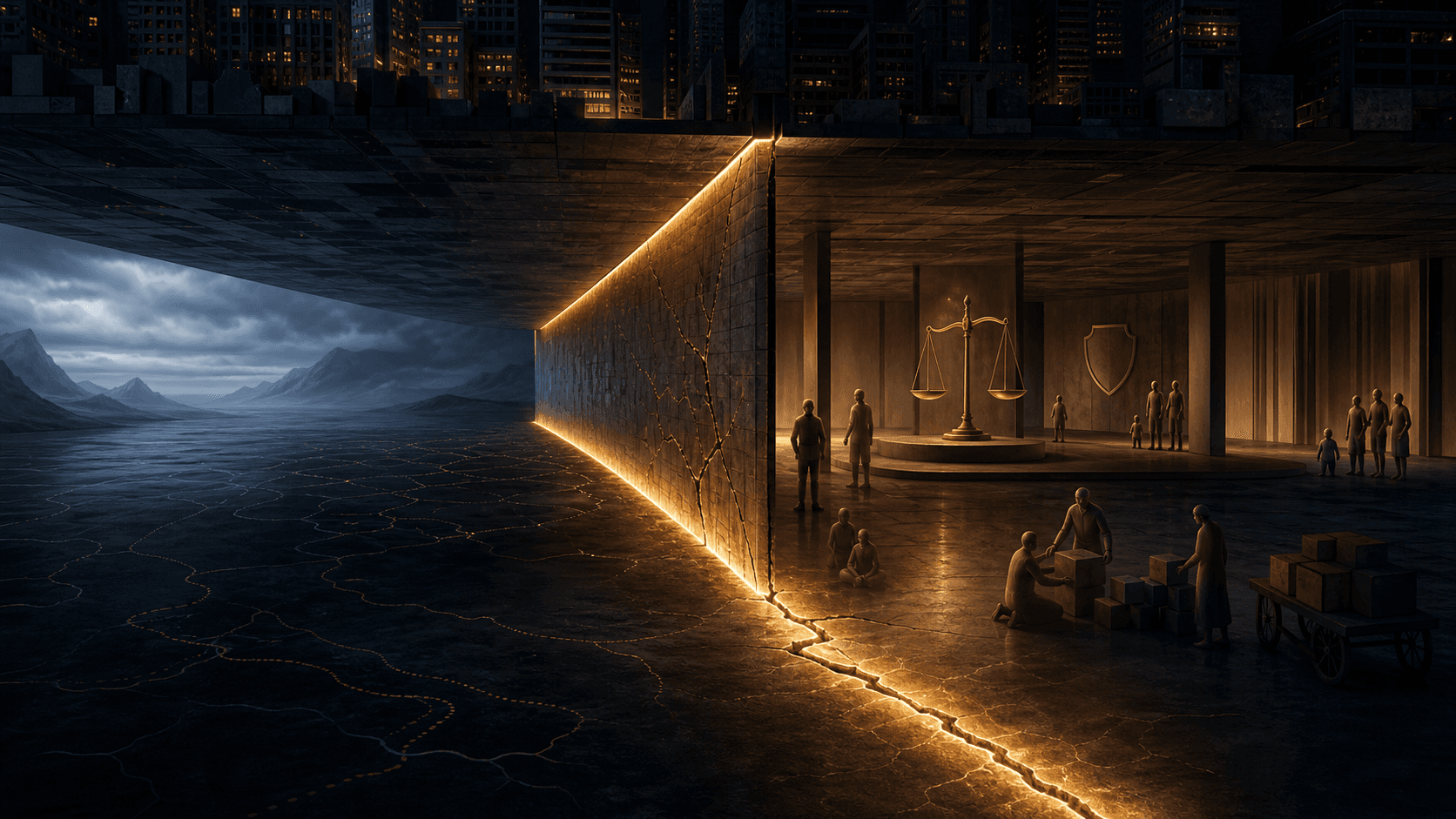
A line on a map looks like an arbitrary mark. Someone drew it, often for reasons that were unjust or accidental, and it determines enormous things about the lives on either side. The instinct, looking at the arbitrariness, is that the world would be freer without the line. Erase it, and people would simply be people, moving across a single shared planet.
The instinct contains a truth and a trap. The line is arbitrary and often unjust. But the line is not just a line. It is the visible edge of a container that holds a set of functions, and removing the edge without replacing the functions does not release people into freedom. It releases the functions into collapse.
A border is not a line. It is a container for law, belonging, protection, and redistribution. Erase the line and you do not get freedom. You get the collapse of everything the line was holding together, unless you have built something to hold those functions instead.
What a boundary actually holds
The line marks a territory, but its real work is to define a container for functions that have to live somewhere. Inside the boundary, there is a legal system that applies, a set of people who belong and can vote, a structure that provides protection and enforces order, a mechanism that collects and redistributes resources, a shared infrastructure of schools and services and rules [1].
None of these functions can float free. They have to attach to a defined population in a defined space. The boundary is what defines them. It says: these laws apply here, these people belong here, this protection covers here, these resources are pooled and shared here. The line is the edge of all of that. It looks like a mark. It is actually the wall of a container [2].
This is why the line, however arbitrary its origin, becomes load-bearing. Things are resting on it. Remove it carelessly and the things resting on it fall, not because the line was sacred, but because it was holding weight.
Removing the line is not the same as removing the boundary
There is a crucial distinction between the line and the boundary it represents. The line is the mark. The boundary is the set of functions the mark organizes. You can erase the line easily. You cannot erase the boundary easily, because the functions still have to live somewhere [3].
If you remove the line without rehoming the functions, the functions do not disappear. They fall into confusion. Whose law applies? Who belongs and gets a say? Who provides protection and bears its cost? Who pools and distributes resources, and for whom? These questions do not go away when the line goes away. They become unanswerable, and unanswerable questions about law, belonging, and protection do not produce liberty. They produce a vacuum, and vacuums get filled by whoever has the most force [1, 3].
This is the trap in the borderless intuition. It treats the line as the thing to be removed, when the line was only the visible part. The hard part, the functions, remains and now has nowhere to attach. Real removal of a boundary requires building a larger container that takes over the functions. Otherwise you have not freed anyone. You have just demolished a wall in a building without checking what it was holding up.
Before the line, not beyond it
It is tempting to imagine that the past, before modern borders, shows what a borderless world looks like. But the world before drawn borders was not boundaryless. It was full of boundaries that were simply not drawn as lines: territories defined by kinship, language, tribe, ecology, zones of protection and danger, regions where one power could reach and another could not [4].
A person moving through that world was not moving through open freedom. They were moving through a dense field of unmarked boundaries, each enforced socially, militarily, or relationally. You could enter the wrong territory and be killed, enslaved, or rejected, not because of an immigration office but because you lacked the kinship or standing that granted protection there. The boundary was real. It just was not a line on a map [4].
So the past does not show a world without boundaries. It shows a world that was, in the phrase, line-less but boundary-filled. The modern border did not invent boundaries. It made them explicit, bureaucratic, and mapped. The functions the boundary holds, law, belonging, protection, were being held before too, just by less visible means.
Unjust and structural at once
The honest position holds two things that feel contradictory. The border is often a moral failure: arbitrary, exclusionary, turning the accident of birthplace into destiny, dividing people who should be able to move and belong freely. And the border is structural: load-bearing, holding functions that cannot simply be dropped without collapse [1, 2].
Both are true. The line is like a wall in a damaged building. Some walls are oppressive, built to exclude, and the building would be better without them. But a wall, even an oppressive one, may be holding up the roof. Smashing it because it is oppressive, without understanding what it carries, brings the roof down on everyone, including the people the wall was excluding [3].
This does not argue for keeping every boundary as it is. It argues that the work of removing a boundary is the work of rehoming its functions, which is far harder and slower than erasing a line. The boundary can be unjust and still be holding weight, and both facts have to be respected at once.
The point
A border is not a line. It is the visible edge of a container that holds law, belonging, protection, and redistribution. The line can be erased in a moment. The functions cannot, because they have to attach to some defined population and space, and removing the container without building a replacement leaves them homeless and the result is collapse, not freedom.
The world before drawn borders was not free of boundaries. It was line-less but boundary-filled, organized by kinship, ecology, and power rather than by maps. The modern border made those boundaries explicit. It did not create the underlying need for a container.
The boundary can be both a moral failure and a load-bearing structure. Recognizing that it is unjust is the beginning of the work, not the end. The end is building something larger that can hold the functions the boundary was holding, so that the line can come down without the roof coming down with it. Until that is built, erasing the line does not liberate. It demolishes a wall whose load has nowhere else to go.
Sources
- Scott, J. C. (1998). Seeing Like a State. Yale University Press. On how states organize legibility, law, taxation, and belonging within bounded territories, and how these administrative functions depend on defined boundaries to operate.
- Sassen, S. (2006). Territory, Authority, Rights: From Medieval to Global Assemblages. Princeton University Press. On how territory, legal authority, and rights are bundled together within bordered states, and the difficulty of disaggregating these functions from the boundaries that contain them.
- Carens, J. H. (2013). The Ethics of Immigration. Oxford University Press. On the moral arbitrariness of borders alongside the practical functions they serve, and the tension between open-movement ideals and the institutional structures that bounded membership sustains.
- Maier, C. S. (2016). Once Within Borders: Territories of Power, Wealth, and Belonging Since 1500. Harvard University Press. On the historical transition from fuzzy, overlapping, socially enforced territorial boundaries to sharply drawn modern borders, showing that pre-modern space was governed by boundaries that were not yet drawn as lines.