
Memory Without an Interpreter
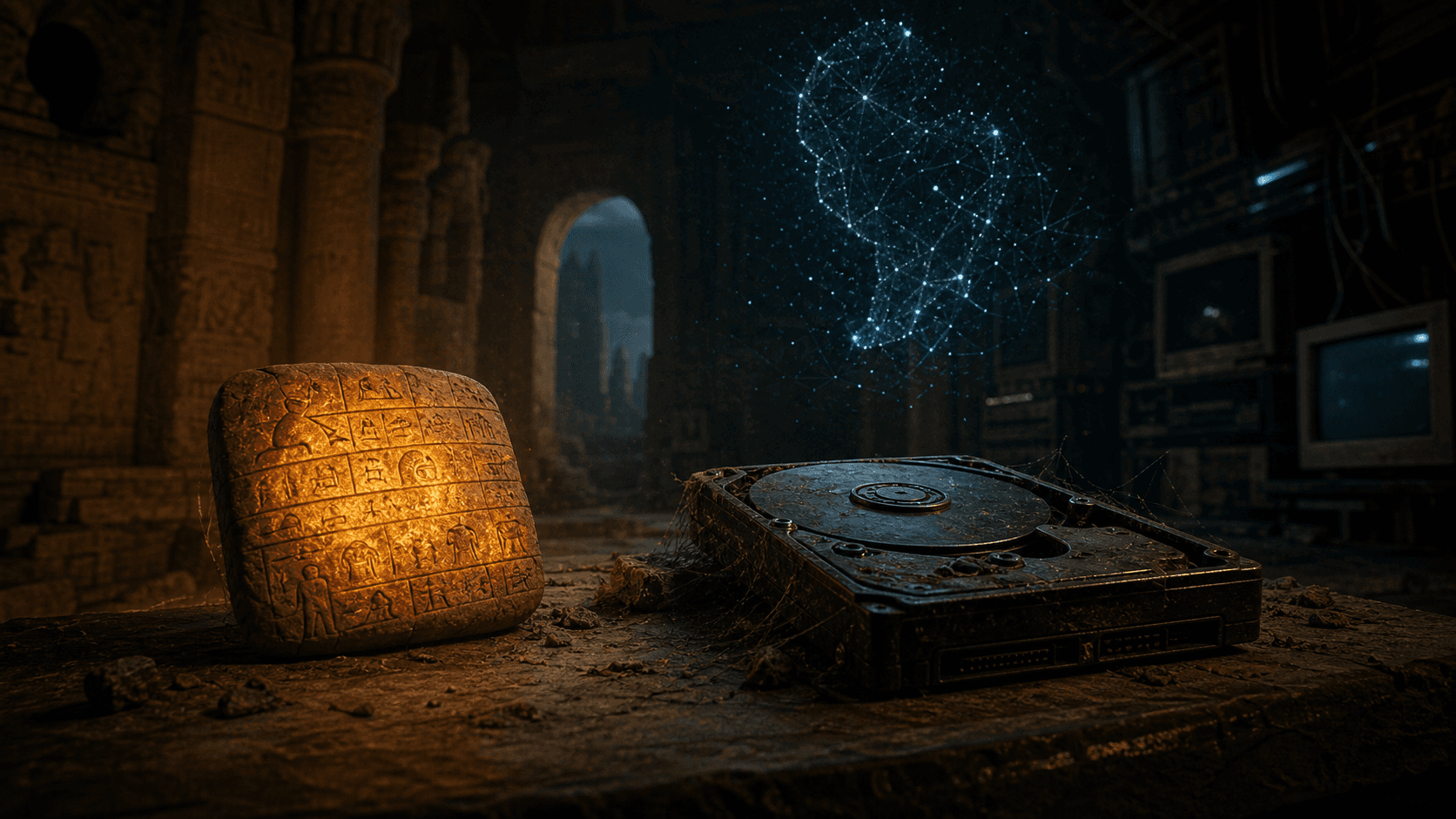
A clay tablet pulled from the ground after three thousand years can still be read. The marks are right there on the surface. You need to know the language, but the object carries its content in itself. It is its own message. Nothing has to be running for the tablet to mean what it means.
A hard drive pulled from a drawer after thirty years may already be unreadable. Not because the magnetic patterns decayed, but because the thing required to interpret them is gone. The format, the software, the operating system, the hardware interface. The bits can survive perfectly and still say nothing, because a digital artifact is not its own message. It is a pattern waiting for a compatible interpreter.
Physical memory survives as itself. Digital memory survives only as a pattern that needs a living interpreter to become meaning again. Preserving the bits is not preserving the message. The two have come apart.
The artifact and the interpreter
For most of human history, memory was stored in objects that carried their meaning on their surface. Writing on stone, clay, parchment, paper. The relationship between the mark and the meaning was direct. A reader with the right language could extract the content from the object alone. The object and the message were the same thing [1].
Digital storage breaks this unity. A file is not a mark that carries meaning. It is a pattern of states that means nothing without a stack of interpreting layers: the file format that says how to parse the pattern, the software that implements the format, the operating system that runs the software, the hardware that runs the operating system. Remove any layer and the pattern becomes noise. The meaning was never in the bits. It was in the relationship between the bits and the machine that knew how to read them [2].
This is a new kind of fragility. Not the fragility of the medium decaying, but the fragility of the interpreter disappearing. The pattern can be perfectly preserved and completely dead, because what died was not the data but the ability to read it.
Why this inverts our intuition about permanence
We tend to assume that digital memory is more permanent than physical memory. It can be copied infinitely without loss. It does not yellow or crumble. It can be backed up across the world. By the logic of the medium, it should outlast stone.
But permanence of the medium is not permanence of the meaning. A digital artifact depends on an entire living ecosystem of compatible technology to remain readable, and that ecosystem turns over rapidly. Formats are abandoned. Software stops being maintained. Hardware interfaces vanish. Each turnover can strand the data behind it, perfectly intact and permanently inaccessible [2, 3].
The clay tablet needs nothing but a reader who knows the language. The digital file needs a continuously maintained chain of interpreting technology, and the chain is only as strong as the willingness of each generation to keep porting the data forward. Stop porting, and the meaning is lost even though the bits remain. Permanence shifted from a property of the object to a property of an ongoing process. Memory now has to be actively kept alive rather than passively surviving [1, 3].
The ruins that need a machine to read
This produces a strange situation for anyone who tries to recover the past of a digital civilization. The remains are not like the remains of earlier eras. Earlier ruins are objects you can examine directly: pottery, bones, walls, texts on durable surfaces. They are legible to a patient investigator with the right knowledge.
Digital ruins are not directly legible. They are sealed patterns. To read them, you do not just need knowledge of a language. You need to reconstruct the interpreting machine: emulate the operating system, recover the format specification, rebuild the software environment that gave the pattern meaning. The artifact cannot be read by inspection. It has to be woken up by a compatible intelligence that recreates the conditions under which it meant something [2, 4].
This is the first civilization whose ruins will be partly invisible without machines. A future investigator examining our remains will not be able to simply look. They will have to resurrect the reading apparatus before the record will speak. Some of it will be recoverable that way. Some of it will not, because the apparatus will be too thoroughly gone to rebuild.
Encryption as the sealed room
There is a further layer. Some digital memory is not merely format-dependent but deliberately locked. Encrypted data without its key is not a faded message that can be patiently reconstructed. It is a sealed room with no door. The pattern is fully present, its size and structure visible, and its contents permanently unavailable absent the key [4].
Earlier memory degraded gradually. Ink faded, edges crumbled, but partial content usually remained, and what survived could be read. Encrypted digital memory has a different failure mode: total availability of the container and total unavailability of the contents. It does not degrade toward partial legibility. It holds at perfect illegibility. The most secure memory is also the most completely lost, if the key is gone.
The point
Memory used to survive as itself. The artifact carried its meaning, and a reader with the right knowledge could extract it from the object alone. Digital memory does not work this way. The meaning is not in the bits. It is in the relationship between the bits and a living interpreter, and that interpreter has to be continuously maintained or rebuilt.
This inverts our intuition about digital permanence. The medium is durable; the meaning is fragile, because the meaning depends on an ecosystem of technology that turns over fast and strands what it leaves behind. Preserving the data is not preserving the message. The message has to be kept readable, which is an ongoing act, not a property of the storage.
We are building the first civilization whose record cannot be read by simply looking at it. Our memory will survive as patterns that need a compatible mind to wake them. What stays meaningful will be what someone keeps choosing to carry forward. The rest will be perfectly preserved and perfectly silent, waiting for an interpreter that may never come.
Sources
- Brown, A. (2013). Practical Digital Preservation: A How-To Guide for Organizations. Facet Publishing. On the fundamental distinction between bitstream preservation and meaningful preservation: keeping the data intact is insufficient if the means of interpreting it are lost.
- Rothenberg, J. (1995). "Ensuring the longevity of digital documents." Scientific American, 272(1): 42-47. The classic statement of the digital preservation problem: digital documents depend on specific hardware and software to be readable, and the rapid obsolescence of that technology threatens to render preserved bits meaningless.
- Conway, P. (2010). "Preservation in the age of Google: Digitization, digital preservation, and dilemmas." Library Quarterly, 80(1): 61-79. On the paradox that digital information is simultaneously more reproducible and more fragile than analog, requiring active ongoing intervention to remain accessible rather than passive survival.
- Kirschenbaum, M. G. (2008). Mechanisms: New Media and the Forensic Imagination. MIT Press. On the forensic materiality of digital storage and the conditions under which digital traces can or cannot be recovered, including the role of encryption and format dependence in determining what remains legible.