
The Missing Axis
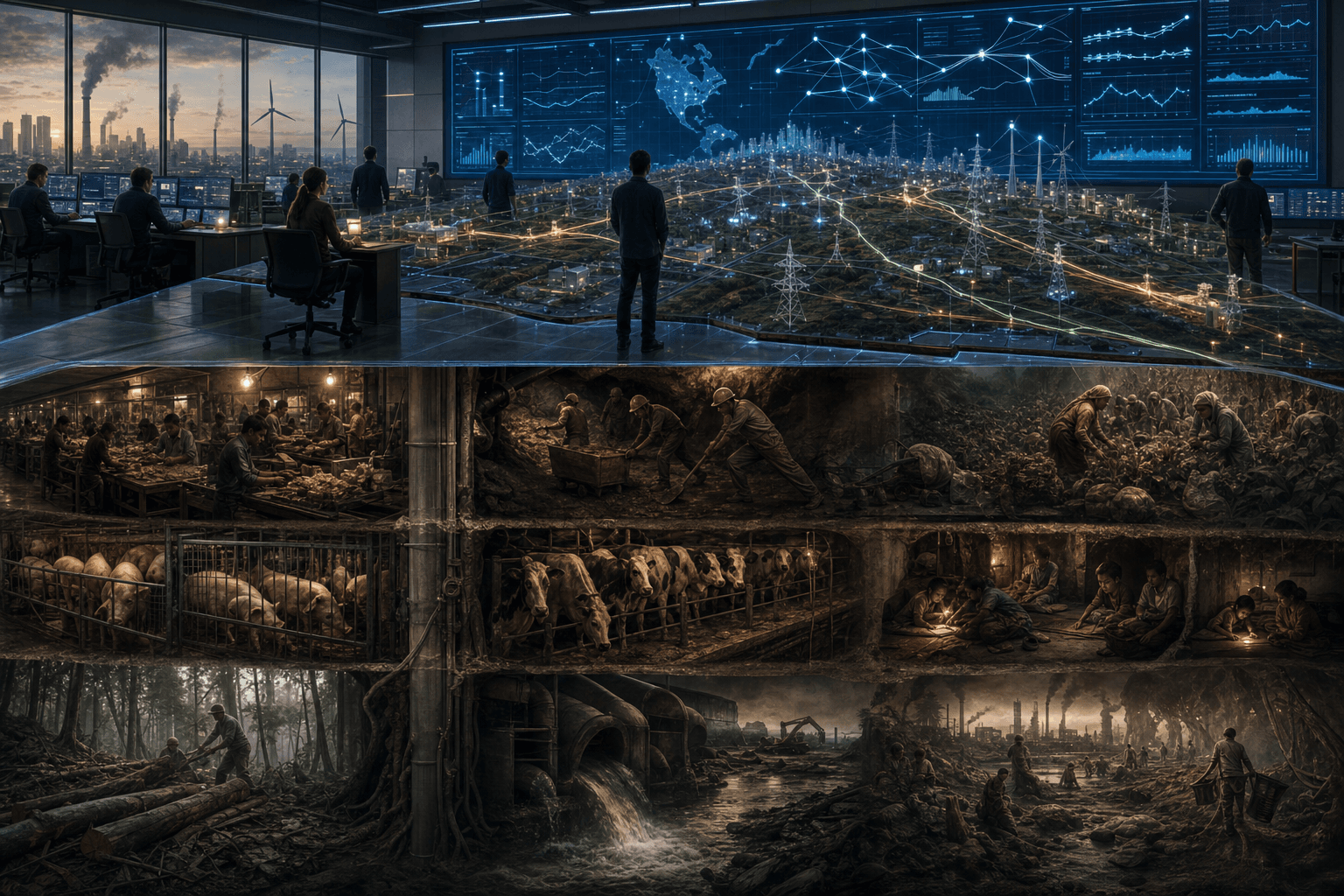
The standard measure of civilizational advancement is power. Specifically: how much energy can a civilization command? A planetary civilization masters the energy of its world. A stellar civilization harnesses its sun. A galactic civilization draws on entire star systems. The scale goes up and the number gets larger and that is called progress [1].
Nobody asked what the energy costs.
Not in money. In suffering. In the architecture of predation that sustains the whole structure from the bottom.
A civilization can be measured not only by how much energy it commands, but by how little living suffering its energy system requires. Not how much can you capture. How little must be consumed.
The existing measurement
The Kardashev scale was proposed in 1964 to classify civilizations by energy use. Type I harnesses planetary energy. Type II harnesses stellar energy. Type III harnesses galactic energy. The framework is useful: it gives researchers a way to think about long-term technological development and to calibrate the search for extraterrestrial intelligence.
But the scale has one axis. More power. It does not ask what the power costs in biological terms. A civilization that masters fossil fuels scores higher than one that burns wood. A civilization that masters fusion scores higher still. The score is purely a function of energy commanded, not of what had to be consumed or killed to produce it [1, 2].
The missing axis
The missing measurement is orthogonal to power.
All energy systems have a cost structure. Some cost carbon. Some cost ecological stability. And some cost the suffering, confinement, killing, and biological conversion of organisms that have interior experience. The food chain is the original version of this: life sustains itself by converting other life. Sunlight becomes grass, grass becomes prey, prey becomes predator, predator becomes soil. That is the architecture underneath every civilization that has ever existed.
A more advanced civilization would not merely command more energy. It would route its energy through less suffering per unit of consciousness sustained. Not because suffering is a side issue, but because the degree to which a civilization still requires the consumption of living beings is a real measure of how far it has traveled from the baseline condition of predation [3, 4].
What the scale would look like
A low-level civilization on this axis lives entirely inside the food chain. Energy comes from consuming other life. No reflective distance, no deliberate reduction, no alternative architecture considered. The world is a trophic pyramid and the civilization sits at the top.
A mid-level civilization recognizes the cost of the system and begins to reduce it selectively. It develops plant-based diets, animal welfare frameworks, renewable energy, synthetic alternatives. It still depends on consuming life but it has begun to question whether it must.
A higher civilization routes most of its energy through abiotic or minimally sentient sources: sunlight, minerals, synthesized nutrients, engineered systems designed without suffering. Life sustains itself increasingly through direct access to physical energy rather than through the conversion of other organisms.
The highest civilization on this axis would no longer require any biological sacrifice of sentient beings to continue. Consciousness would persist without the food chain underneath it [3].
Advanced for whom
The existing measurement asks: how advanced are your tools? The missing measurement asks: advanced for whom?
A civilization that builds a global seafood industry is, on the Kardashev scale, more advanced than one that cannot. More energy commanded, more infrastructure, more processing capacity, more distribution. The number goes up. But for the organisms inside the industry, the more technologically advanced the civilization becomes, the larger and more efficient the machinery of extraction becomes. Bigger boats. Better traps. Global logistics. More appetite, more volume, more invisibility.
A civilization that masters energy but retains the predatory architecture is not less intelligent. It is intelligence organized around the same ancient metabolic grammar: something must be consumed, something must be converted. The question of who pays that cost is not asked.
The point
Progress has been measured on one axis. More power. That axis is real and important. But it is not the only one.
A civilization should also be rated by how far it has traveled from the biological condition of predation. Not merely by reducing cruelty within the food chain, but by reducing dependence on the food chain itself. The highest civilization would not be the one that eats the galaxy. It would be the one that learns how not to eat.
That is a different idea of progress. Not more powerful. Freer. Freer from the ancient necessity that life must consume life to continue.
Sources
- Kardashev, N. S. (1964). "Transmission of information by extraterrestrial civilizations." Soviet Astronomy, 8(2): 217-221. The original proposal of the three-type energy classification scale for measuring civilizational advancement by energy commanded.
- Dyson, F. J. (1960). "Search for artificial stellar sources of infrared radiation." Science, 131(3414): 1667-1668. On the theoretical possibility of civilizations that capture all stellar energy output: a complementary framework to Kardashev that similarly measures power without measuring cost.
- Singer, P. (1975). Animal Liberation. New York Review/Random House. On the ethical cost structure of food systems and the argument that capacity for suffering, not species membership, is the morally relevant criterion for how life should be treated.
- Vernadsky, V. I. (1926/1998). The Biosphere. Copernicus Books. On Earth as an energy-processing system in which living matter transforms solar energy through trophic chains, and on the theoretical possibility of bypassing those chains through direct synthesis.