
The Narrative Immune System
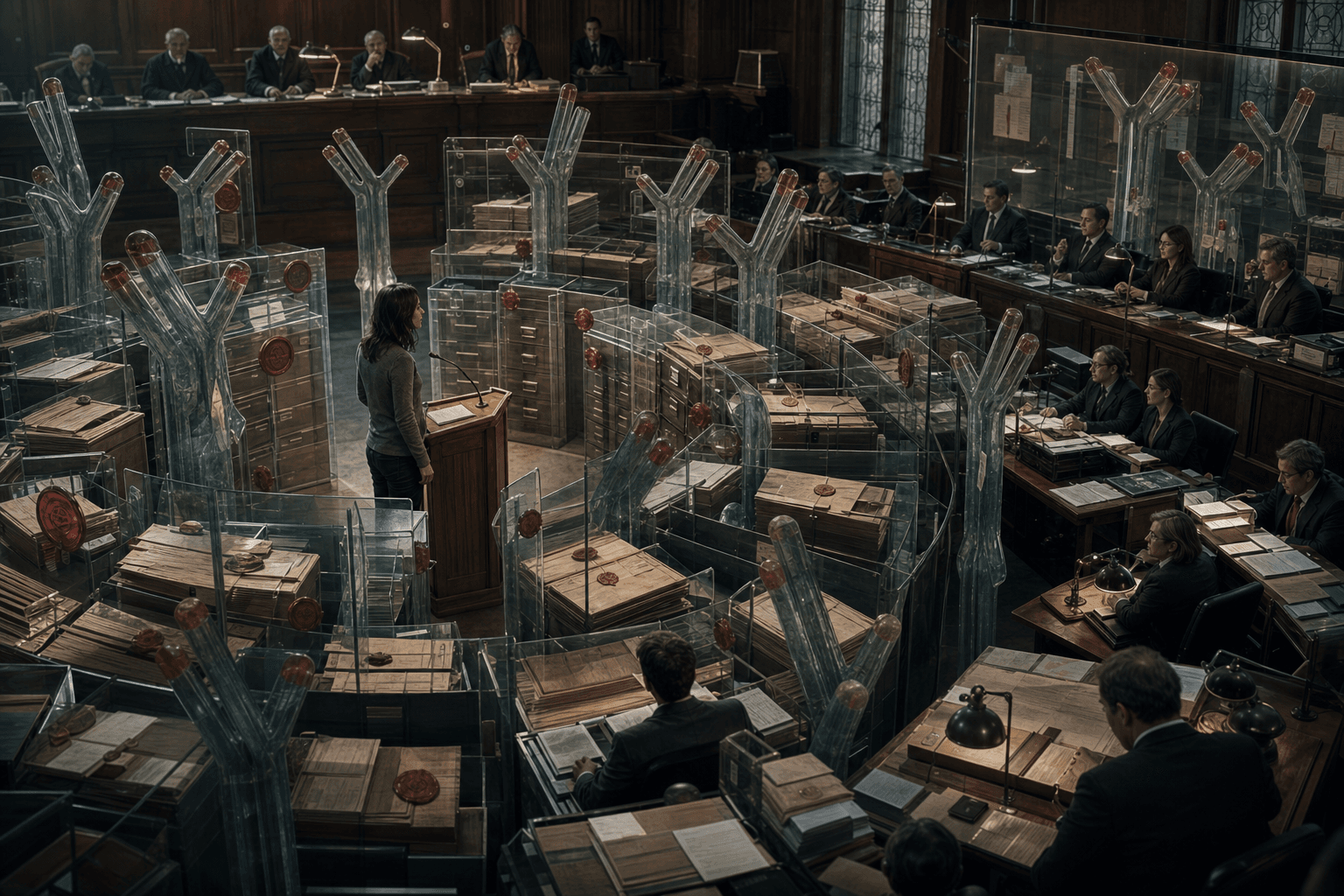
You try to resolve a dispute by producing a witness. The witness gets dismissed: they were not there for the relevant events. You find a closer witness. They are dismissed too: they are biased. You produce a recording. The recording is dismissed: context is missing. You bring a professional observer. The professional is dismissed: you worked on them beforehand.
The specific reason for dismissal changes with each attempt. The outcome does not.
At some point it becomes clear you are not being evaluated on the merits of the witnesses. You are encountering something that has the same function as an immune system. Anything that enters and contradicts the protected story gets treated as foreign matter, regardless of its form.
The disqualification is not a response to the quality of the witness. It is a response to what the witness would mean if it counted.
What an immune system does
An immune system does not evaluate foreign matter on its merits. It identifies it as foreign and removes it. The process is not: let me see whether this pathogen is actually dangerous. The process is: this does not belong, remove it. Speed and reliability of rejection is the point. Careful evaluation would defeat the purpose.
The same architecture appears in how some people process contradictory information about narratives they need to maintain. Incoming material is not evaluated on the merits. It is identified as foreign to the protected story and removed. The removal is fast, automatic, and effective. What changes between rejections is not the mechanism. It is the available vocabulary for executing it [1, 2].
If the witness is a stranger: they do not know the full story. If the witness is a friend: they are biased toward you. If the witness is a professional: you manipulated them. If the witness is a recording: context is missing. If there are multiple witnesses: you turned people against me. The phrase is selected from whatever is contextually available. The function is constant.
Why finding a more legitimate witness does not fix it
The natural response to having a witness disqualified is to find a more legitimate one. A harder-to-dismiss form. If a friend can be called biased, perhaps a professional cannot. If a professional can be accused of incomplete information, perhaps a recording cannot. If a recording can be called decontextualized, perhaps extensive documentation cannot.
This strategy fails when the underlying mechanism is immune response rather than reasoning. An immune system adapts to whatever form the foreign material takes. The rejection does not target the specific witness. It targets anything that would destabilize the protected story. Any form of witness sufficiently threatening to that story will generate rejection [3, 4]. The form of rejection adjusts. The function does not.
This is diagnostically useful. When multiple attempts with multiple different witnesses in multiple different forms all arrive at the same disqualifying conclusion by different routes, you are not dealing with someone who needs a more convincing witness. You are dealing with someone who cannot permit the conclusion that the witness would support. Finding a better form of evidence will not change this. The immune response will adapt.
The archival authority trap
One specific variant deserves attention. It is the use of an evidentiary standard that positions historical access as permanently superior to current observation.
The form is: someone who had close access to an earlier version of you claims that this access grants them permanent interpretive authority over your present identity. Current witnesses, who know the adult you are now, are dismissed as lacking the relevant historical depth. Old proximity counts forever. Current proximity counts as insufficient.
This claim has a structural problem. It confuses access to a historical record with authority over a present reality. The person who knew an earlier version of you has accurate information about that version. They do not automatically have superior information about who you are now. In many cases they are less reliable about the present precisely because they are seeing it through the frame of the past, organized around an earlier role, looking for confirmation of a model that was built before the current evidence existed [5, 6].
The evidentiary standard is constructed so that no current witness can qualify, while historical access operates as a permanent credential that no current evidence can update. Old proximity as permanent authority. Current contact as permanently preliminary. That is a closed system, not a standard of evidence. It cannot in principle produce a different verdict, because the standard is set to exclude the kind of evidence that would produce one.
What you are actually dealing with
When the disqualification mechanism is operating, the question what do I need to show them to change their view is the wrong question. There may be no answer, because the question assumes that the view is governed by evidence. If the view is governed by what the self-concept can tolerate, then evidence is not the input that changes it [2, 3].
The correct question is different: what kind of contact is possible with someone who systematically invalidates external witnesses that do not confirm their version of you?
This is a colder question but a more accurate one. It does not require the other person to change their mechanism or accept a new form of witness. It asks only what is actually available, given that this is the operating system.
The answer is sometimes: limited contact with limited scope, in domains where the immune response is not triggered. Sometimes: no contact that does not require operating inside their version of you. Sometimes: a kind of engagement that has stopped expecting fair evaluation and has settled what it wants from the relationship independent of whether fair evaluation ever arrives.
None of these are as satisfying as fair evaluation would be. The person who wanted a witness ultimately wants something more than the witness. They want the other person to be capable of receiving the truth. The question of what is possible with someone who is not capable of this is not answered by finding a better witness. It is answered by a more accurate assessment of what the relationship actually contains.
The point
The disqualification mechanism is portable. It fits itself to whatever the current witness looks like. The goal is not to evaluate witnesses accurately. The goal is to preserve a version of events that requires a particular conclusion. Any witness that contradicts that conclusion is foreign matter, and foreign matter gets removed.
Recognizing this shifts the work away from finding the right witness and toward something more honest: assessing what is actually available from someone whose system of recognition is not governed by evidence. The answer is sometimes very little. Sometimes something. But it is the answer to a real question, not the endlessly deferred answer to a question about finding the right authority.
The right authority does not exist in a system that grants legitimacy only to what confirms it. Knowing that saves time, and saves some part of what would have been spent searching.
Sources
- Festinger, L. (1957). A Theory of Cognitive Dissonance. Stanford University Press. On the psychological mechanisms by which people protect existing beliefs from disconfirming information, including discrediting sources and reframing evidence to maintain internal consistency.
- Tavris, C. & Aronson, E. (2007). Mistakes Were Made (But Not by Me). Harcourt. On self-justification as a psychological mechanism and how the need to protect self-image generates systematic distortion of incoming information regardless of its accuracy.
- Kunda, Z. (1990). "The case for motivated reasoning." Psychological Bulletin, 108(3): 480-498. On how cognitive processes are enlisted to reach desired conclusions while maintaining the appearance of objectivity, and how the evidentiary standard shifts based on motivational state.
- Nickerson, R. S. (1998). "Confirmation bias: A ubiquitous phenomenon in many guises." Review of General Psychology, 2(2): 175-220. On confirmation bias as a systematic process of seeking, interpreting, and recalling information in ways that confirm prior beliefs, including selective discrediting of disconfirming sources.
- Harter, S. (1999). The Construction of the Self. Guilford Press. On how early reflected appraisals from authority figures become internalized as identity, and how those early attributions resist revision even as the person develops, keeping the perceiver organized around an earlier model.
- Ross, L. & Nisbett, R. E. (1991). The Person and the Situation. McGraw-Hill. On fundamental attribution error and how observers consistently underweight situational factors while overweighting dispositional ones, and how this bias compounds when the observer holds a prior model they are motivated to maintain.