
Awareness Is Time Made Sensitive to Itself
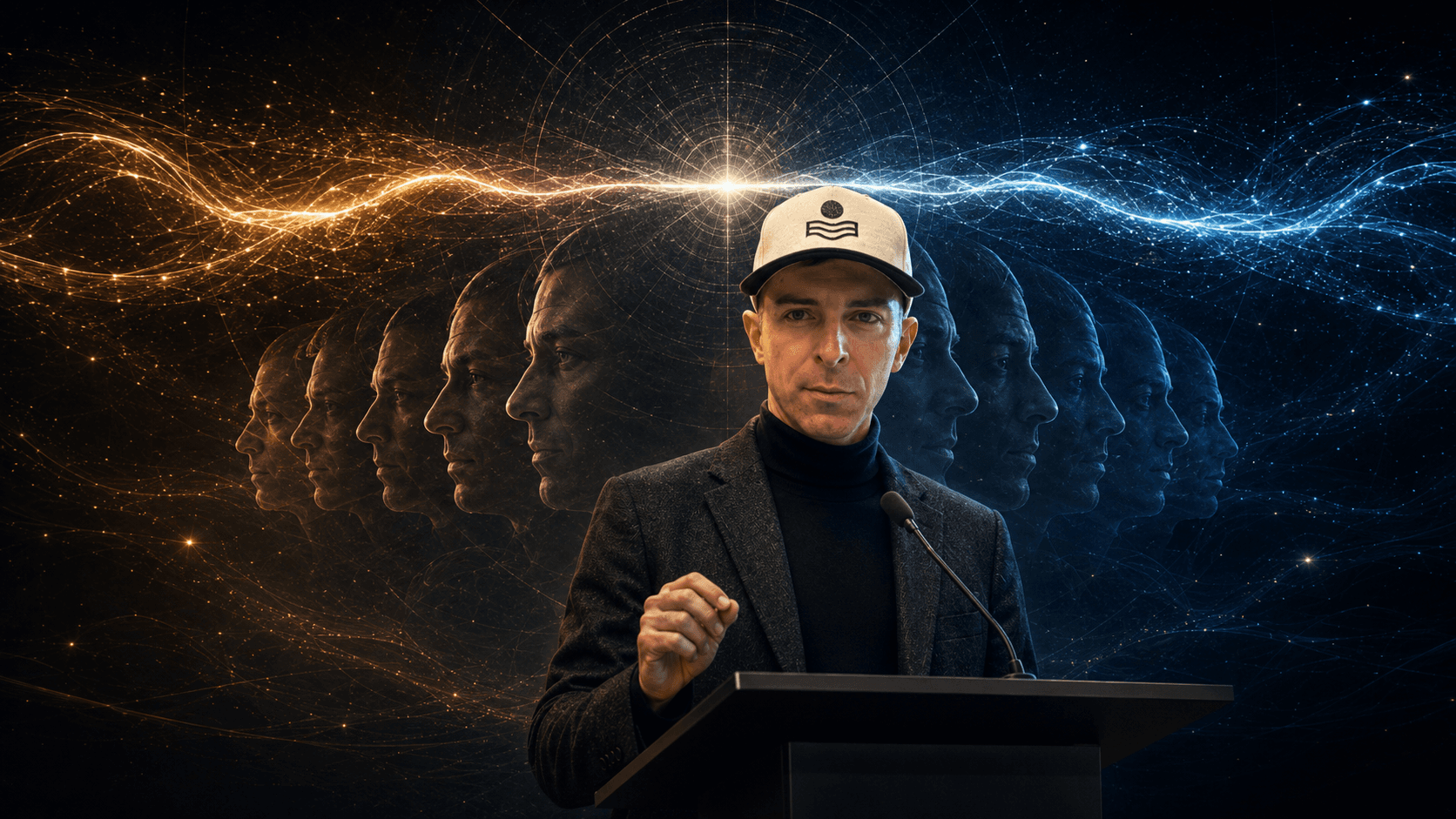
You are aware right now. You are so certain of this that the sentence barely registers. Awareness is the one thing you have never had to work for, never had to question, never had to wonder whether it was present. It just is. It has always just been. The light, as far as you can tell, has always been on.
That certainty is worth examining. Because it turns out awareness is not a given. It is a condition. And the condition has a specific requirement that almost no one notices, because it is so basic it is invisible from the inside.
The requirement is time.
Not time in the large sense: the years of a life, the arc of memory, the feeling that things are changing. Time in the most minimal sense possible. The thin sliver of before-and-after that has to be present for any signal to mean anything at all. Without it, the light does not go out. There is simply no one for the light to be on for.
Awareness is not what happens when a stimulus arrives. It is what happens when a system holds enough of the just-past to know that something has changed. Remove time and there is no registration. Remove registration and there is no awareness. There is only impact.
What you actually take for granted
Light hits a retina. Pressure hits skin. Sound waves compress the air against an eardrum. These are contacts. They are real physical events, measurable and precise. But contact is not awareness. A rock receives the impact of rain all day and is aware of nothing. The contact happens. The registration does not.
What is the difference between the rock and you?
The automatic answer is complexity: a nervous system, a brain, feedback loops, integration. This is true but it describes a mechanism without identifying what the mechanism is for. The actual difference is more specific. You retain. The rock does not. Your system carries a trace of the immediately prior state into the present state, and that trace is what allows the present state to be legible as different from what came before [1, 2].
That is all micro-memory is. Not the recollection of last year or last week. Not even the memory of the last sentence. The present moment holding just enough of the moment before it for the current state to have an edge, to be distinguishable, to register as signal rather than noise. Without that retention, every instant is isolated. Nothing accumulates. The signal arrives and vanishes simultaneously. There is impact and there is nothing.
The structure Husserl found
The phenomenologist Edmund Husserl spent years working out what this structure looks like from the inside [1]. What he found was that every single moment of conscious experience has three dimensions occurring at once. There is the primal impression: what is happening now. There is retention: the just-past moment still echoing in the present, not remembered but still present as a fading trailing edge. And there is protention: a lean toward what is about to come, a forward-reaching anticipation that shapes how the present is received.
These three are not separate events. They are simultaneous layers of a single moment. And the crucial point is this: remove any one of them and experience collapses. A consciousness with only the knife-edge of the present, with no retention and no protention, would experience nothing. It would be like a film running with no frames: the projector on, the light present, the screen white. No image, because no sequence of differences has been given enough time to become meaning.
Awareness is not a point. It is a wave. And a wave that is stopped at a single instant is no longer a wave. It is just a position.
What happens when you follow this to its end
If awareness requires temporal structure, then a timeless awareness is not a deeper or purer form of awareness. It is not awareness at all. It is awareness minus the one thing that makes awareness possible.
This has real consequences for how we interpret certain states that get described as timeless: deep meditation, mystical experience, the moments people report near death where time seems to dissolve. What is almost certainly happening in those states is not the absence of temporal structure but the collapse of the narrative layer that normally sequences experience into labeled past, present, and future [3, 4]. The deeper micro-temporal structure, the retention and protention that Husserl identified, must remain intact, or awareness would simply cease. What dissolves is the story of time. The structure that makes awareness possible is still running underneath.
The spiritual traditions that describe the goal as timeless awareness may be pointing at something real while describing it in a way that, taken literally, points at the absence of what they value. You do not transcend time to become more aware. You become more aware of time's structure as it runs through you.
The compression
The argument, followed to its core, is airtight.
Awareness requires registration. Registration requires contrast. Contrast requires a difference between states. Difference between states requires an ordered sequence: first this, then that. That ordered sequence is time, or at minimum something that functions like time, something that provides before and after [4, 5].
Remove time and there is no sequence. Remove sequence and there is no contrast. Remove contrast and every state is equivalent to every other state. Nothing can be noticed as different from anything else. There is no awareness because there is nothing for awareness to push against. Not darkness. Not silence. Not emptiness. Just no structure in which experience could occur.
This is also why a perfectly static universe, one in which nothing anywhere changes at all, would contain no awareness, not even of its own stillness, even if it contained every physical structure associated with consciousness. Awareness is not a property of arrangement. It is a property of process [3].
The point
You do not experience time the way you experience a room you are moving through. Time is not the container. You are the process, and time is what that process is made of at the most basic level.
The awareness you take as a given, the light you have never had to wonder about, is not a background condition of existence. It is what happens when a system becomes sensitive to the sequence of its own states. When the trace of what just was meets what is now, and the meeting produces the felt sense that something is here.
Awareness is not in time. Awareness is time made sensitive to itself.
Minimum viable truth: without a before and after, there is no one home.
Sources
- Husserl, E. (1928). On the Phenomenology of the Consciousness of Internal Time. Translated by John Brough, Kluwer, 1991. The foundational account of retention, primal impression, and protention as the simultaneous structure of every moment of conscious experience.
- James, W. (1890). The Principles of Psychology. Holt. On the stream of consciousness and the specious present: the temporal thickness of the experienced now and why consciousness cannot be understood as a series of durationless instants.
- Whitehead, A. N. (1929). Process and Reality. Macmillan. The philosophical account of reality as fundamentally constituted by events and processes rather than static substances, and the consequences of this for understanding mind and experience.
- Pöppel, E. (1997). "A hierarchical model of temporal perception." Trends in Cognitive Sciences 1(2): 56-61. On the temporal integration window: the empirical basis of the experienced present as a constructed interval rather than a point, and the hierarchy of temporal structures underlying conscious experience.
- Edelman, G. M. & Tononi, G. (2000). A Universe of Consciousness: How Matter Becomes Imagination. Basic Books. On reentrant signaling, dynamic core theory, and the role of temporal integration in producing unified conscious experience from distributed neural activity.