
You Are Not a Thing. You Are a Process.
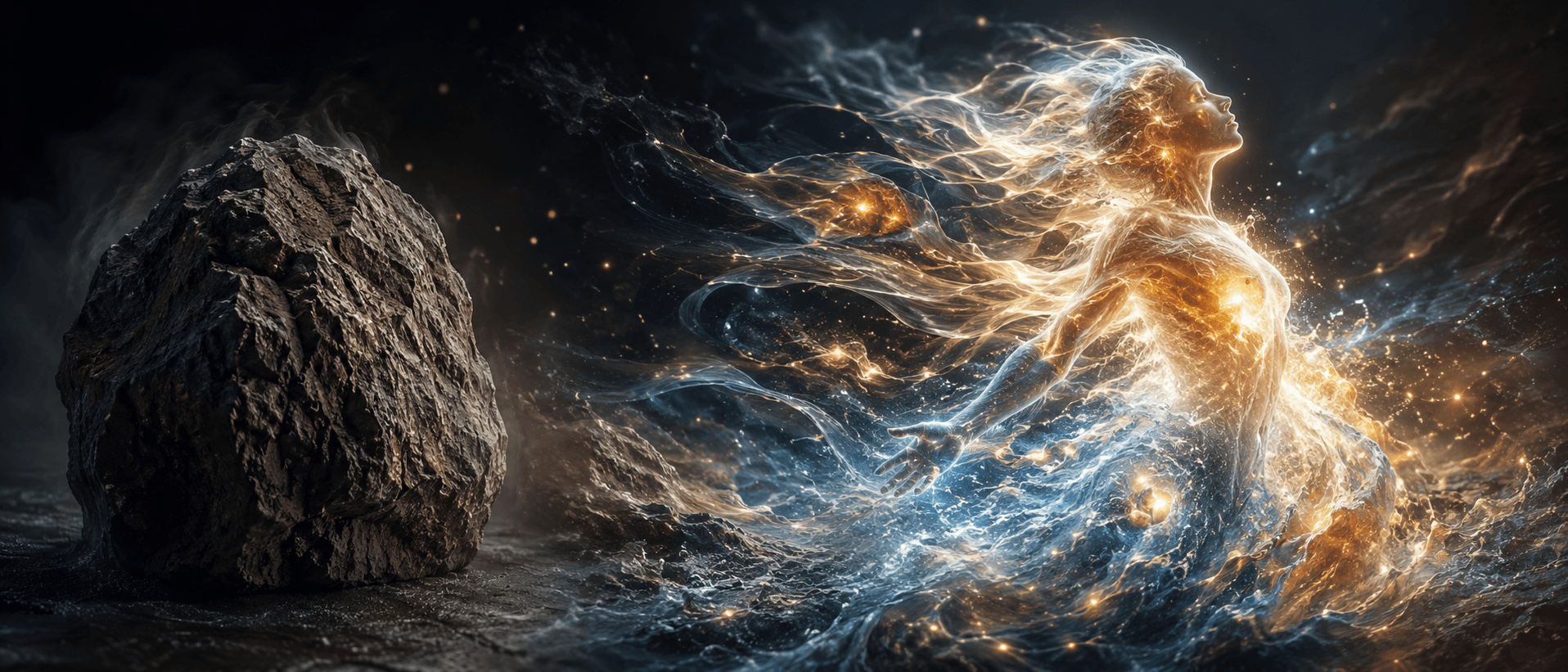
Hold a rock in your hand. It is the same rock it was a minute ago, a year ago, a decade ago. The atoms that make it up are the same atoms, in the same arrangement, with no significant turnover. The rock persists by staying identical to itself.
Now hold a flame near your hand. The flame you are looking at is not the same flame it was a second ago. The molecules burning now are different from the molecules that were burning before. The shape is continuous. The substance is in constant replacement. The flame persists not by staying identical but by maintaining a pattern across continuous change.
You are not a rock. You are a flame [1].
You are not a thing that persists through time. You are a pattern that persists through change. Those are not the same.
What actually stays
The atoms in your body are replaced over time, at different rates for different tissues. Most of your cells divide and are replaced over years. The atoms in your bones turn over more slowly, but they turn over. The you of a decade ago and the you of today share very few of the same atoms [2].
It is not only the physical. The beliefs you held ten years ago may be unrecognizable to you now. The relationships that defined you may have ended or transformed. The fears that organized your life in your twenties may have dissolved or been replaced by different ones. The things you wanted, the things you were certain of, the people you were loyal to: many of them are gone.
What remained through all of that is not a thing. It is a pattern. A continuity of process: memory linking moments together, habits carrying forward, the narrative the mind tells about the self weaving the changes into something that feels like the same person persisting.
The self is the flame. What it is made of is always changing. What holds is the shape.
Why the confusion matters
Treating yourself as a fixed thing has consequences.
The most immediate one is rigidity. If you are a thing, then changing is a threat to your existence. A rock that becomes different minerals has ceased to be that rock. So a self that treats itself as a thing experiences change as a kind of death: the death of who it was, the threat of becoming unrecognizable to itself. This is the structure underneath resistance to growth. Not laziness. Not weakness. The misidentification of a process as a thing, and the resulting terror of the change that processes naturally undergo [3].
The second consequence is the way you relate to your own past. If you are a thing, then your past selves were you, and you are responsible for them and bound to them in the same way a rock is bound to its earlier configuration. This produces a particular kind of suffering: the inability to separate from old identities, old wounds, old versions of yourself that no longer reflect the pattern you actually are. You cannot step away from what you were if you believe you are still it [4].
The flame and what it teaches
A flame has identity without rigidity. It has continuity without sameness. It maintains a recognizable form while its substance is in constant flux. This is not a compromise or a weakness. It is the only way a flame can exist at all. A flame that stopped burning would stop being a flame.
The same is true of you. The continuity of self is not achieved by staying the same. It is achieved by the ongoing process of integration: taking in, transforming, expressing, releasing. The moment that process stops, the self does not become more stable. It begins to die in the way that living things die when they stop metabolizing.
Change is not the enemy of identity. Change is how a process-identity maintains itself. The fear of change is the fear of the very mechanism that keeps you alive [1, 3].
What this means for suffering
A specific category of human suffering is produced by trying to be a thing.
The suffering of refusing to let go of a past self that no longer fits. The suffering of insisting that a relationship must stay exactly what it was. The suffering of holding a fixed self-concept against the pressure of new experience. The suffering of needing to be right about who you are, because if you are wrong about who you are, then you do not exist.
All of this suffering comes from applying the logic of a rock to the reality of a flame. The rock model demands that identity be preserved through sameness. The flame model understands that identity is preserved through continuity of process, which allows for and requires change.
The Buddhist traditions arrived at a version of this several thousand years ago, through a different route [4]. Western physics is arriving at something similar through yet another route [2]. The convergence is not coincidence. It is what you find when you look carefully enough at what a self actually is.
The point
You are not a fixed object moving through time. You are a process that time moves through. The you of right now is a configuration that will be different tomorrow, not because you are falling apart, but because that is how a living process maintains itself.
The identity is real. The fixedness is a story. And the suffering that comes from defending the fixedness against the reality of the process is optional, once you see it clearly enough to recognize what is actually happening.
You are the flame. The burning is not a problem to be solved. It is the evidence that you are alive.
Sources
- Heraclitus. (c. 500 BCE). Fragments. On the nature of flux, the identity of opposites, and the river you cannot step in twice.
- Zimmer, C. (2021). "The Secret Life of a Coronavirus." The New York Times Magazine. On cellular and atomic turnover in the human body and the timescales of physical continuity.
- Dweck, C. S. (2006). Mindset: The New Psychology of Success. Random House. On fixed versus growth orientations and the consequences of treating the self as a fixed entity.
- Thich Nhat Hanh. (1988). The Heart of the Buddha's Teaching. Broadway Books. On the Buddhist doctrine of anatta (non-self) and impermanence as a basis for understanding identity as process rather than substance.
- Parfit, D. (1984). Reasons and Persons. Oxford University Press. The philosophical account of personal identity over time and the argument that what matters in survival is not identity but continuity of process.