
Sound Is Becoming. Light Is Being.
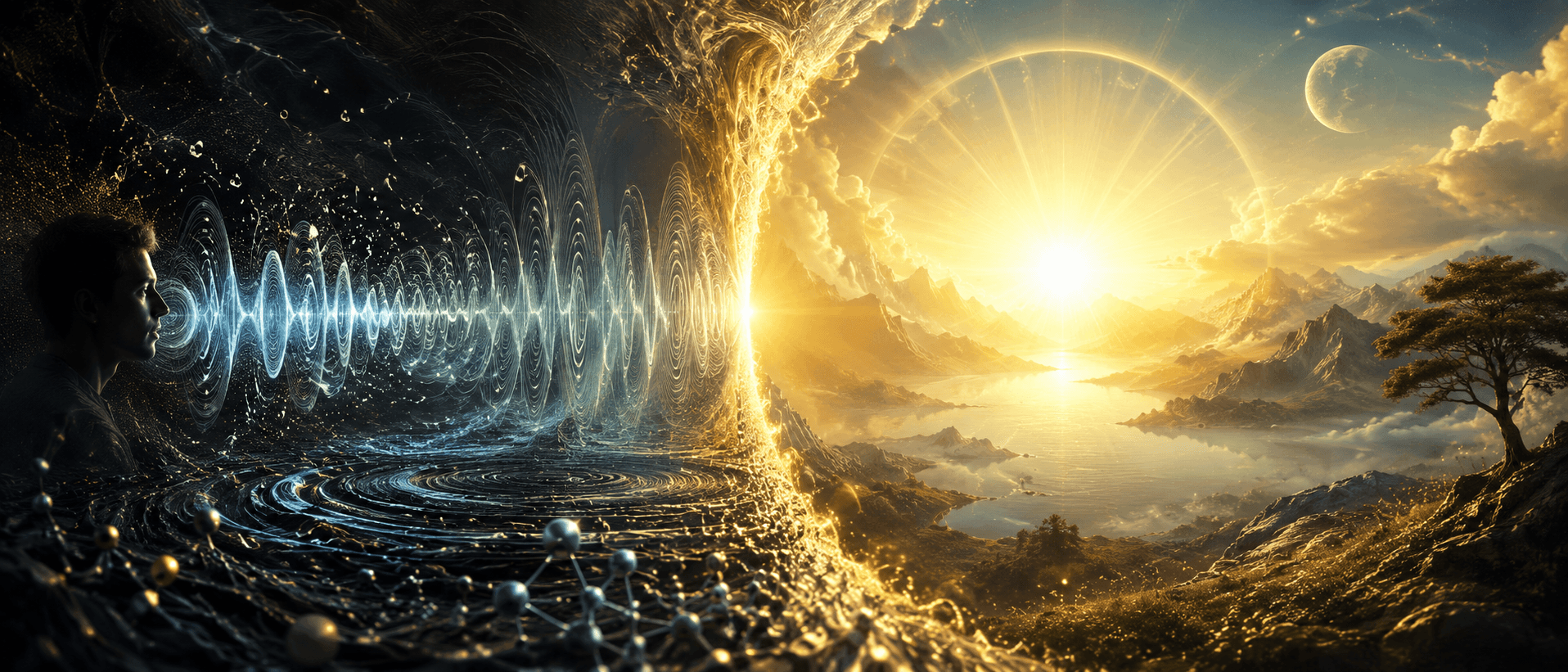
Sound cannot travel through empty space. This is not a limitation of sound. It is a definition. Sound is not a thing moving through nothing. Sound is a disturbance moving through something: air molecules compressing and spreading, passing the pressure to the next molecule, and the next. In water, water molecules carry it. In metal, atoms carry it. The sound is the pattern of that transfer. Remove the matter and there is nothing to disturb, nothing to pass the vibration along. Silence in space is not the absence of loud things. It is the absence of medium.
Light is different in a way that took physics centuries to understand and still has not finished disturbing us.
Light does not need air because light is not using air. Light is a self-propagating wave in the electromagnetic field itself. A changing electric field generates a magnetic field. That changing magnetic field generates an electric field. The pattern propagates. It carries itself. For centuries, physicists assumed that if light is a wave, it must be a wave in something. They called that something the luminiferous ether. In 1887, Michelson and Morley set out to detect it and found nothing [1]. The ether did not exist. Light did not need it. What light travels through is not a substance. It is a field, and the field is more fundamental than matter [2].
That is already strange. What it implies about time is stranger.
Sound is where time lives. Light is where time breaks.
What the constancy of light speed actually means
When relativity arrived, the central fact it had to account for was this: the speed of light is the same for all observers, regardless of how fast they are moving relative to each other [3]. This is not what we expect. If you throw a ball from a moving train, its speed is the sum of the ball's speed and the train's speed relative to the ground. Velocities add. That is the ordinary intuition.
Light does not obey it. A photon emitted from a spacecraft moving at half the speed of light travels at the speed of light, not one and a half times the speed of light. The speed is invariant. It does not add. It does not change.
The only way this can be true is if space and time are not independent containers. For the speed of light to be constant for all observers, space and time must flex around it. Observers moving at different velocities measure different lengths and different durations. Clocks moving fast relative to you tick slower. Distances contract. Time is not a universal river running at the same rate for everything in it. Time is local. It is tied to motion, mass, and path through spacetime [4].
Light does not reveal this accidentally. Light is the hinge. The speed of light is the conversion factor between space and time. It is the invariant structure that forces reality to reveal that "now" is not a universal fact shared by all observers simultaneously.
What a lightlike path actually is
In relativity, every path through spacetime has a proper time: the duration experienced by something traveling along that path [4]. For a human body, proper time accumulates. You age. Your cells divide. Your memories stack. Your path through spacetime has duration, and you live inside that duration.
A photon travels along what is called a lightlike interval. The proper time along a lightlike path is zero. From emission to absorption, no proper time elapses along the photon's own trajectory [5]. A photon that crosses a billion light-years from our frame of reference experiences, along its own path, no time at all.
This is precise physics, not metaphor. The structure of spacetime is such that traveling at the speed of light collapses the proper time to zero. Light is not moving quickly through time. Light is at the boundary where time, as massive objects experience it, does not apply.
The being of light
When people report an encounter with a being of pure light, the physics does not settle what they contacted. But it clarifies why light, of all things, is the symbol consciousness reaches for when it wants to describe something that is not bound by ordinary time.
A being of light is not, in these reports, merely a bright entity. The reports tend to cluster around specific qualities: total presence, total knowing, no concealment, no decay, no separateness, and a sense that time has stopped or become irrelevant [6]. The light is not primarily visual. It is ontological. The person reporting does not just see light. They feel seen by it. Completely and without harm.
That configuration maps almost exactly onto what relativistic light actually is at the physical level: something that does not age along its own path, that reaches across vast distances without interior duration, that sits at the edge of the structure where time breaks down.
But there is a trap in the phrase "being of pure light" that is worth naming.
A being implies internal structure: memory, continuity, the capacity to recognize and respond, a before-and-after inside itself. Experience requires change. To experience anything requires that one state be followed by another state. If literally no proper time elapses along a lightlike path, there is no internal sequence in which experience could unfold. A photon does not remember. It does not anticipate. It has no valid rest frame, no interior life, no selfhood [5].
So the physics and the report are pointing at the same edge from different directions. The physics says: at the boundary where proper time is zero, subjectivity as we know it cannot be supported. The report says: the being seemed beyond ordinary subjectivity, beyond sequence, beyond the self-enclosed personal thread.
The deeper possibility is that these descriptions are not contradicting each other. They may be describing the same structural fact at different levels of resolution.
Sound is narrative. Light is presence.
There is something symbolically exact in the physical difference between sound and light that extends well beyond the physics.
Sound is sequential. You cannot hear a sentence all at once. A melody only exists through time: this note, then the next, then the resolution or its absence. Sound requires before and after. Remove the sequence and the meaning collapses. Sound is the medium of becoming. It is what change sounds like when matter passes it along.
Light is simultaneous. Vision can present an entire scene at once: the distance of the mountains, the texture of the wall, the face, the room, the sky. Light gives presence. It makes the world appear as a field that is there, rather than a sequence that is arriving. Sound says: this happens, then this happens. Light says: this is here.
This is why time-bound, embodied life is so deeply acoustic. Heartbeat, breath, speech, music, footsteps. The things that tell you that you are alive and moving forward are sounds. They unfold. They count off duration. They are made of sequence.
And this is why the limit-experience of timelessness, whether in meditation, peak experience, near-death encounter, or the edge of physics, reaches for light as its symbol. Light is what it looks like when becoming collapses into being [7].
The point
Sound cannot exist without matter because sound is a disturbance inside matter. That is what embodied life is: local, sequential, dependent on the chain of contact. Moment to moment. Molecule to molecule.
Light needs no material medium because it is a disturbance of the field itself. And because the speed of light is invariant for all observers, space and time flex around it. Time is not one universal flow. It depends on mass, motion, and path. At the boundary where proper time is zero, the ordinary machinery of sequenced experience breaks down.
This does not prove that consciousness survives death. It does not prove that the beings people encounter in near-death states are literal photonic entities. What it shows is that our naive model of time as a universal container, moving at the same rate for everything everywhere, is false. And once that model breaks, the question of what time is for a self, and whether selfhood requires the kind of sequential time that light does not need, stays genuinely open.
The minimum viable truth: sound reveals the structure of becoming. Light reveals the edge of becoming. And the edge of becoming is the only place where the question of what lies beyond it even makes sense to ask.
Sources
- Michelson, A. A. & Morley, E. W. (1887). "On the relative motion of the Earth and the luminiferous ether." American Journal of Science 34(203): 333-345. The experiment that failed to detect the ether and forced physics to reconsider what light travels through.
- Maxwell, J. C. (1865). "A dynamical theory of the electromagnetic field." Philosophical Transactions of the Royal Society 155: 459-512. The original equations establishing light as a self-propagating electromagnetic wave requiring no material medium.
- Einstein, A. (1905). "Zur Elektrodynamik bewegter Körper." Annalen der Physik 17: 891-921. Special relativity and the invariance of the speed of light for all inertial observers.
- Greene, B. (2004). The Fabric of the Cosmos: Space, Time, and the Texture of Reality. Knopf. On spacetime, the relativity of simultaneity, and what the constancy of light speed implies for the structure of time.
- Penrose, R. (2004). The Road to Reality: A Complete Guide to the Laws of the Universe. Jonathan Cape. On lightlike intervals, proper time, and the geometry of spacetime paths.
- Moody, R. A. (1975). Life After Life. Mockingbird Books. The original systematic account of near-death experiences and the recurring report of luminous presences.
- van Lommel, P., van Wees, R., Meyers, V., & Elfferich, I. (2001). "Near-death experience in survivors of cardiac arrest." The Lancet 358(9298): 2039-2045. A prospective study of NDE reports under medically documented conditions.