
The Last-Mile Body
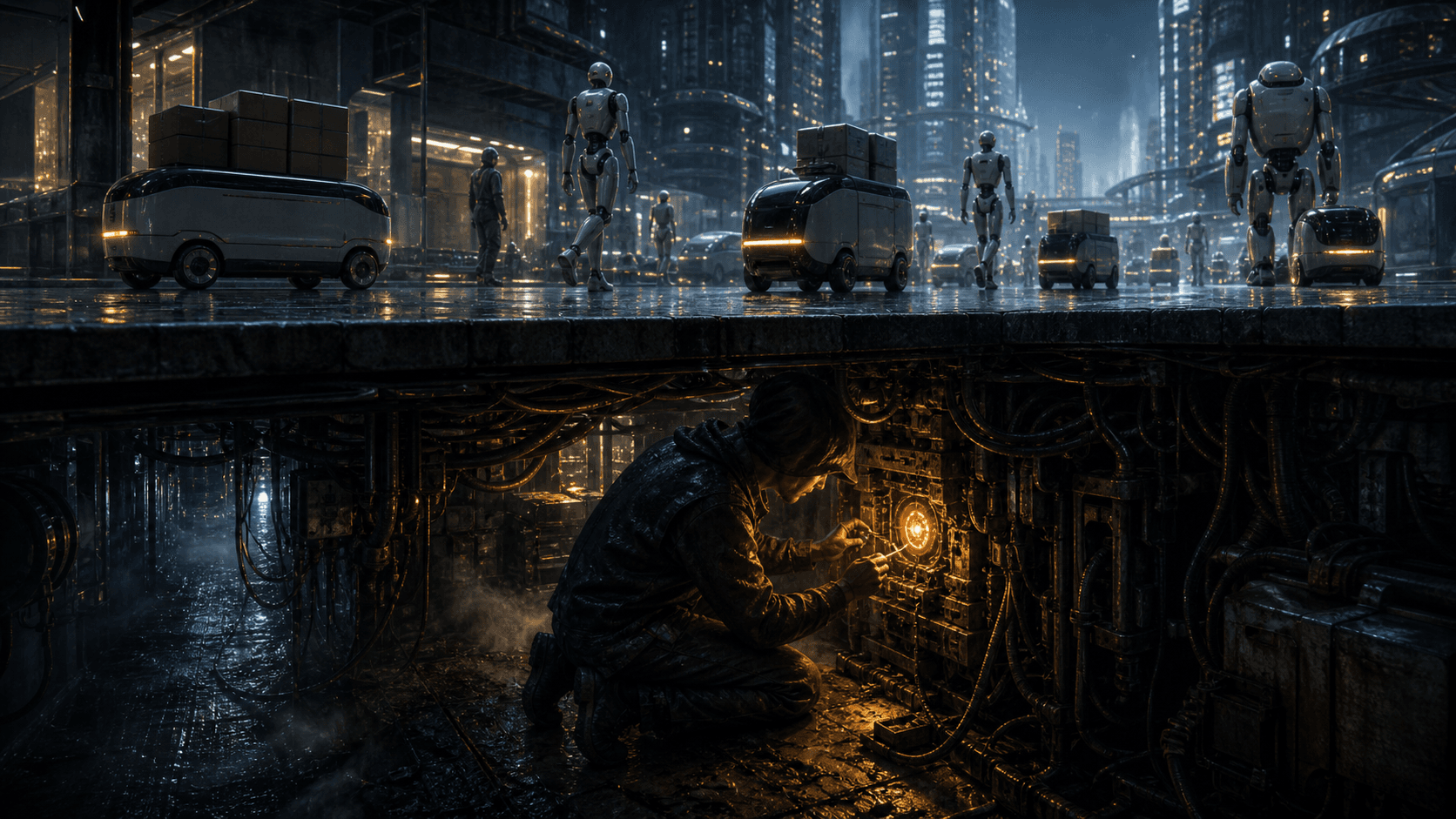
There is an appealing prediction about automation: one day machines and AI will do the mowing, the construction, the plumbing, the sewer work, all the dangerous and depleting tasks that humans currently absorb. And when that happens, the hierarchy of bodily labor will finally end. People will look back amazed that humans ever had to do such things.
The first part of the prediction may well come true. Machines probably will take over much of the dirty work. But the conclusion does not follow. Removing the dirty work does not automatically remove the hierarchy, because the hierarchy was never really about the tasks. It was about who is exposed to necessity. And automation, arriving inside a world that is still unequal, may not end that exposure. It may just relocate it.
Automating dirty work does not end hierarchy. If inequality persists, a new lowest layer forms at the edges of the machine world: the humans cheap, flexible, or disposable enough to send where the machines cannot economically go.
The bottleneck moves
Today, physical labor is a bottleneck. Things need to be built, cleaned, repaired, carried, and grown, and human bodies are required to do it. This requirement is part of what creates the labor hierarchy: someone has to do the work, and the unpleasant parts fall downward to those with the least power to refuse [1].
When automation takes over the labor, the bottleneck does not disappear. It moves. Labor stops being the scarce, contested resource. What becomes scarce and contested instead is ownership and access: who owns the machines, the AI systems, the land, the energy, the compute, the infrastructure. If automation arrives without a redesign of who owns its output, then the benefits flow to the owners, and everyone else competes for access, relevance, and permission rather than for wages [2].
So the first thing to notice is that automation does not by itself distribute its gains. It removes one bottleneck and creates another. Whether that is liberation or a new hierarchy depends entirely on who controls the automated world, and nothing about the technology guarantees that control will be shared [2].
The last-mile body
Even in a heavily automated society, there will likely be tasks where a human body is still cheaper, more flexible, or more legally convenient than a machine. Automation is rarely total. It tends to be brittle at the edges: the awkward physical case, the unpredictable environment, the situation too rare to justify building a machine for, the legally risky act that a company would rather have a disposable human perform than a liable machine [3].
These edge cases create a role: the last-mile body. The human who does what the machines almost do, but not quite. The person who cleans and maintains the robots, who labels the data that trains them, who moderates the traumatic content the filters miss, who crawls into the space the machine cannot fit, who repairs the sensor in the rain, who handles the angry customer when the AI fails, who performs the authenticity that automation cannot fake, who supervises ten machines for low pay, who provides the human body where automation is still too expensive, too fragile, or too risky [3].
In a society that is still unequal, these tasks will not be distributed randomly. They will fall downward, the way dirty work always has. The last-mile body becomes the new lowest layer: the biological edge-case of the machine world, absorbing whatever automation cannot economically reach. The exposure did not end. It migrated to wherever the machines stop [3].
Clean from above, brutal from below
This produces a society that can look clean from above and remain brutal from below. The people at the top live in frictionless, automated environments where the machinery handles everything smoothly. From their vantage, the dirty work has genuinely vanished. The demos are elegant. The surfaces are seamless [4].
Underneath, invisible humans maintain the underside: the supply chains, the rare-earth mining, the robot repair, the data cleanup, the content moderation, the messy physical and emotional labor that does not fit into the clean automation story. The hierarchy did not disappear. It became less visible, pushed to the places the powerful do not have to see. A cleaner, more deniable version of the same arrangement [4].
This is the danger. Automation's great power is the power to make hierarchy invisible. The old hierarchy was at least visible: you could see the people doing the hard work. A fully automated surface can hide the remaining exposed bodies completely, so that the people benefiting from them never encounter them at all. The arrangement becomes easier to deny precisely because it is easier not to see [4].
The real test
The real test of automation, then, is not whether it can remove unpleasant work. It probably can, eventually, for most tasks. The test is whether society allows the removal of dirty work to become human liberation, or uses it to build a cleaner hierarchy with a new exposed layer at the bottom [2, 4].
A liberatory version is possible: machines absorb the dangerous and depleting tasks, and the gains are distributed so that no human is forced into bodily exposure by necessity. In that world, physical work becomes chosen, skilled, or recreational rather than coerced. Someone may still build, farm, or repair because they want the connection to matter, but no one destroys their body because rent is due [2].
A darker version is also possible: machines absorb the visible work, the gains concentrate at the top, and a new layer of last-mile bodies forms around the machine world, doing the edge-case labor for low pay and low status, more invisible than the peasants they replaced. The technology permits both outcomes. It chooses neither. The choice is made by how ownership and access are arranged, not by the machines [3, 4].
The point
The prediction that automation will end the labor hierarchy assumes the hierarchy was about the tasks. It was not. It was about exposure to necessity, about which bodies are close to survival pressure and which are buffered from it. Removing the tasks does not remove that exposure. It relocates it.
If inequality persists, a new lowest layer forms at the edges of the machine world: the last-mile body, the human cheap or flexible or disposable enough to send where the machines cannot economically go. The dirty work does not vanish. It migrates to wherever automation stops, and in an unequal society it falls downward as it always has.
The result can look clean from above and stay brutal from below, with the remaining exposed bodies pushed out of sight. That is automation's most dangerous capacity: not that it fails to remove dirty work, but that it can make the remaining hierarchy invisible. The test is not whether the machines can do the work. It is whether their gains liberate people or simply buffer the already-buffered more completely than ever before.
Sources
- Autor, D. H. (2015). "Why are there still so many jobs? The history and future of workplace automation." Journal of Economic Perspectives, 29(3): 3-30. On how automation shifts rather than eliminates the demand for human labor, and how the tasks left to humans are determined by where machines remain uneconomical.
- Brynjolfsson, E. & McAfee, A. (2014). The Second Machine Age. Norton. On how the gains from automation flow to the owners of capital and technology absent deliberate redistribution, shifting the central scarcity from labor to ownership and access.
- Gray, M. L. & Suri, S. (2019). Ghost Work: How to Stop Silicon Valley from Building a New Global Underclass. Houghton Mifflin Harcourt. On the hidden human labor that sustains automated systems: data labeling, content moderation, and edge-case tasks performed by a poorly paid, largely invisible workforce at the margins of the machine world.
- Crawford, K. (2021). Atlas of AI. Yale University Press. On the concealed material and human substrate of automated systems, including mining, maintenance, and labor, and how the clean surface of AI hides the exposed bodies that make it function.