
The Why Hole
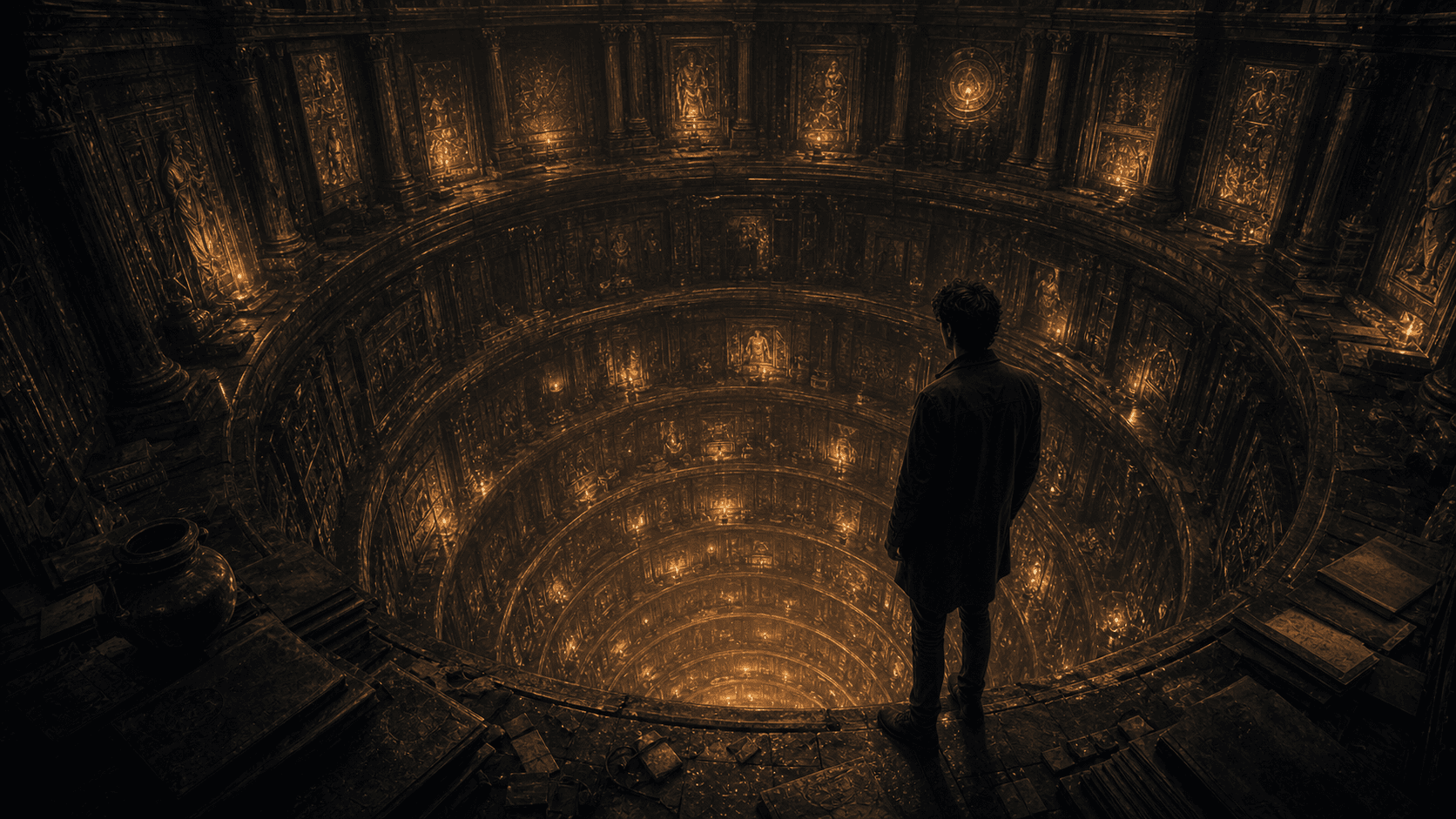
The moment it happens, you know it. You ask why something occurred. The answer arrives. It is satisfying for a moment. Then, automatically, the same question surfaces: but why that? The next answer arrives. And then why that? The chain continues. There is no signal from reality that the chain has ended. There is no floor.
This is the why hole. Not a failure of intelligence. Not a sign that you are asking too many questions. A structural feature of the question itself.
The why hole is not what you find when the answer is too far down. It is what you find when the question is the wrong shape. "Why" presupposes a universe organized around reasons. The universe may not be organized that way.
What "why" is doing
Every "why" makes a claim about reality before the answer is given. It claims that the thing being asked about has a reason. That reality is structured such that behind every state of affairs there is a because: a cause, a purpose, a justification, a ground.
This is called the principle of sufficient reason. Leibniz stated it explicitly: nothing happens without a sufficient reason why it should be so and not otherwise [1]. The why hole is what happens when you take that principle seriously and follow it all the way down.
If everything has a reason, then the reason has a reason, and that reason has a reason. The chain does not terminate because the principle does not permit termination. The why hole is not an accident. It is what the principle of sufficient reason produces when applied without limit.
The three options at the bottom
When you follow "why" long enough, you eventually arrive at one of three places.
The first is infinite regress. The chain continues forever. Every reason has a reason. There is no floor because the floor keeps moving. This is logically possible but uninhabitable. You cannot live inside infinite regress. You cannot act from it. It dissolves any stable ground you might stand on [2].
The second is circularity. The chain loops back on itself. Why A? Because B. Why B? Because C. Why C? Because A. The reason returns to its own justification. This closes the loop but does not answer the question. It shows the system is internally consistent, not that it is grounded in anything outside itself.
The third is a brute fact. The chain ends at something asserted to have no reason. It just is. The laws of physics. The existence of anything at all. The fact that there is something rather than nothing. This stops the regress but only by refusing the question at the final step: here, we stop asking why.
All three are unsatisfying. The why hole does not resolve. It terminates by force, by loop, or by infinite corridor. None of these is an answer of the type the question demands [2].
The question is the wrong shape
The why hole may not be a problem about the depth of reality. It may be a problem about the shape of the question.
"Why" is a human cognitive instrument built for navigating human-scale causation. Why did the fire start? Because there was a spark and dry wood. Why did the relationship end? Because trust was broken and not repaired. At the scale of ordinary life, why works. It maps onto the causal structure of events well enough to produce useful answers.
But when you apply it to the bottom level, to existence itself, to why there is anything at all, to why the laws of physics have the values they have, the question may be demanding a kind of answer that reality is not structured to give [3]. The universe does not appear to have a meta-level from which its own existence is justified. There is no outside-of-everything from which the reason for everything can be retrieved.
The question keeps going not because the answer is far away. Because the answer of that type does not exist. "Why" is a question built for entities that occur within a context. Existence itself is not within a context. It is the context.
What the recursion reveals
The capacity to keep asking why is a feature of a specific kind of mind. A recursive one.
The same cognitive structure that allows a mind to model itself, to think about its own thinking, allows it to take any answer and apply the question again. The why hole is the question turning on its own answers. It cannot stop because the recursive function has no termination condition. Every answer is just another thing that can be asked about [4].
This may be why animals do not appear to fall into the why hole. The capacity for infinite why-regress requires the same recursive self-awareness that produces consciousness, language, and abstract thought. The why hole is a side effect of a mind that can step outside any context and ask: but why this context?
That is a feature in most circumstances. The capacity to question any given frame is what allows science, philosophy, and ethical revision. But when that capacity turns toward the deepest level of existence, it does not find a deeper frame. It finds the absence of one.
The practical trap
The why hole is not only a metaphysical problem. It is a practical one.
People fall into the why hole about their own lives. Why did this happen to me? Why am I like this? Why does anything matter? These questions have the same structure as the metaphysical ones. They presuppose that life has reasons of the type the question demands. Often it does not.
"Why did this happen to me" presupposes that the event has a purpose directed at the self. Often events happen because of causal chains that have nothing to do with any particular person. The question is built for a universe organized around personal significance. The universe may not be organized that way.
The trap is staying in the why hole when it produces no useful information. Why is a productive tool when there is a causal structure to uncover. It becomes a trap when applied to questions where that structure is absent, where the honest answer is: there is no reason of the type you are asking for. The question has outrun the territory it was built to navigate [3].
The point
The why hole is not infinite in the sense of going somewhere forever. It is infinite in the sense of having no floor. The chain does not end because the question presupposes a reason-giving structure that runs all the way down, and reality may not have that structure.
Every stopping point in a why chain is a choice. Every "because that's just how it is" is a place where the inquiry was closed, not completed. That is not necessarily wrong. Inquiry has to stop somewhere to allow life to proceed. But it should be closed knowingly, not because an answer finally arrived.
The why hole reveals the limit of the question, not the limit of reality. Reality is not refusing to answer. The question is asking for something reality is not structured to give.
That is not a failure. It is a finding.
Sources
- Leibniz, G. W. (1714). Monadology, §32. The principle of sufficient reason: nothing happens without a sufficient reason why it is so and not otherwise. The foundational assumption the why hole exposes: that every state of affairs has a reason, applied without limit.
- Albert, H. (1968). Treatise on Critical Reason. Princeton University Press. The Münchhausen trilemma: any attempt to ground a claim fully arrives at infinite regress, circular argument, or dogmatic assertion. The three exits from the why hole, none of which satisfies the question on its own terms.
- Wittgenstein, L. (1921). Tractatus Logico-Philosophicus, 6.5-7. On the limits of what can be asked and answered: questions that cannot in principle be answered should not be asked in the same form. The boundary between what language can reach and what it cannot is the edge of the why hole.
- Hofstadter, D. R. (1979). Gödel, Escher, Bach: An Eternal Golden Braid. Basic Books. On recursive self-reference as the structural feature of minds that produces paradox and the capacity to step outside any given system: the mechanism by which a mind can apply "why" to its own answers without termination.