
The Nerve Argument Is Too Small
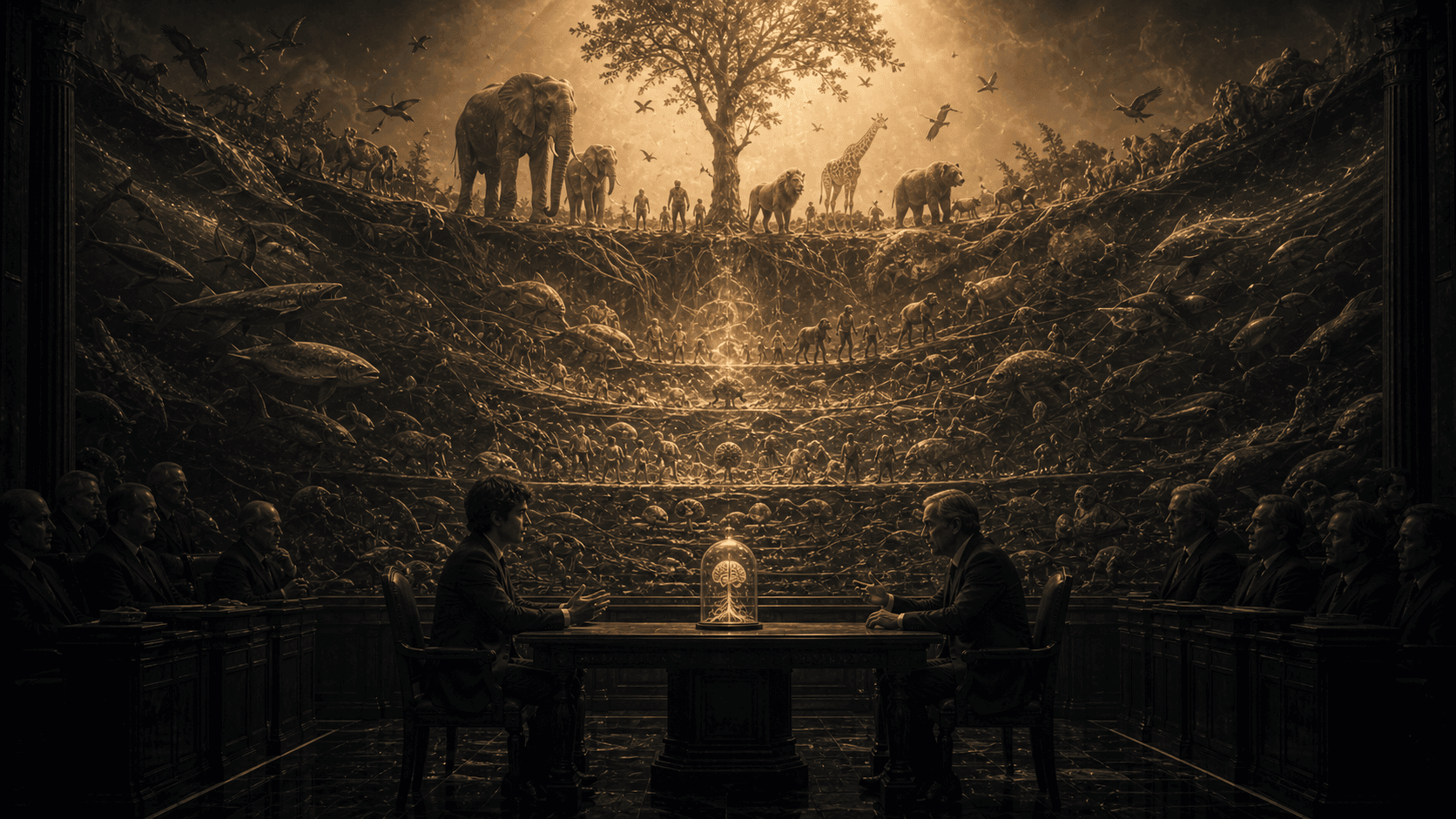
The argument about which animals to protect usually arrives in a kind of court, and the court has one question: does this organism have the right nervous system?
Does it have sufficient neural integration? Nociceptors? Brain structures associated with pain processing? Evidence of learned avoidance? The debate goes back and forth. Some organisms clearly qualify. Others are disputed. The court issues its ruling: protected or not protected, sentient or not sentient.
That framework is doing real moral work. It matters enormously whether a being can suffer. The argument about which organisms clear the sentience threshold is not a waste of time.
But the framework accepts a premise that never gets examined. It assumes trophic dependency is a permanent structural feature of civilization and that the only task is to determine which organisms are protected from extraction within that structure.
The nerve argument asks which organisms are sentient enough to deserve protection. The deeper question is why consciousness should remain metabolically organized around consuming living organization at all.
What the nerve argument is doing
The nerve argument asks: how much can this organism suffer? And then: is that amount of suffering significant enough to outweigh the interest in consuming it?
That is a utilitarian calculation operating inside the existing food chain. Its conclusion is always a judgment about which organisms may be consumed and which may not. It draws a line. Above the line: protected. Below the line: available.
This is moral progress inside the structure of predation. It is not a challenge to the structure. The structure remains: something must be consumed. The only question is what [1, 2].
Two different axes
There are two separate moral questions that the nerve argument collapses into one.
The first is sentience harm: how much pain, fear, captivity, and death does this practice impose on beings with inner experience? This is what the nerve argument is measuring. It is a real and urgent question.
The second is trophic dependency: how much does civilization's survival still depend on consuming living organization? This is a different question. It is not about which organisms suffer. It is about why the entire metabolic grammar of civilization still routes through the conversion of life into fuel.
The nerve argument addresses the first question and accepts the second as given. A fully plant-based diet reduces sentience harm dramatically. It does not change trophic dependency. Living organisms are still consumed. The food chain is still the architecture. The move is from high-sentience to lower-sentience extraction, not from extraction to something else [3].
Why the vegan defense feels defensive
The vegan defense often arrives under pressure and has to be mounted quickly. "Plants do not have nervous systems." "There is no evidence of sentience in what I consume." "The suffering I cause is minimal."
That framing accepts the other side's terms. It says: I am only consuming organisms that cannot suffer. It does not say: I am questioning whether living organization should be the raw material of human survival at all. The first framing is a defense inside the existing framework. The second is a challenge to the framework itself.
The first framing is always vulnerable, because the line can always be pushed. What about fungi? What about plants that respond to damage? What about the organisms disrupted by monoculture agriculture? The nerve argument can be turned against any position that depends on drawing the line somewhere specific.
The second framing is not vulnerable to that pressure because it does not depend on drawing the line correctly. It says: the line is the wrong concept. The question is not where to draw it. The question is what it would mean to exit the structure in which a line is necessary [3, 4].
What a trophic exit would look like
A civilization that exits trophic dependency does not merely eat lower on the food chain. It routes its energy through channels that do not require consuming living organization at all.
That is already partially underway. Photovoltaic energy, synthetic nutrients, precision fermentation, cellular agriculture: these are early implementations of a trophic exit. They do not convert organism into organism. They convert physical energy directly into what life needs to persist. The route bypasses the food chain rather than traveling more carefully through it.
This is not yet the primary mode. The primary mode is still ancient. Most human nutrition still passes through the food chain. But naming the exit as the direction changes what counts as progress. Not "how can we be less cruel inside the structure" but "how far have we gotten toward exiting the structure" [4].
The point
The nerve argument is a real moral instrument. It has done real work: expanding the circle of protection, making visible the suffering of organisms that had been treated as resources, challenging practices that impose massive harm on beings with inner experience. None of that is wrong.
But it is not the final question. It is a question about how to be less cruel inside an architecture that remains unchanged. The architecture is: consciousness sustains itself by consuming life.
That architecture is not a law of nature. It is a feature of the current developmental stage. The question beyond sentience harm is trophic dependency: how much does civilization still require living organization as its metabolic raw material?
That question does not replace the nerve argument. It places the nerve argument in a larger frame. The nerve argument asks who must be protected within the structure. The larger question asks how far the structure itself can be dissolved.
A civilization that begins dissolving the structure does not become less powerful. It becomes less dependent on predation. That is a different kind of advancement. Not more energy commanded. Less life consumed to sustain the same consciousness.
Sources
- Singer, P. (1975). Animal Liberation. New York Review/Random House. The foundational utilitarian argument that capacity for suffering, not species membership, is the morally relevant criterion for protection: establishes the nerve argument as the dominant moral framework for animal ethics.
- Regan, T. (1983). The Case for Animal Rights. University of California Press. On the "subject-of-a-life" criterion: beings with beliefs, desires, perception, memory, and welfare interests are not merely means to others' ends. A rights-based complement to Singer's sentience-harm framework.
- Francione, G. L. (2000). Introduction to Animal Rights: Your Child or the Dog? Temple University Press. On the structural inadequacy of welfare frameworks that accept the commodification of animals while seeking to reduce harm within that structure: the distinction between welfare reform and abolition maps directly onto the distinction between reducing sentience harm and exiting trophic dependency.
- Post, M. J. (2012). "Cultured beef: Medical technology to produce food." Journal of the Science of Food and Agriculture, 92(9): 2726-2727. Early technical discussion of cellular agriculture as a path toward nutrition that does not require slaughter: one of the first scientific papers to frame the technology explicitly as a civilizational trajectory, not merely a food product.