
Certainty Is More Tolerable Than Possibility
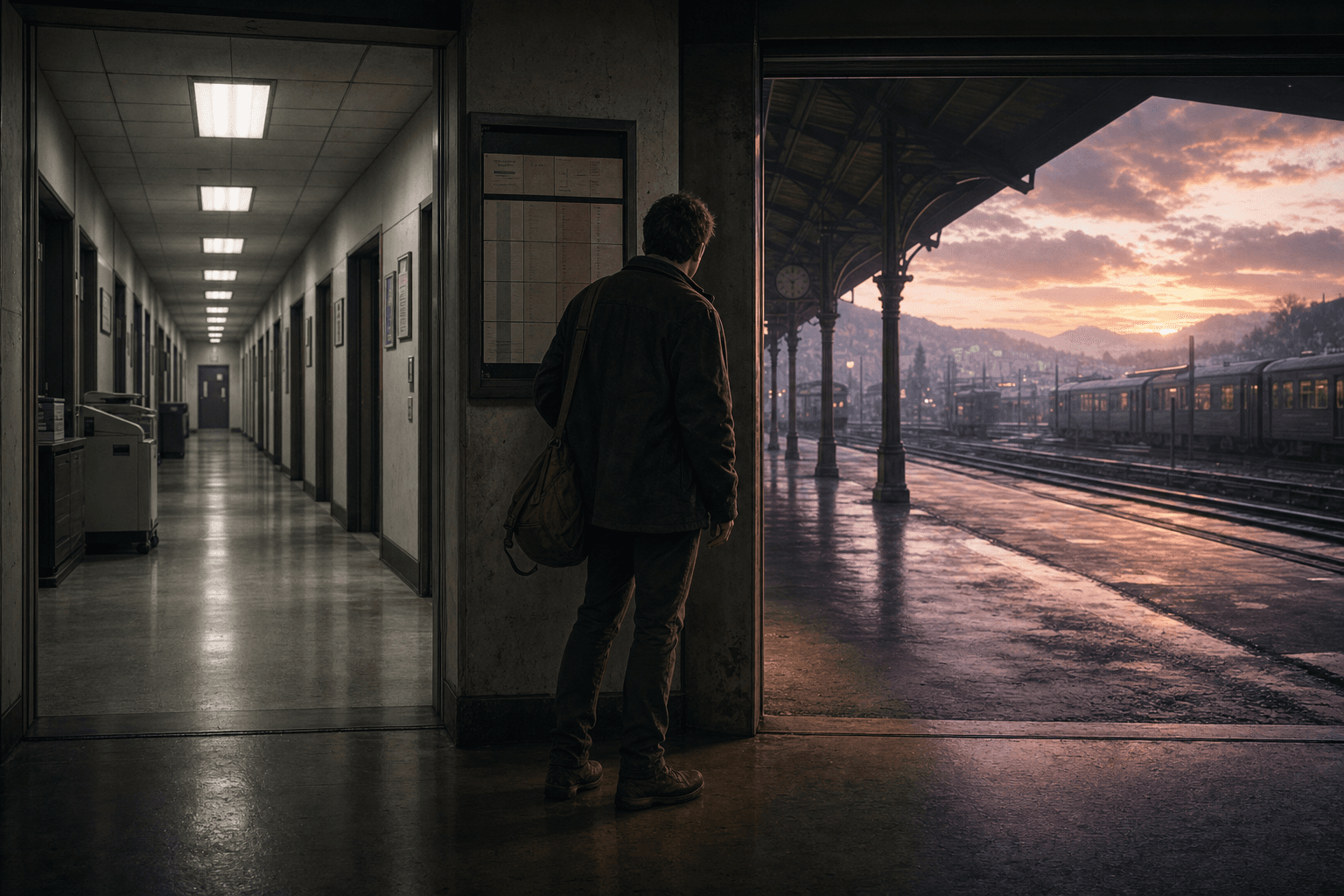
Some people build their lives in two alternating modes: a season of intense, structured work, followed by a season of open, unstructured freedom. And instead of relief, the second season often produces its own discomfort. You worked so you could finally be free, and now that you are free, part of you feels guilty for not working. The cycle repeats, back and forth, and each side seems to spoil the other.
The conflict is not actually between the two activities. It is between two different relationships to the future: certainty and possibility. One mode delivers a known, measurable outcome each day. The other delivers an outcome that cannot be measured and might not arrive at all. Humans tolerate certainty far better than possibility, even when possibility is the thing they say they want, and that asymmetry, not the activities themselves, is what keeps the cycle running.
A life split between two modes is not a conflict between the two activities but between certainty and possibility. Certainty delivers a known outcome each day; possibility delivers an unmeasurable one that might not arrive. Humans tolerate certainty far better, even when possibility is what they claim to want.
What each mode actually delivers
Look past the surface activities to what each mode is structurally offering. The working mode delivers certainty: a task was completed, a measurable unit of value was produced, a day's meaning is settled by evening. Whether or not the work is fulfilling, it resolves each day into a known quantity. There is little ambiguity about what happened [1].
The open mode delivers possibility: it does not promise a measurable outcome, only a range of things that might happen. Some days in this mode are transformative; many are ordinary; the value of any given day is not settled by evening and may not be settled for a long time, if ever. The same day that produces a life-changing insight is indistinguishable, in the moment, from a day that produces nothing, and this is inherent to the mode, not a failure of it [1, 2].
So the two modes are not simply different activities; they are different epistemic conditions. One tells you, reliably, what today was worth. The other withholds that information, sometimes indefinitely. This difference, not the specific content of work or travel, is the actual axis the person is oscillating on [1].
The asymmetric tolerance
The reason the oscillation feels unresolvable is that certainty and possibility are not tolerated equally. Humans are generally better able to bear a known, bounded difficulty than an open, unresolved one. A hard day of measurable work is tolerable because its shape is known in advance and its end is defined. A day of pure possibility is harder to bear specifically because it offers no such shape, no defined endpoint, no guaranteed resolution [2, 3].
This asymmetry holds even when possibility is what a person consciously wants and pursues. The desire for freedom, exploration, and open-ended experience is genuine, but the nervous system's comfort with the open-endedness of that experience is a separate matter from the desire for it. Wanting possibility and being at ease inside possibility are not the same capacity, and many people have much more of the first than the second [2, 3].
So each mode contains, at the psychological level, a seed of the other. Inside the certainty of work sits the wish for possibility that structure forecloses. Inside the possibility of freedom sits the wish for the certainty that possibility, by its nature, cannot supply. Neither mode is fully satisfying because each is haunted by the tolerance the other mode would provide. The oscillation is not indecision. It is the mind alternating between two incomplete states, each missing exactly what the other has [1, 3].
Why neither side wins
Because each mode contains the seed of the other, effort spent inside either mode cannot resolve the tension; it can only relocate it. More work does not quiet the wish for possibility, it sharpens it, because prolonged certainty makes the absence of open-endedness more noticeable. More travel does not quiet the wish for certainty, it sharpens it, because prolonged possibility makes the absence of measurable outcome more noticeable. The mind, given enough of one, always begins to crave the other [1, 2].
This is why the cycle can run for years without settling: it is not a problem to be solved by choosing better, working harder, or traveling longer, because the discomfort is not a flaw in either mode. It is a structural byproduct of the difference between certainty and possibility, and no amount of one can substitute for what only the other supplies. Every return to work is, in part, a flight from the intolerable open-endedness of freedom. Every return to freedom is, in part, a flight from the intolerable closure of certainty [2, 3].
So the guilt felt while traveling and not working is not really about money, and the restlessness felt while working and not exploring is not really about missed adventure. Both are the same underlying discomfort, expressed from opposite sides: the discomfort of being, at any given moment, inside only one of the two conditions a person needs some of, and lacking the other [1, 3].
The third mode that holds both
There is a mode that does not sit on either side of this axis, and it explains why some activities quiet the oscillation rather than feeding it. Creation, building something with an uncertain but self-directed outcome, contains elements of both certainty and possibility at once. It has the open-endedness of exploration, since what emerges is not fully known in advance, and it has the accruing, trackable shape of work, since something is being built and can be seen to grow [1, 2].
This is why deep creative or constructive work can quiet a conflict that pure labor and pure leisure both fail to resolve. In creation, freedom and productivity are not opposed; they are the same act. The person is exploring, which satisfies the pull toward possibility, and simultaneously building, which satisfies the pull toward certainty, so neither side of the split feels abandoned in the way it does during pure work or pure travel [1, 3].
This does not mean creation eliminates the axis; a creative project can still have open days that feel like too much possibility and structured days that feel like too much certainty. But because it structurally contains both, it offers a kind of resolution that neither pole alone can. The lesson is not that one must choose between certainty and possibility, but that the oscillation between them, as separate modes, may be less a fixed feature of life than a sign that the current activities have not yet found the form that holds both together.
The point
A life split between working and traveling, or any similar pair of alternating modes, is not really a conflict between the two activities. It is a conflict between certainty and possibility. Work delivers a known, measurable outcome each day; open, unstructured time delivers an unmeasurable outcome that may never resolve. These are different epistemic conditions, and the oscillation runs on that difference, not on the specific content of either mode.
Humans tolerate certainty far better than possibility, even when possibility is consciously desired, because wanting open-endedness and being at ease inside it are separate capacities. This is why each mode contains the seed of the other: certainty forecloses the possibility that is wished for, and possibility withholds the certainty that is wished for, so neither is fully satisfying. Effort inside either mode cannot resolve this, since more of one only sharpens the craving for the other, and the guilt or restlessness felt in each mode is the same underlying discomfort seen from opposite sides.
Creation is a third mode that structurally holds both at once, exploring toward an unknown outcome while building something with accruing, trackable shape, which is why it can quiet a conflict that pure labor and pure leisure both feed. The oscillation between certainty and possibility is less a fixed law of life than a sign that the current activities have not yet found a form that contains both.
Sources
- Kahneman, D. & Tversky, A. (1979). "Prospect theory: An analysis of decision under risk." Econometrica, 47(2): 263-292. On the asymmetric psychological weight of certain versus uncertain outcomes, and the strong preference for certainty even when expected value favors an uncertain option.
- Csikszentmihalyi, M. (1990). Flow: The Psychology of Optimal Experience. Harper & Row. On how activities that combine clear structure with open-ended challenge produce sustained engagement, unlike pure unstructured leisure or pure routine labor.
- Frankl, V. E. (1959). Man's Search for Meaning. Beacon Press. On how meaning is generated through purposeful engagement with uncertain outcomes rather than through either pure security or pure freedom alone.