
We Have Not Yet Learned to Touch
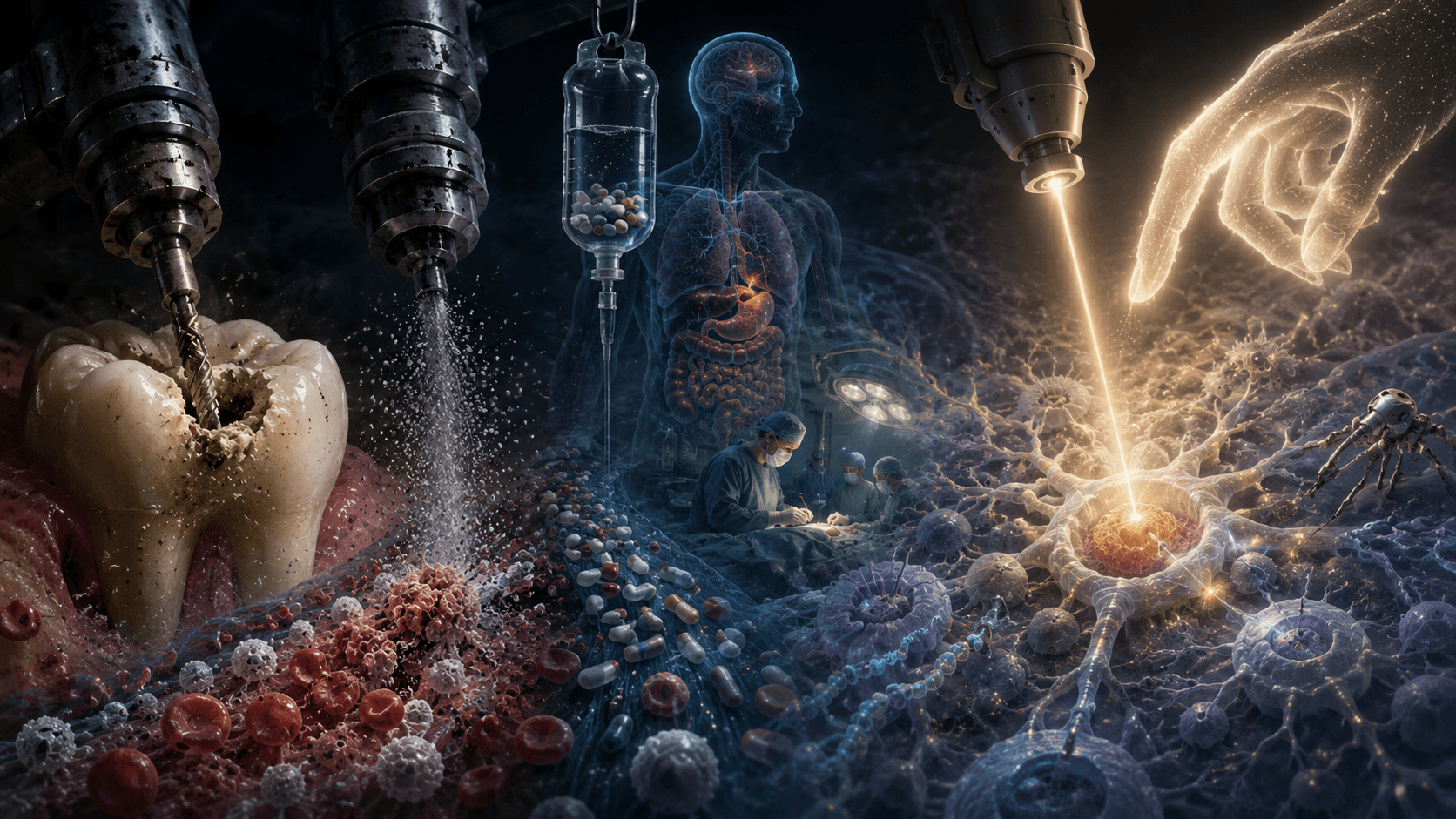
I drill teeth for a living. I know the science behind the procedure, the precision required, the genuine benefit delivered. I also know, with my hands, that the instrument is larger than the ideal. The bur does not negotiate with the tooth at the level of disease versus preservation. It creates access, shape, clearance, retention, and mechanical feasibility. It removes healthy structure to reach unhealthy structure. The patient is better off afterward. The procedure is also, by a more demanding standard, still blunt.
This is not a complaint about dentistry. It is an observation about the age.
Every generation measures its advancement by looking backward. Compared to extraction without anesthesia, to wooden dentures, to the barber-surgeon with his unsterilized instruments, modern dentistry is miraculous. The comparison is accurate. It is also the wrong comparison. The more honest comparison is not to the past. It is to what precision actually looks like when a civilization has fully understood what it is working on.
By that standard, we are not there yet. We are early. Very early.
True advancement is the ability to create the desired change with the least collateral damage. By that definition, most of what we call advanced medicine is still a low-tech era wearing high-tech clothes.
The drill as a symbol
What bothers me about drilling is not the discomfort or the noise. It is the structural logic of the act. In order to address a specific region of decay, I must first create access. Creating access means removing material beyond the disease boundary. The instrument is larger than the target. The treatment zone is wider than the problem zone. This is not malpractice. It is physics and geometry given our current tools. It is, however, a confession: we cannot yet locate the exact border between what belongs and what does not, and act only on what does not. We are approximating at a scale larger than the problem.
Now apply that logic outward.
Chemotherapy attacks cancer cells and healthy cells. Psychiatric medication travels systemically through the body to influence a specific neural pathway it cannot yet reach directly [1]. Antibiotics eliminate pathogens and disrupt microbiomes that took decades to establish [2]. Surgery requires opening a body to reach a target the body is already surrounding. In each case, the intervention works. In each case, the intervention also confuses access with treatment, sacrifices surrounding structure for the sake of reaching the problem, and tolerates collateral disturbance as the acceptable price of repair.
These are not failures of medicine. They are signatures of an age that has learned to intervene but has not yet learned how to touch [3].
The backward and the forward measure
Most progress narratives measure backward. Compared to bloodletting, to trepanation, to amputation without sterile technique, to surgery without anesthesia, modern medicine is an extraordinary achievement. That comparison is real and should not be dismissed. The drop in infant mortality, the elimination of diseases that once annihilated populations, the extension of functional life: these are genuine and profound.
But there is another measurement axis, and it runs forward rather than backward.
On that axis, the question is not "how far have we come from the worst?" but "how close are we to the ideal?" The ideal, in this framing, is an intervention that can locate exactly what needs to change, act precisely on that and nothing else, leave the surrounding system undisturbed, and produce the desired outcome without producing others.
By that standard, we are nowhere near advanced [4]. We are in an early period of power without elegance. We have learned to force systems to change. We have not yet learned to understand systems so precisely that change can happen without forcing anything.
The future will almost certainly look back at this era the way we look back at miasma theory, at mercury cures, at radical mastectomy as standard treatment for early breast cancer. Not as evil, not as stupid, but as the predictable clumsiness of an age that had real tools and partial understanding. Clever, but still using hammers in rooms that required keys.
What precision would actually mean
Precision medicine is beginning to move in this direction [5]. Gene editing, targeted drug delivery, personalized oncology, microbiome-aware treatments, and early work on tissue regeneration all gesture toward a future in which the intervention can be calibrated to the specific biology of the specific person at the specific moment. That future is not here. The gesture toward it is the first evidence that the current era knows, somewhere, that it is not precise enough.
In dentistry, the equivalent would be caries reversal without structural removal, enamel regeneration from the tooth's own biology, bacteria-specific antimicrobials that leave the oral microbiome intact, dentin-pulp healing, and eventually biological restoration of tooth architecture. Some of this is beginning to exist in research settings [6]. None of it is routine clinical practice. What is routine clinical practice is still, at its core, controlled removal in service of reconstruction.
The fact that improvement is happening does not change the assessment of where we currently are. It confirms it.
The same principle operates in every domain
The bluntness of the drill is a medical instance of something civilization-wide.
Advice is blunt. A generalized recommendation applied to a highly specific personal architecture is an intervention at the wrong scale. "Set boundaries," "take medication," "journal," "reframe your thinking": these may relieve pressure, but they often operate like broad-spectrum antibiotics against a specifically mapped infection. They cover the general region. They do not locate the exact structure.
Institutions are blunt. Policy that changes behavior through incentive, punishment, or mandate is an intervention at the level of outputs rather than the level of the organizing logic that produces the outputs. The behavior may shift. The structure that generates the behavior often does not.
Education is blunt. Teaching curricula to everyone at the same pace and in the same sequence is not precision. It is logistics dressed as instruction.
What all of these share with the drill is the same underlying limitation: we can push on a system. We cannot yet read it well enough to know exactly where and how hard to push, what to leave alone, and what the push will disturb that we did not intend to disturb [3, 4].
What "archaic" actually means
Archaic does not mean useless. A drill can save a tooth. A drug can save a life. A surgery can keep a person alive who would otherwise die. A blunt intervention is still the best available tool during a phase of development when nothing more precise exists. The danger is not using the tools we have. The danger is mistaking the tools we have for advanced tools.
The word archaic, accurately applied, means: sophisticated by the standards of its era, not yet sophisticated by the standards of what the problem actually requires. That is the honest assessment of most current medical, psychological, and social intervention. It is not a condemnation. It is a location.
We are located at a point in the development of human knowledge where power has significantly outpaced precision. We can alter systems. We cannot yet fully understand systems. We can force change. We cannot yet read structure deeply enough to change it without disturbing what we intended to leave alone.
That gap, between intervention and understanding, between power and precision, between the scale of the tool and the scale of the problem, is what makes this era archaic to anyone measuring forward rather than backward.
The point
The modern world is advanced relative to the past and archaic relative to the ideal. Both of these are true at the same time, and holding both simultaneously is more accurate than holding either one alone.
The person who only measures backward sees a miracle. The person who only measures forward sees a primitive age. The Reality Scientist position is to see both: the genuine achievement of what we have built, and the clear-eyed acknowledgment of what we are still doing, which is treating molecular, biological, emotional, and relational realities with instruments that are too large for the problem.
We have not yet learned to touch. That is not a failure. It is a stage. But it is the stage we are in.
Sources
- Nestler, E. J. & Hyman, S. E. (2010). "Animal models of neuropsychiatric disorders." Nature Neuroscience 13(10): 1161-1169. On the current limits of psychiatric pharmacology and the gap between systemic delivery and targeted neurological action.
- Blaser, M. J. (2014). Missing Microbes: How the Overuse of Antibiotics Is Fueling Our Modern Plagues. Henry Holt. On the collateral damage of broad-spectrum antibiotic treatment on the microbiome.
- Illich, I. (1976). Limits to Medicine: Medical Nemesis. Pantheon. The foundational argument that modern medicine's iatrogenic effects reveal the structural limits of intervention at scale.
- Tenner, E. (1996). Why Things Bite Back: Technology and the Revenge of Unintended Consequences. Knopf. On how technological interventions consistently produce side effects that reveal the gap between power and understanding.
- Collins, F. S. & Varmus, H. (2015). "A new initiative on precision medicine." New England Journal of Medicine 372(9): 793-795. On the turn toward individual-specific biological targeting as an acknowledgment of the limits of generalized treatment.
- Manton, D. J. et al. (2014). "Remineralization of enamel subsurface lesions in situ by the use of three commercially available sugar-free gums." International Journal of Paediatric Dentistry 18(4): 284-290. On early evidence for non-invasive caries reversal as a gesture toward precision over structural removal.