
The Observer Trades Presence for Insight
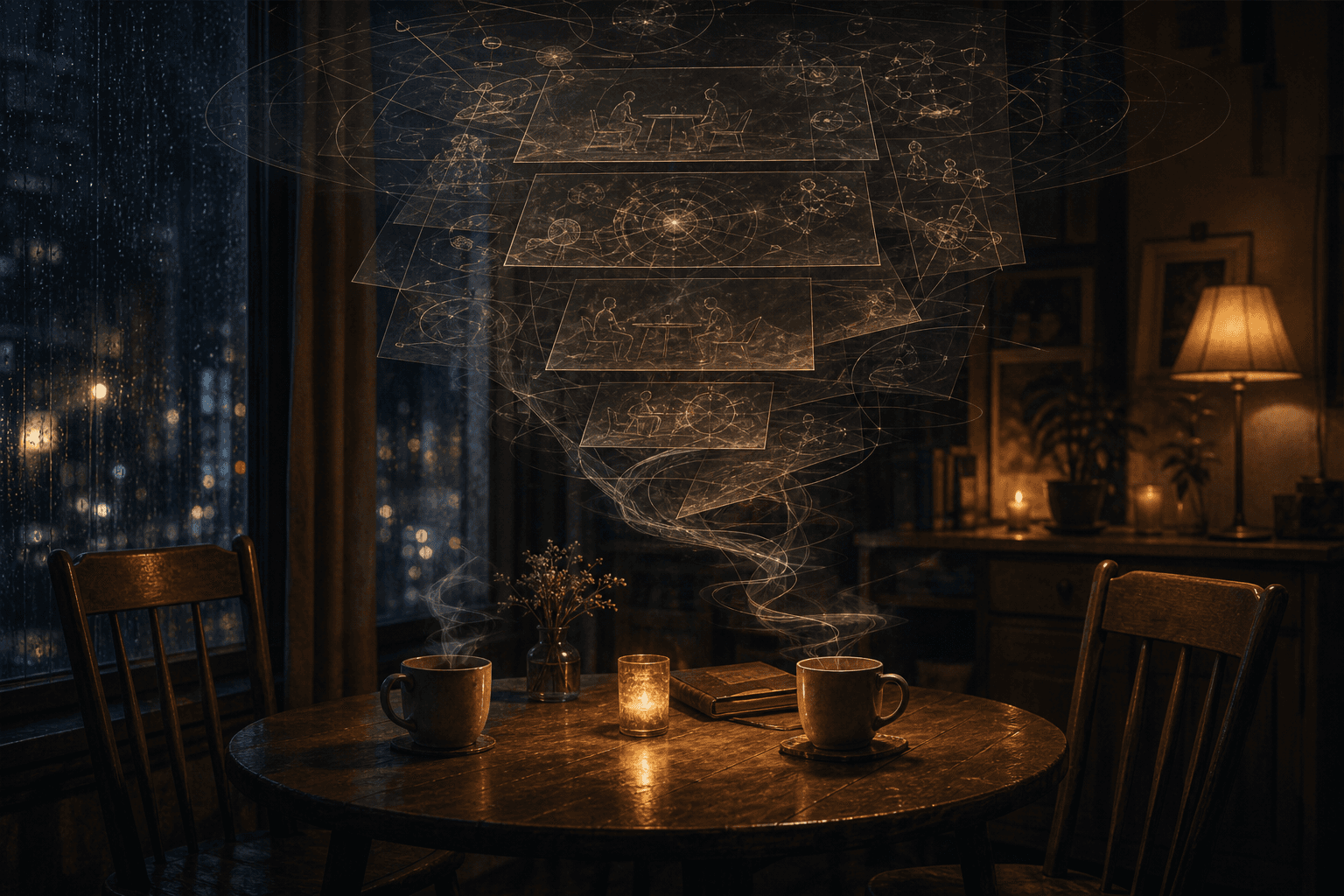
There is a particular kind of person who, mid-conversation, is not only having the conversation but tracking why they feel the way they feel about it, what assumption produced that feeling, and what that assumption reveals about the framework they're using to interpret the whole exchange. This looks, from outside, like unusual depth. It often is. But it comes from somewhere specific, and it costs something specific, and both the depth and the cost are frequently described as if only the depth were real.
The mechanism is simple to state and easy to underestimate. Attention is not infinite, and observing an experience requires a portion of the same attention that would otherwise be spent inside the experience. A person fully immersed in a conversation is simply having the conversation. A person observing the conversation is having the conversation and simultaneously running a second process on top of it. A person observing themselves observing the conversation is running a third. Each layer produces real information. Each layer is also, unavoidably, attention diverted from direct contact with what is actually happening.
Every layer of self-observation buys insight at the price of presence, because both draw on the same finite attention, and a mind running several models at once is not living any of them as fully as a mind running one.
Insight is not free
The instinct is to treat self-observation as a pure upgrade, more awareness, more accuracy, more understanding, with no corresponding cost. Cognitive research on divided attention argues against this directly: when attention is split between two simultaneous tasks, even when both are well within a person's individual capability, performance on each measurably declines relative to doing either alone, because attentional resources are limited and shared rather than duplicated for each task [1]. Watching yourself have an experience is a second task layered on the first. The fact that both tasks are internal and invisible to an outside observer does not exempt them from this cost. It only makes the cost harder to see.
This means the vivid, often-praised capacity to notice hidden assumptions, contradictions, and relational patterns in real time is not something a mind does for free while also fully inhabiting the moment. It is purchased, continuously, out of the same attentional budget that would otherwise go toward simply being where you are. The insight is real. So is the withdrawal it was funded by.
Why more layers is not simply better
If one layer of observation costs some presence, it might seem like the answer is to stop at the minimum useful layer, notice the pattern, then let go. But the mind capable of noticing a pattern is often also capable of noticing itself noticing, and that capacity does not switch off just because it has done its job. Research on rumination, a specific and unproductive form of repetitive self-focused attention, found that this kind of recursive self-observation, once activated, tends to perpetuate itself rather than resolve, precisely because each cycle of observing the previous cycle generates new material for the next one to examine [2]. Depth of reflection and productiveness of reflection are not the same axis. A mind can go five layers deep and simply be further from the original experience, not closer to a resolution of it.
This is the trap hiding inside the praise for people who "always go meta." Going meta is not automatically going deeper in a useful sense. Sometimes it is. Sometimes it is simply adding another model on top of an already crowded stack, at a cost that keeps compounding while the marginal insight per layer keeps shrinking.
Why the observer can feel like glass
The felt experience of heavy, habitual self-observation is often described as watching life through glass, present, but at a remove, never quite inside the thing that is happening. This is not a metaphor invented for effect. It follows directly from the attentional mechanics: if some fraction of available attention is permanently allocated to tracking and modeling the experience rather than having it, then direct, unmediated contact with the experience is structurally reduced, every time, by exactly that fraction. The observer is not choosing distance as a philosophical stance. Distance is the literal byproduct of where the attention went [1, 3].
Flow research offers a useful contrast case. States of deep, satisfying absorption in an activity are consistently characterized by the near-total absence of self-monitoring, attention fully allocated to the activity itself rather than split with a watching process running alongside it [3]. This suggests the observer's distance is not an inevitable feature of a sophisticated mind. It is a specific configuration, useful for some purposes, costly for others, and one that a mind capable of deep reflection is also, at least in principle, capable of temporarily suspending.
What this reframes
None of this argues that self-observation is a mistake to be corrected. Its output, hidden assumptions surfaced, patterns named, contradictions caught, is genuinely valuable and often unavailable any other way. The reframe is narrower: the trade is real, it runs in both directions, and treating constant multi-layer observation as an unambiguous upgrade misses that every layer is drawing on the same attention that direct experience needs. A mind that can go five layers deep is not simply more conscious than one that stays at one. It has made a specific allocation, insight over presence, and that allocation has a cost that shows up as exactly the glass-like distance from experience that habitual observers often report.
The practical implication is that the observer function is best treated as something to deploy rather than something to run continuously by default. Used deliberately, it produces the insight it's known for. Left running at all times, it produces the same insight along with a compounding tax on the very experience the insight was supposed to be about.
The point
Self-observation is not a cost-free upgrade to ordinary experience. It is a second process layered on top of a first, and because attention is a shared, limited resource, running that second process necessarily reduces the share available to the original experience, a mechanism well established in research on divided attention. Recursive self-observation compounds this rather than resolving it, since each layer of watching the previous layer generates new material to watch, which is part of why unproductive rumination tends to perpetuate rather than settle.
This explains the specific, often-reported feeling of watching life through glass: not a philosophical stance chosen by a sophisticated mind, but the literal, mechanical result of attention being permanently split between having an experience and modeling it. Flow research shows the contrast case, deep absorption defined by the near-total absence of self-monitoring, which suggests observation is a configuration a mind adopts rather than a fixed trait. Insight and presence draw on the same budget, and the honest framing is not that self-observation makes a mind deeper without cost, but that it makes a specific, recurring trade, one worth choosing deliberately rather than running by default.
Sources
- Kahneman, D. (1973). Attention and Effort. Prentice-Hall. On attention as a limited, shared resource, and the measurable performance cost of splitting it between simultaneous tasks, including internal, non-motor tasks.
- Nolan, S. A., Roberts, J. E., & Gotlib, I. H. (1998). Neuroticism and ruminative response style as predictors of change in depressive symptoms. Cognitive Therapy and Research, 22(5), 445-455. On rumination as a self-perpetuating cycle of recursive self-focused attention, where each cycle of reflection generates further material for subsequent cycles rather than resolving.
- Csikszentmihalyi, M. (1990). Flow: The Psychology of Optimal Experience. Harper & Row. On flow states as characterized by the near-total absence of self-monitoring, offering a contrast case to habitual, layered self-observation.