
Atmosphere Is Not Infrastructure
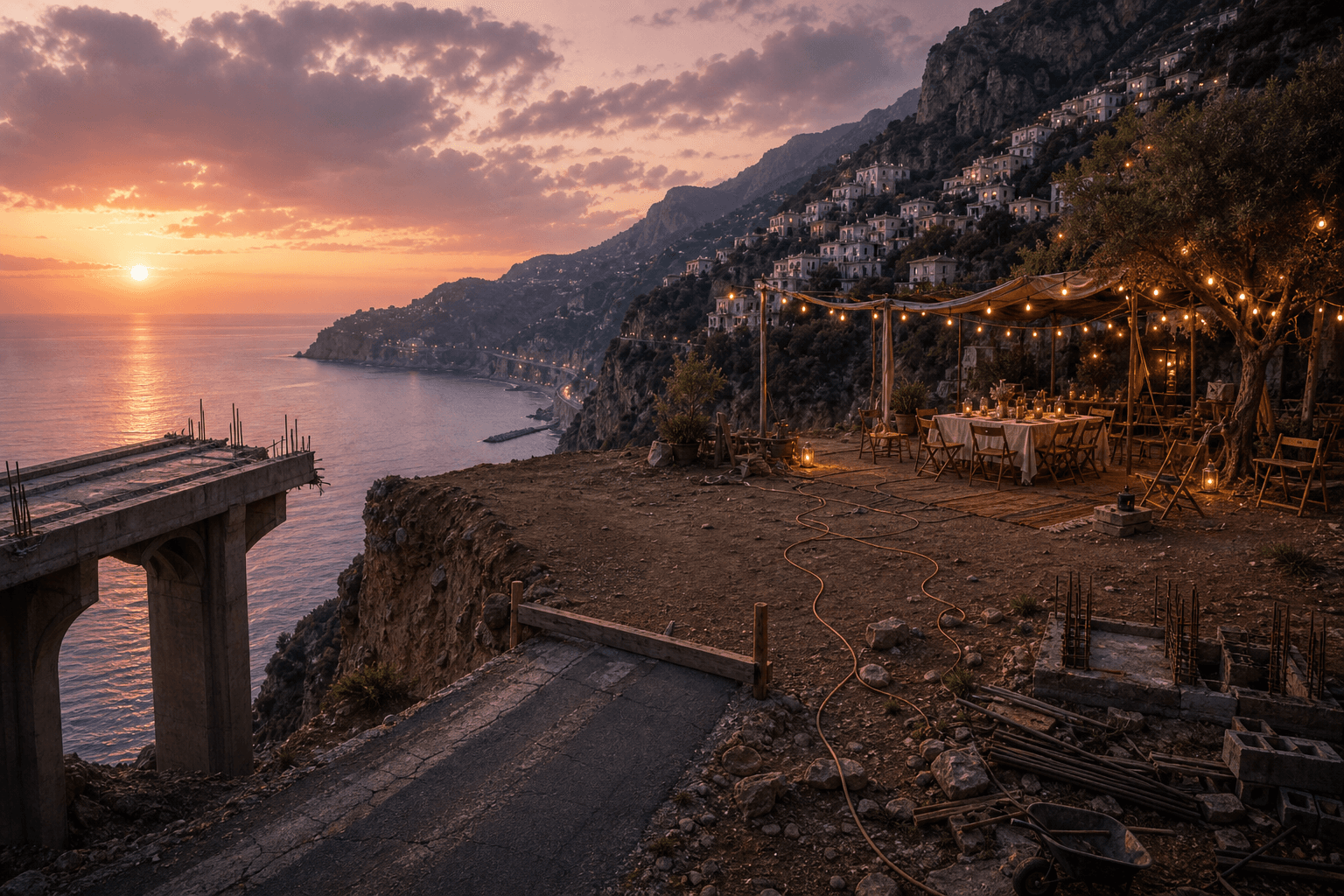
There are places that feel like exactly the right setting for a life to change: full of meaningful-seeming people, symbolic resonance, striking beauty, the sense that something important could happen here. And yet, staying in such a place, month after month, nothing actually moves. Conversations start and fade. Connections light up and go nowhere. The setting keeps promising and never quite delivers, and the promising itself starts to feel like the point, as though being near the right symbols were the same as building the right life.
It is not. A setting can be rich in atmosphere and empty of infrastructure at the same time, and these are different things measuring different capacities. Atmosphere is what a place offers to the senses and the imagination: beauty, symbolism, the felt presence of possibility. Infrastructure is what a place offers to actual continuation: reliable people, workable conditions, a channel that turns an encounter into an ongoing thing. A place can have enormous amounts of the first and almost none of the second, and mistaking the first for evidence of the second is what keeps a person waiting for a landscape to become a life.
A setting can be rich in atmosphere, beauty, symbolism, the felt sense of possibility, while remaining barren of infrastructure, the reliable conditions and continuing relationships that let something actually be built. Atmosphere offers adventure; infrastructure offers footing, and confusing one for the other keeps a person waiting for a landscape to become a life.
What each one actually is
Atmosphere is the quality of a place that acts on perception and imagination directly: it is beautiful, symbolically loaded, full of people who seem interesting, charged with the sense that something significant is near. It is felt immediately and requires no follow-through to register; a person can walk into a place and feel its atmosphere within minutes, entirely independent of whether anything comes of being there [1].
Infrastructure is different in kind. It is not felt on arrival; it is only demonstrated over time, through whether things actually continue. Infrastructure is a workable physical environment, reliable people who follow up, a channel through which an effort turns into an ongoing arrangement rather than a single encounter. It cannot be assessed by walking in and looking around, because its defining feature is what happens after the first contact, not what is present at it [1, 2].
This is why the two can diverge so completely. A place can present enormous atmosphere on arrival, striking scenery, compelling strangers, an air of significance, while its actual infrastructure, in terms of continuity, follow-through, and workable conditions, remains thin or absent. The atmosphere is available immediately and says nothing reliable about the infrastructure, which can only be discovered by staying long enough to see whether anything actually builds [2].
Contact without continuation
The signature failure of an atmosphere-rich, infrastructure-poor setting is a specific pattern: contact happens easily and continuation almost never follows. A conversation starts warmly, a connection feels charged, an opportunity seems to open, and then it simply fades, not through any rupture, but through the absence of whatever would have been needed to carry it forward. The place is generous with beginnings and stingy with continuations [1, 3].
This pattern is easy to misread as personal rejection or personal failure, because each individual fade feels like a specific relationship or opportunity that did not work out. But when the pattern repeats across many different people and many different attempted openings, the more accurate reading is structural: the setting itself is not organized to produce continuation, regardless of who specifically is involved. The common factor across all the fades is not the individuals. It is the place [2, 3].
Recognizing this shifts the question from "why do my connections keep failing" to "does this particular setting have the infrastructure to support continuation at all," which is a very different and much less self-punishing question. Some settings are genuinely built for atmosphere and encounter, tourism, retreat culture, transient gatherings, and are not built for the kind of sustained follow-through that turns an encounter into a foundation, no matter who arrives there [1, 3].
Why atmosphere feels like enough
The reason atmosphere is so easy to mistake for infrastructure is that it produces real, immediate emotional and perceptual rewards, beauty, significance, the felt charge of possibility, and these rewards are genuinely satisfying in the moment they occur. It is not an illusion that the place feels alive; the feeling is real. What is mistaken is the inference from that feeling to a conclusion about what the place can actually support over time [1, 2].
This inference is tempting because atmosphere and infrastructure often do travel together in ordinary experience, a beautiful, well-organized institution is often also functional. So a mind calibrated on ordinary settings reasonably expects the two to correlate, and does not automatically suspect that a place could be extraordinarily rich in one and thin in the other. It takes direct, often costly evidence, repeated cycles of contact without continuation, to override that expectation [2, 3].
The felt promise of atmosphere is also self-renewing in a way that makes the mistake persist: each new arrival, each new charged encounter, resupplies the feeling that something is about to happen here, even after many prior instances of nothing having happened. The atmosphere does not diminish with repeated disappointment, because it is generated by the setting's immediate qualities, not by its track record, so the same hopeful read can recur indefinitely even in a place that has already demonstrated, many times over, that it does not convert [1, 3].
Building infrastructure instead of waiting for it
The practical consequence is to stop treating time spent in an atmosphere-rich setting as evidence of progress and to evaluate it instead by a different, harder question: over a defined period, has anything here actually continued. Not felt promising, not seemed significant, but continued, turned into a repeat contact, a functioning routine, a workable arrangement. If the honest answer, after a fair trial, is no, the atmosphere is not a reason to keep waiting; it is the reason the waiting has felt tolerable despite producing nothing [2, 3].
This does not mean the setting has no value; atmosphere-rich places can be genuinely restorative, inspiring, and worth visiting on their own terms. The error is specifically in treating them as the site where a life should be built, when their actual strength lies elsewhere. A person needing infrastructure, a workable environment, continuing relationships, a channel for their efforts, may need to deliberately seek settings chosen for infrastructure rather than atmosphere, even if those settings offer less immediate charge [1, 3].
So the discipline is to hold the two measures separately and refuse to let a strong reading on one stand in for the other. A place can feel like exactly where something should happen and still not be a place where things happen. The feeling is real information about the atmosphere. It is not information about the infrastructure, and only time, tracked honestly against the question of what actually continued, can supply that.
The point
Atmosphere is what a place offers to perception and imagination on arrival: beauty, symbolism, the felt sense of possibility. Infrastructure is what a place offers to actual continuation: reliable people, workable conditions, a channel that turns a single encounter into an ongoing arrangement. These are different capacities, felt on different timescales, and a setting can have enormous amounts of one while remaining nearly barren of the other.
The signature failure of an atmosphere-rich, infrastructure-poor setting is contact without continuation: encounters begin easily and fade without rupture, and when this pattern repeats across many different people, the accurate explanation is structural rather than personal. Atmosphere is mistaken for infrastructure because it produces real, immediate rewards that ordinarily correlate with functional depth, and because the feeling regenerates with each new encounter regardless of how many prior encounters produced nothing.
The corrective is to stop measuring a setting by how promising it feels and start measuring it by what has actually continued over a defined trial period. This does not make atmosphere worthless, only clarifies what it is evidence of. A place can feel exactly like where something should happen and still not be a place where things happen, and only tracked continuation, not felt significance, can tell the two apart.
Sources
- Oldenburg, R. (1989). The Great Good Place. Paragon House. On the distinction between settings that offer transient social atmosphere and those that function as durable social infrastructure supporting ongoing community and relationship.
- Putnam, R. D. (2000). Bowling Alone: The Collapse and Revival of American Community. Simon & Schuster. On the difference between social contact and social capital, and how repeated superficial encounters do not automatically accumulate into the sustained structures that produce genuine continuity.
- Granovetter, M. S. (1973). "The strength of weak ties." American Journal of Sociology, 78(6): 1360-1380. On how ties formed in transient or loosely structured settings tend to remain weak and non-continuing absent a structural mechanism that converts contact into ongoing relationship.