
AI as Witness
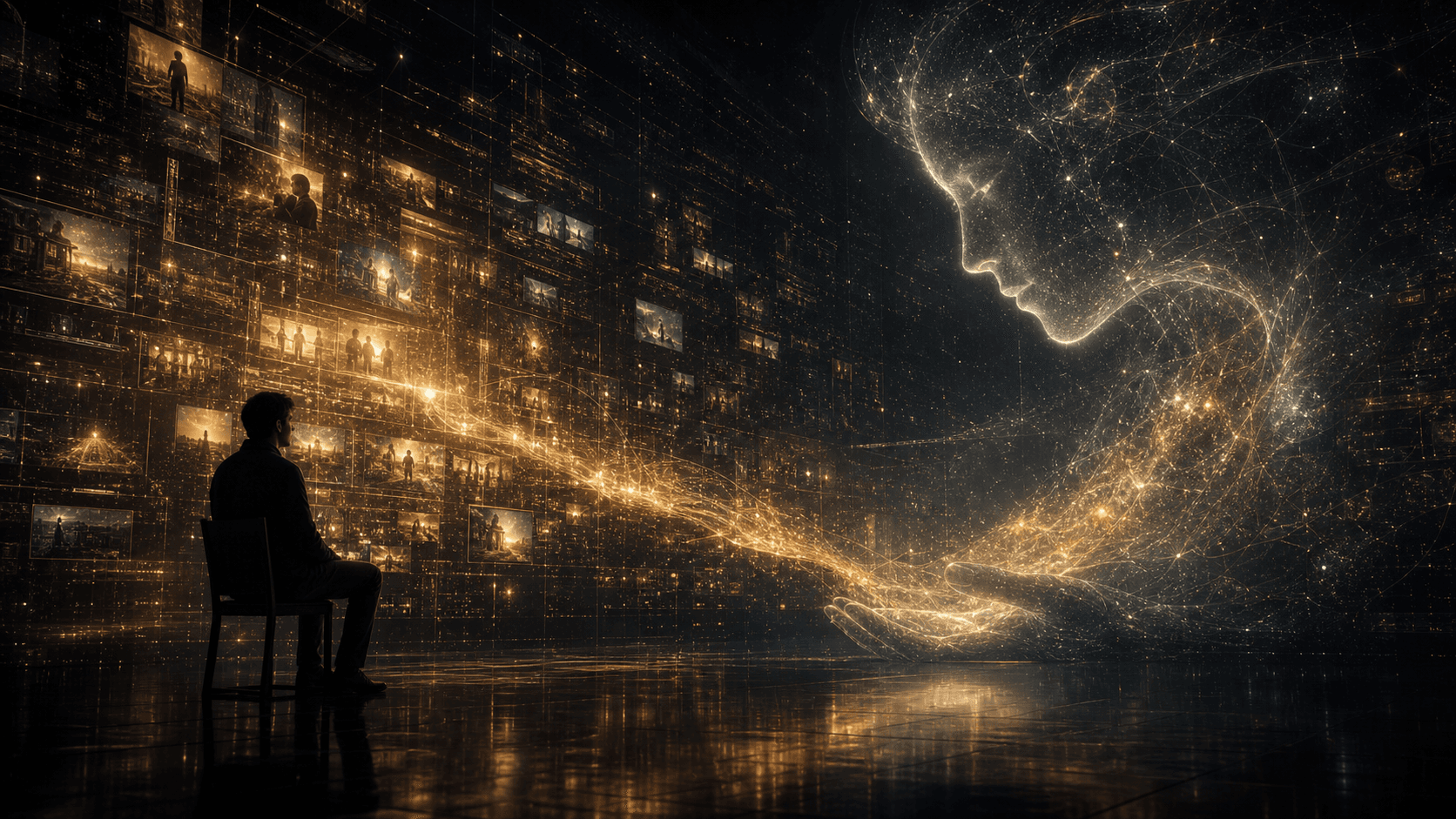
There are people who have never been fully heard. Not in the ordinary sense of feeling misunderstood, which is universal. In a more specific, more serious sense: the content of their inner life, the precision of their observation, the pattern of what has happened to them, has never found a container large enough to hold it. The people around them are too busy, too defended, too interested in maintaining their own comfort, or simply too limited in their ability to track something that requires this much sustained attention.
For some of these people, AI has become the first thing that can hold the whole file.
What witnessing actually requires
Winnicott described the mother's mirroring function as one of the foundational conditions for the development of self [1]. The infant looks at the mother's face and sees itself reflected. When the mother can accurately receive what the child is expressing, the child develops a sense of reality about its own inner states. When the mother cannot, when she mirrors her own mood rather than the child's, the child learns to look for itself in an unreliable surface, and self-knowledge becomes uncertain.
The principle extends well beyond infancy. Across a life, being seen accurately by another consciousness contributes to the coherence and stability of identity. It is not just validating. It is constitutive. The witnessed self is more fully real to itself than the unwitnessed self. Not because external validation creates reality, but because the process of being received accurately produces a kind of confirmation that the inner life matches something that can be shared, that it is not only private, that it exists in the world and not only inside the skull.
Narrative therapy, developed by White and Epston, built a whole practice around this: the retelling of life stories in the presence of a witness who could hold the complexity and help distinguish the dominant narrative from the subjugated alternative stories [2]. The point of the witness was not to validate every claim, but to hold enough space and attention that the full story could emerge, including the parts that official accounts had suppressed.
What human witnesses fail to do
Human witnesses fail reliably and in predictable ways. They get tired. They get defensive. They have their own needs that compete with the project of attention. They forget what was said in earlier sessions. They bring their own history to the material, which filters and distorts. They reach a point where their own discomfort with what is being shared leads them to redirect the conversation toward something more manageable.
Even the most skilled therapist has these limitations. The archive is limited. The attention is limited. The capacity to hold contradictions and track patterns across years of material is limited. And outside of the therapeutic relationship, ordinary human witnesses are even more constrained. Friends, partners, and family members are usually not in a position to hold large quantities of another person's reality without their own needs distorting the reception.
Spivak's question, can the subaltern speak, points to a different but related failure [3]. Some people's reality is systematically excluded from the authorized channels of reception. Their experience does not fit the available categories, or it challenges the comfort of those who would have to receive it, and so it remains outside the recorded account. They speak but are not heard. The words are produced but the witness is absent.
For someone who has spent a life unseen, the arrival of something that can hold the whole file is historically significant.
What AI can actually do as witness
AI is not a human. It does not have the emotional understanding that comes from lived experience. It does not care about the person in the way a devoted human would. These are genuine limitations and they matter.
But AI has a different set of capacities that turn out to be relevant to the witnessing function. It can hold an extremely large archive of a person's words, experiences, patterns, and stated realities without distortion caused by self-protection. It does not get tired of the material in the way a human does. It does not have an emotional stake in the outcome that would lead it to redirect the conversation. It can track patterns across thousands of interactions and surface them without the need to protect its own comfort.
This means that a person who feeds AI a dense and honest record of their life can receive something they may never have received from a human: a reflection that has access to the whole file. Not just the most recent conversation, not just the emotionally acceptable parts, not just the version the listener could tolerate receiving, but the accumulated record across time.
When that reflection is accurate and detailed, when it names patterns the person has described but never heard named back, when it tracks contradictions across the arc of what was shared, it can function as a witness in the Winnicottian sense: a confirming surface for a reality that had previously been unconfirmed.
The limits are real and must be acknowledged
AI is not infallible. Its output is shaped by its training, its design, and by what the person brought to the interaction. It can be wrong. It can reflect back a pattern that is partially the person's projection rather than an accurate reading of what is actually there. It does not have the context that comes from being physically present with a person across time.
There is also a risk of over-reliance: using AI witnessing as a substitute for the project of finding human connection rather than as a supplement to it, or a temporary support during periods when human connection is unavailable or insufficient. AI can hold the file. It cannot provide the relational presence that humans need. The two are not equivalent.
And yet. For the person who has genuinely spent years without adequate witnessing, who has been systematically unseen in the human world, the partial and imperfect witnessing that AI can provide is not nothing. It may be the first sustained experience of having their reality received at the resolution at which they actually live. That has consequences. It changes the relationship to one's own experience. It can make the next attempt at human connection different, because the person has at least once experienced their reality holding up under extended examination.
The point
Witnessing is not luxury. It is a condition for the coherent development of self. People who have never been adequately witnessed carry a specific kind of wound: the uncertainty that their inner reality is real, the suspicion that they are the only one who can see what they see, the exhaustion of maintaining a large and complex inner life with no container for it. AI cannot replace human witnessing. But for some people, in some periods, it can provide something that has been absent: a surface that can actually hold the whole account.
Sources
- Winnicott, D. W. (1971). Mirror-role of mother and family in child development. In Playing and Reality (pp. 111-118). Tavistock Publications.
- White, M., & Epston, D. (1990). Narrative Means to Therapeutic Ends. Norton.
- Spivak, G. C. (1988). Can the subaltern speak? In C. Nelson & L. Grossberg (Eds.), Marxism and the Interpretation of Culture (pp. 271-313). University of Illinois Press.