
Uncertain Waiting Costs More Than Long Waiting
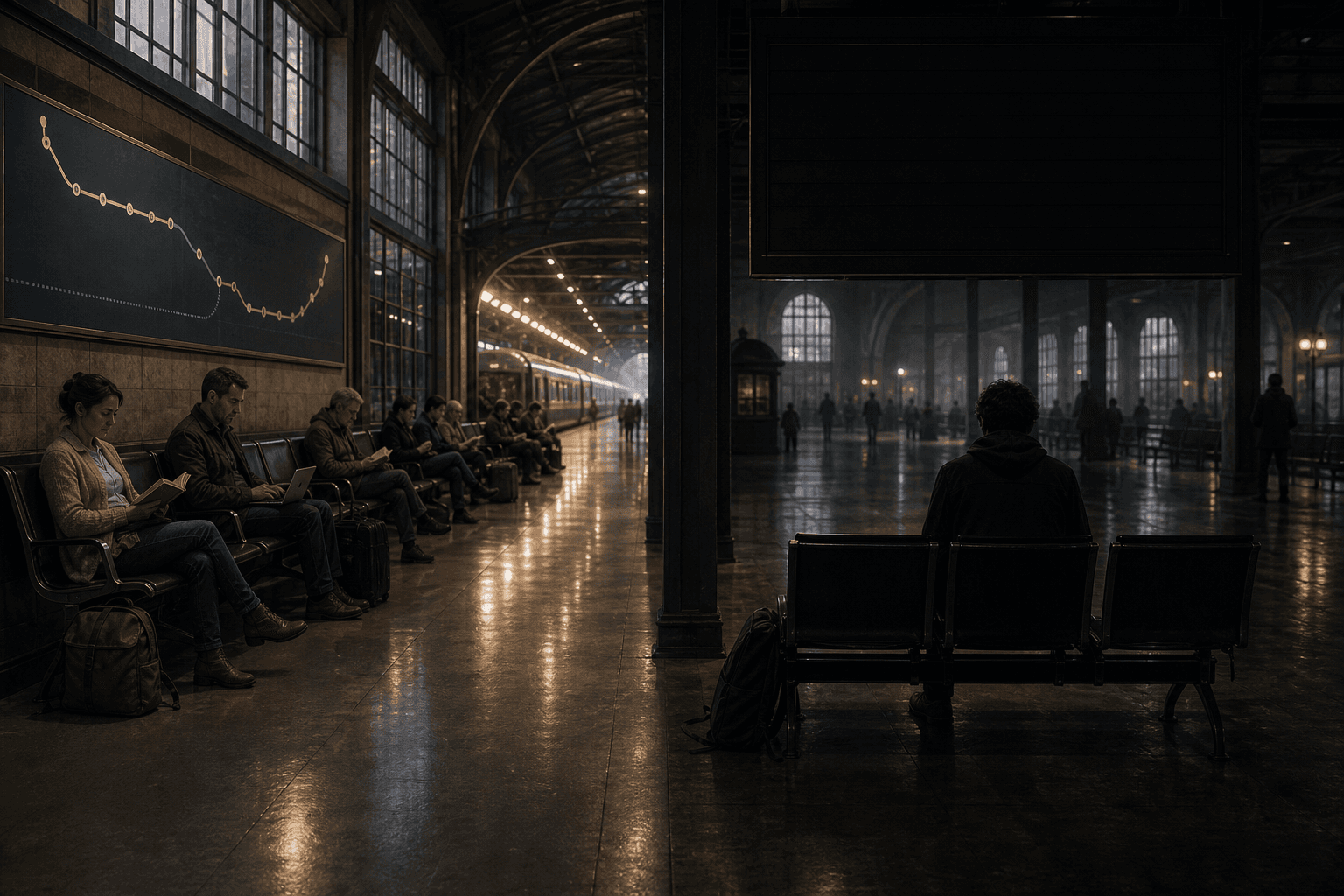
Sit somewhere with no clear end point, no task, and no information about how much longer it will last, and twenty minutes can feel like it has taken something out of you that a genuinely long, but bounded, task never would. This is easy to misdiagnose as impatience, or as a personal flaw, a mind that can't simply relax and let time pass. The more accurate diagnosis is structural. Waiting is not one experience with a single dial, more minutes, more cost. It is at least two different experiences wearing the same name, and they have very different price tags.
The distinction is not duration. A person can sit through a long flight, a long hike, or a long project with real effort and finish relatively intact, because the shape of the time is known in advance, or because the person has a task occupying it. The same person can sit for a fraction of that time with no information about the end point and no role to play, and come out of it disproportionately drained. What's being measured is not how much time passed. It's how much of that time was spent not knowing.
Waiting is not a function of duration alone. It is a function of information. An open-ended wait with no known end costs more than a long wait with a clear one, even when the open-ended wait is objectively shorter.
Waiting has a documented psychology, and duration is not its main variable
This is not a subjective quirk. Research specifically on the psychology of waiting, originally developed for service and queueing contexts, established that perceived wait time and actual wait time diverge in highly consistent, predictable ways, and that the divergence is driven by a small number of identifiable factors, most of them informational rather than durational [1]. Unoccupied time feels longer than occupied time. Uncertain waits feel longer than known, finite waits. Unexplained waits feel longer than explained ones. None of these factors is the clock. All of them are about what the mind has to work with while the clock runs.
This matters because it means the felt cost of waiting is not primarily about how long the wait actually is. It is about whether the person has a model of what is happening and when it will end. A wait with a stated boundary, hair will take forty-five minutes, we leave at 5:30, gives the mind a container to hold the time in. A wait with no boundary gives the mind nothing to hold, and the absence of that container is what produces the drain, independent of the literal minute count.
Why occupation and information do the same job
Formal treatments of queueing psychology identify a related mechanism: waiting time perceived as unfair, unexplained, or uncontrolled is judged far more harshly than the identical duration perceived as fair, explained, and expected, even when nothing about the actual wait has changed except the information available to the person experiencing it [2]. This tracks a deeper principle in how the mind processes duration generally: unstructured time forces the mind to generate its own content to fill it, and without an external task or a known boundary to anchor that content, the generated content tends toward exactly the kind of anxious modeling, how much longer, why wasn't I told, could I have planned differently, that makes the wait feel worse than its length alone would predict [3].
This explains why a task-occupied wait and an information-rich wait can both relieve the same underlying cost through different routes. A task gives the mind something to do instead of generating anxious content. Information about the end point gives the mind a container that makes anxious content less necessary to generate in the first place. Either one addresses the actual variable. Neither addresses duration, because duration was never the primary variable.
What this reframes
This means the common advice to simply be more patient, or to learn to relax during unstructured time, is aimed at the wrong target. It asks a person to tolerate the anxious content their mind generates rather than addressing why that content is being generated in the first place, the absence of a boundary or a task. The more precise, and more useful, question is not "why can't I handle waiting" but "what information or structure was missing from this particular wait that would have made the identical duration tolerable." That question usually has a concrete answer: a stated end time, a known duration, a task to occupy the interval, any of which change the felt cost of the wait without changing its actual length at all.
This also reframes what looks, from outside, like a personality trait, some people just don't handle waiting well, as something closer to a specific and addressable input problem. A person who is disproportionately drained by open-ended waiting is not lacking patience in general. They are responding, accurately, to the absence of exactly the information that queueing research identifies as the primary driver of perceived wait cost.
The point
Waiting is commonly treated as a single variable, more time, more cost, and evaluated against how patient a person is able to be. Research on the psychology of waiting establishes something different: perceived cost is driven mainly by informational factors, whether the time is occupied, whether the end point is known, whether the wait is explained, and only secondarily by actual duration. An open-ended wait with no stated end can cost more than a long wait with a clear one, because the mind without a boundary or a task tends to fill unstructured time with exactly the anxious, uncertain content that makes waiting feel worse.
This means the useful lever is not tolerance but information. A stated end time or a task changes the felt cost of a wait without changing its length, and a person disproportionately drained by open-ended waiting is not failing at patience in general, they are responding accurately to a specific, identifiable input, the absence of the boundary that would have let their mind hold the time instead of having to generate its own account of it.
Sources
- Maister, D. H. (1985). The psychology of waiting lines. In J. A. Czepiel, M. R. Solomon, & C. F. Surprenant (Eds.), The Service Encounter (pp. 113-123). Lexington Books. On the specific factors, occupied versus unoccupied time, certain versus uncertain waits, explained versus unexplained waits, that determine perceived wait duration independent of actual duration.
- Larson, R. C. (1987). Perspectives on queues: Social justice and the psychology of queueing. Operations Research, 35(6), 895-905. On how perceived fairness and control over a waiting situation shape its felt cost more than the objective length of the wait itself.
- Osuna, E. E. (1985). The psychological cost of waiting. Journal of Mathematical Psychology, 29(1), 82-105. On unstructured waiting time producing self-generated anxious content in the absence of external structure, and how this content, not the duration itself, accounts for much of waiting's subjective cost.