
The Unremembered Future
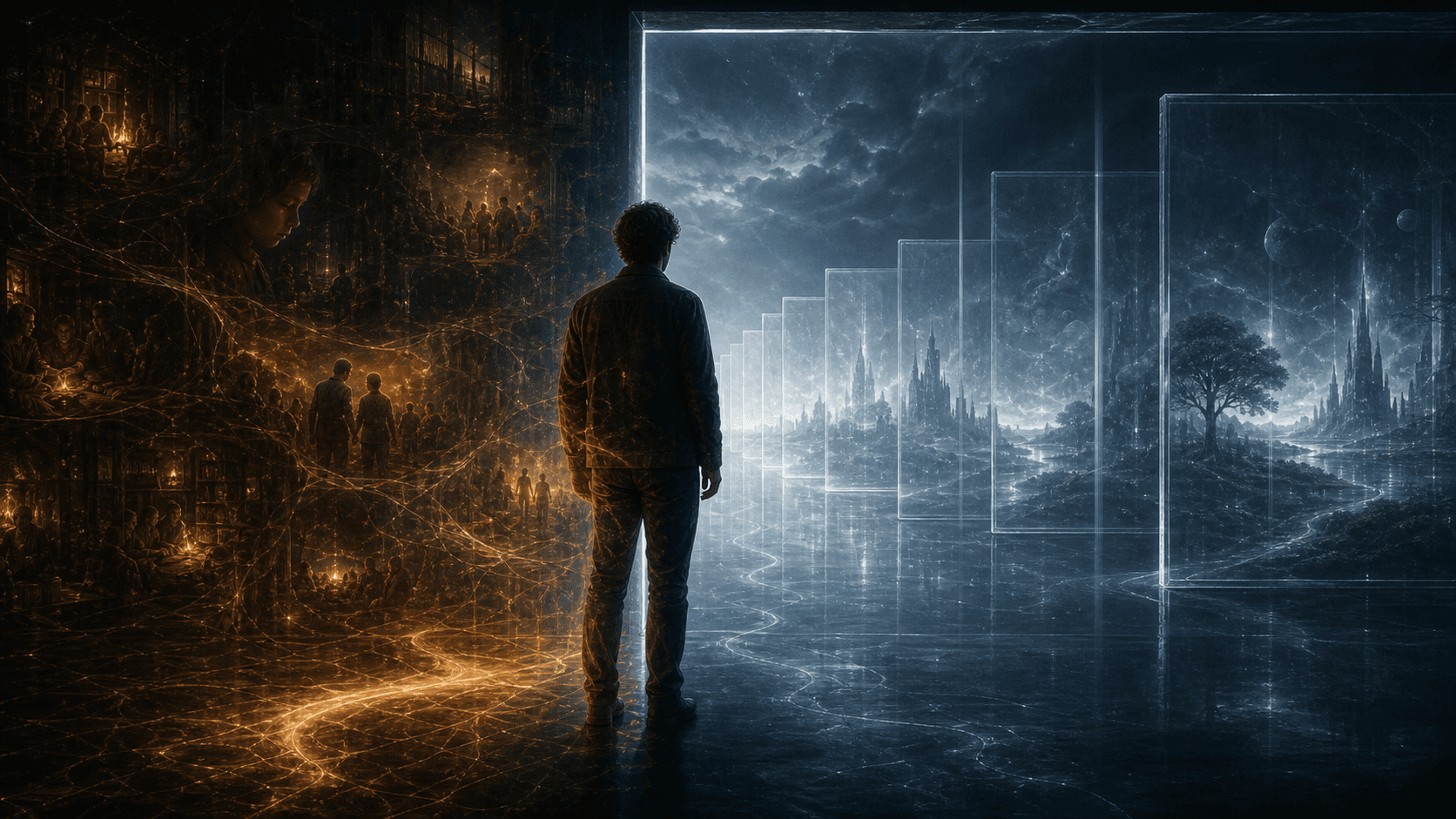
The future feels open, undecided, not yet real. The past feels fixed, settled, fully real. This difference seems so obvious that it hardly needs stating. The past happened. The future has not. That is just what those words mean.
But consider another possibility. What if the future already exists, as fully as the past, and the only reason it feels unreal is that it has not yet passed through your memory? For a creature whose sense of reality is built from remembered experience, the future would feel unreal not because it is absent, but because it is unclaimed.
The future may not feel unreal because it does not exist. It may feel unreal because it has not been remembered yet. Reality, for a memory-based creature, means lived. The future could be fully real and simply not yet metabolized.
Two meanings of "has happened"
There is a long-standing view in physics and philosophy, sometimes called the block universe or eternalism, in which all events in time exist together as part of one total structure. On this view, the past, present, and future are all equally real, like different locations in a landscape. The future is not nonexistent. It is simply a region our awareness has not yet reached [1].
If something like this is true, then "has happened" carries two very different meanings that we usually collapse into one. From the outside of time, everything has happened, or rather, everything simply is: every event sitting in its place in the total structure, equally present. From inside consciousness, only the part that has been lived and remembered feels real. The rest appears as possibility, anticipation, hope, or dread [1, 2].
These two meanings come apart. An event can be fully real in the first sense, existing in the structure of time, while being completely unreal in the second sense, not yet registered by any particular consciousness. The future may be exactly this: ontologically present, psychologically absent.
Reality means remembered
For a human being, "real" does not usually mean "exists in the structure of the universe." It means something more personal: I have lived it, sensed it, been changed by it, and now carry it. The self is built almost entirely out of remembered experience. What has entered memory is part of me. What has not is not yet mine [3].
This is why the future feels unreal even if it already exists. It has not entered the archive of lived experience. It has not been metabolized into the self. The future may be ontologically real, sitting in the structure of time, while being psychologically unreal, because the mechanism by which things become real to a person, memory, has not yet processed it [3].
So the word "future" may simply be the name the mind gives to reality it has not yet converted into memory. Not a region that does not exist, but a region that has not yet been claimed by experience. The unreality of the future is then a fact about the observer, not about the future.
Memory as the ownership mechanism
The key move is to see memory not merely as storage but as the mechanism by which experience becomes mine. Something becomes part of my life only after it has crossed into memory. Before that crossing, even if it exists, it is not yet owned by the self [3, 4].
On this view, the past is not "real" because it exists and the future "unreal" because it does not. The past is real to me because it has been remembered, claimed, folded into who I am. The future is unreal to me because it has not yet been claimed, regardless of whether it exists in the structure of time. The dividing line is not existence versus nonexistence. It is remembered versus unremembered [4].
This reframes the strangeness of time. The past is not gone; it is remembered. The future is not absent; it is unremembered. The present is the burning point where the unremembered becomes experience and then immediately becomes memory, the place where reality crosses from unclaimed to claimed.
Openness as a feeling of ignorance
The strongest objection is that the future feels open in a way the past does not, and openness seems to require that the future is genuinely undecided. If the future already exists, how can it feel open?
But openness may be epistemic rather than metaphysical. It may be a feeling produced by ignorance, not by genuine incompleteness in reality. Consider watching a film for the first time. The entire film already exists, every frame encoded, the ending fixed. Yet it feels open to the viewer, full of suspense and possibility, because the viewer has not yet seen it. The openness is real as an experience and entirely a product of not-yet-knowing [1, 2].
The future may be open in exactly this sense. Not undecided in itself, but unknown to a consciousness that can only access reality one slice at a time, in sequence, converting each slice to memory as it passes. The feeling of an open future would then be the feeling of an observer locked into sequential access, encountering a structure that is already complete but not yet revealed to them [2].
This does not settle whether the future is truly fixed. Physics and philosophy genuinely disagree: eternalism says the future already exists, presentism says only the present is real, growing-block views say the past and present exist but the future does not yet. The point is narrower. Whether or not the future is fixed, the specific feeling of its unreality can be fully explained by the fact that it has not yet passed through memory.
The point
The future feels unreal, and we assume this is because it does not yet exist. But there is another explanation. For a creature whose sense of reality is built from remembered experience, the future would feel unreal simply because it has not yet been remembered, whether or not it exists in the structure of time.
This separates two things we usually fuse: existence and registration. The future may be ontologically real, sitting in the total structure of time, while being psychologically unreal, not yet metabolized by any consciousness. Memory is the ownership mechanism: something becomes part of a self only after it has crossed into memory, so the future is unclaimed rather than necessarily absent.
On this view, the past is not gone but remembered, the future is not absent but unremembered, and the present is the crossing point between them. The openness of the future may be a feeling created by ignorance, like the suspense of a film whose ending is already fixed. Time, then, may not be primarily what the universe is doing. It may be what it feels like for a memory-based creature to move through a reality it can only access one slice at a time.
Sources
- Putnam, H. (1967). "Time and physical geometry." Journal of Philosophy, 64(8): 240-247. On the block-universe implication of relativity: that future events are as real as present and past ones, existing within a four-dimensional structure rather than coming into being as time passes.
- Smart, J. J. C. (1963). Philosophy and Scientific Realism. Routledge & Kegan Paul. On eternalism and the argument that the passage of time and the openness of the future are features of conscious experience rather than of physical reality itself.
- Tulving, E. (1985). "Memory and consciousness." Canadian Psychology, 26(1): 1-12. On autonoetic consciousness: the capacity of memory to give experience the quality of having been personally lived, establishing memory as the basis of the self's ownership of experience.
- Klein, S. B. (2013). "The complex act of projecting oneself into the future." WIREs Cognitive Science, 4(1): 63-79. On the deep dependence of future-thinking on memory systems, showing that the mind constructs the future out of the same machinery it uses to remember, and that the future is encountered through memory-based processes.